


Horacio Pietragalla felt "like a cat raised in a family of dogs" and was puzzled that, at the age of 14, he was already taller than his father. It was only later that he discovered he was the child of a leftwing activist murdered by the Argentine military during the "dirty war." The executioners gave Horacio away to a general's maid more than a quarter of a century ago.
Pietragalla and dozens of other young Argentines are now discovering who their real parents were and meeting their grandparents for the first time. Some are bringing legal actions against their parents' kidnappers, while others are going through the painful process of realizing the people they thought were their parents had lied to them.
An estimated 30,000 people were killed by the junta that ruled Argentina between 1976 and 1983 before it finally collapsed in the wake of the defeat in the Falklands War. Most of the victims were young and some were pregnant when arrested. Around 500 babies are believed to have been born in the army's prisons. After their parents were tortured and killed, the children were handed over to military families.
Most of the children were unaware of their origins but their families, including activist groups such as the Mothers and Grandmothers of the Plaza de Mayo, continued to search for them. Now, through the development of DNA testing, they have been able to trace and match 88 children to parents many of them never knew they had. Their story is told by award-winning director Estela Bravo in a film, Who Am I, that has just won the main documentary prize at the Latin American cinema festival in Havana.
Juan Cabandie was one of the children handed over for adoption. He is now bringing a legal action against the man he had originally believed to be his father.
"The woman who brought me up was a good person, loveable," he said. "She tried to compensate for the bad times I had with my supposed father. But, today I don't have any relations with her, because I can't understand a lie that lasted for 25 years."
He maintains relations with his "sister" who, he said was supportive of his search to find out about his past.
"She'll always be my sister," he said.
Cabandie has now entered politics as a city councillor in Buenos Aires, inspired partly by the apology made in 2004 on behalf of the state by former president Nestor Kirchner, who turned the Naval Mechanical School, where much of the torture took place, into a "museum of memory."
Some of the children handed over for adoption had already been born when their parents were arrested. Others who believe they may be children of the disappeared are now waiting to have their DNA tested, Bravo said.
After the fall of the junta, a number of those in the military fled, many to the US and Miami in particular. Bravo now hopes to show her film there in the hope that more children will come forward.
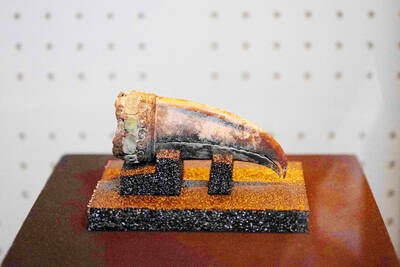
Archeologists in Peru on Thursday said they found the 5,000-year-old remains of a noblewoman at the sacred city of Caral, revealing the important role played by women in the oldest center of civilization in the Americas. “What has been discovered corresponds to a woman who apparently had elevated status, an elite woman,” archeologist David Palomino said. The mummy was found in Aspero, a sacred site within the city of Caral that was a garbage dump for more than 30 years until becoming an archeological site in the 1990s. Palomino said the carefully preserved remains, dating to 3,000BC, contained skin, part of the
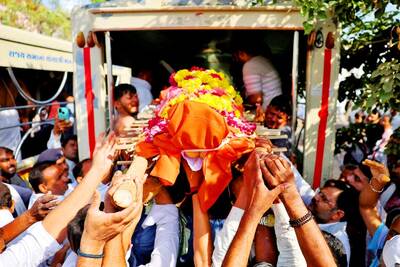
‘WATER WARFARE’: A Pakistani official called India’s suspension of a 65-year-old treaty on the sharing of waters from the Indus River ‘a cowardly, illegal move’ Pakistan yesterday canceled visas for Indian nationals, closed its airspace for all Indian-owned or operated airlines, and suspended all trade with India, including to and from any third country. The retaliatory measures follow India’s decision to suspend visas for Pakistani nationals in the aftermath of a deadly attack by shooters in Kashmir that killed 26 people, mostly tourists. The rare attack on civilians shocked and outraged India and prompted calls for action against their country’s archenemy, Pakistan. New Delhi did not publicly produce evidence connecting the attack to its neighbor, but said it had “cross-border” links to Pakistan. Pakistan denied any connection to

TRUMP EFFECT: The win capped one of the most dramatic turnarounds in Canadian political history after the Conservatives had led the Liberals by more than 20 points Canadian Prime Minister Mark Carney yesterday pledged to win US President Donald Trump’s trade war after winning Canada’s election and leading his Liberal Party to another term in power. Following a campaign dominated by Trump’s tariffs and annexation threats, Carney promised to chart “a new path forward” in a world “fundamentally changed” by a US that is newly hostile to free trade. “We are over the shock of the American betrayal, but we should never forget the lessons,” said Carney, who led the central banks of Canada and the UK before entering politics earlier this year. “We will win this trade war and

Armed with 4,000 eggs and a truckload of sugar and cream, French pastry chefs on Wednesday completed a 121.8m-long strawberry cake that they have claimed is the world’s longest ever made. Youssef El Gatou brought together 20 chefs to make the 1.2 tonne masterpiece that took a week to complete and was set out on tables in an ice rink in the Paris suburb town of Argenteuil for residents to inspect. The effort overtook a 100.48m-long strawberry cake made in the Italian town of San Mauro Torinese in 2019. El Gatou’s cake also used 350kg of strawberries, 150kg of sugar and 415kg of


 RSS
RSS