


Former UN secretary-general Kofi Annan was set yesterday to push to break the deadlock in Kenya's political crisis a day after fresh ethnic strife cast a pall over efforts to halt the killings.
Annan, on his fifth day in the country, was to continue meetings in the capital as security forces patrolled the western Rift Valley's volatile towns of Nakuru and Molo, where the latest round of killings left at least 15 dead.
Long-festering tribal tensions burst out into violence following charges that President Mwai Kibaki had stolen the Dec. 27 presidential polls from opposition chief Raila Odinga, plunging the country into a vortex of violence.
The death toll from weeks of violence has topped 800 and is rising.
What started as post-election riots rapidly descended into settling of tribal vendettas, with marauding gangs armed with machetes, metals bars, bows and arrows stalking parts of the west of the country, which until the crisis was seen as a beacon of democracy and stability in the troubled east African region.
International mediators have failed to make headway in the crisis marked by the rape of women, burning of trading posts, slums and rural houses, derailing of trains and police killing of looters as well as tear gassing opposition marchers.
On Thursday, Annan organized a symbolic first meeting between Kibaki and Odinga, who shook hand, called for peace and hinted at a willingness to talk, but the gesture was later undermined by further squabbling and maintaining hardline positions.
"The meeting was an important first step to launch a process of dialogue on a political solution to the elections crisis," US State Department deputy spokesman Tom Casey said on Friday in a statement.
The fighting in Nakuru, where authorities imposed a night-time curfew, pitted rival ethnic groups against each other as police struggled to end the unrest that has also left some 260,000 people displaced across the country.
Police helicopters flew over a deserted Nakuru and Molo late on Friday, as paramilitary police patrolled on the ground and army trucks drove towards the main road to Nairobi, where gangs had cut down trees to erect roadblocks.
Until recently, Nakuru, the Rift Valley's provincial capital, had a been relatively calm refuge for people displaced from elsewhere in the region.
"So far since the conflict started, we have some 5,000 camped in Nakuru and we are struggling to give them supplies," Abdi Shakur Abdullahi, a Kenya Red Cross official, said on Friday.
"We fear that the numbers will swell if the situation does not improve," he said.
Disputes in the area stem from the 1960s when Kikuyus -- Kibaki's ethnic group -- acquired land but displaced the Kalenjin, leaving a grievance that has remained unresolved and has been worsened by political vendettas.
The Kalenjin mainly supported Odinga and have taken advantage of the post-poll turmoil to chase out other ethnic groups, who are now regrouping to fight back.
One Kikuyu fighter said they were seeking revenge for recent attacks.
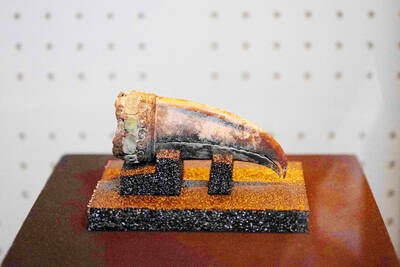
Archeologists in Peru on Thursday said they found the 5,000-year-old remains of a noblewoman at the sacred city of Caral, revealing the important role played by women in the oldest center of civilization in the Americas. “What has been discovered corresponds to a woman who apparently had elevated status, an elite woman,” archeologist David Palomino said. The mummy was found in Aspero, a sacred site within the city of Caral that was a garbage dump for more than 30 years until becoming an archeological site in the 1990s. Palomino said the carefully preserved remains, dating to 3,000BC, contained skin, part of the

TRUMP EFFECT: The win capped one of the most dramatic turnarounds in Canadian political history after the Conservatives had led the Liberals by more than 20 points Canadian Prime Minister Mark Carney yesterday pledged to win US President Donald Trump’s trade war after winning Canada’s election and leading his Liberal Party to another term in power. Following a campaign dominated by Trump’s tariffs and annexation threats, Carney promised to chart “a new path forward” in a world “fundamentally changed” by a US that is newly hostile to free trade. “We are over the shock of the American betrayal, but we should never forget the lessons,” said Carney, who led the central banks of Canada and the UK before entering politics earlier this year. “We will win this trade war and
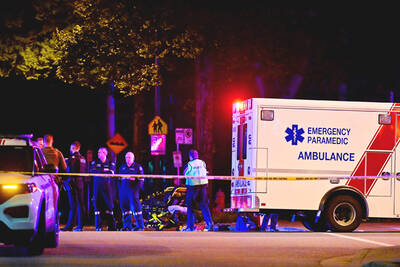
‘BODIES EVERYWHERE’: The incident occurred at a Filipino festival celebrating an anti-colonial leader, with the driver described as a ‘lone suspect’ known to police Canadian police arrested a man on Saturday after a car plowed into a street party in the western Canadian city of Vancouver, killing a number of people. Authorities said the incident happened shortly after 8pm in Vancouver’s Sunset on Fraser neighborhood as members of the Filipino community gathered to celebrate Lapu Lapu Day. The festival, which commemorates a Filipino anti-colonial leader from the 16th century, falls this year on the weekend before Canada’s election. A 30-year-old local man was arrested at the scene, Vancouver police wrote on X. The driver was a “lone suspect” known to police, a police spokesperson told journalists at the
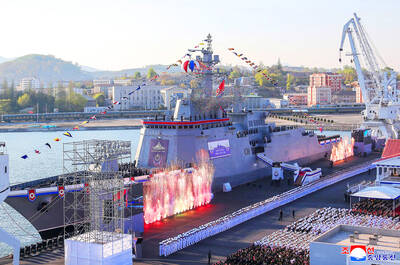
North Korean leader Kim Jong-un has unveiled a new naval destroyer, claiming it as a significant advancement toward his goal of expanding the operational range and preemptive strike capabilities of his nuclear-armed military, state media said yesterday. North Korea’s state-run Korean Central News Agency (KCNA) said Kim attended the launching ceremony for the 5,000-tonne warship on Friday at the western port of Nampo. Kim framed the arms buildup as a response to perceived threats from the US and its allies in Asia, who have been expanding joint military exercises amid rising tensions over the North’s nuclear program. He added that the acquisition


 RSS
RSS