


The Tennessee tax authorities slapped a young concertgoer with US$11,506 in taxes and penalties when he was caught with Rice Krispie Treats laced with marijuana. North Carolina collected US$11 million in taxes last year on illegal drugs and moonshine. And in Alabama, the rare drug user who chooses to pay state taxes on a stash is issued a sticker to place on the package that declares, "Say no to marijuana."
Strange as it may seem to levy a tax on a commodity that no one is supposed to have, 29 states have passed legislation that impose taxes on illegal drugs and controlled substances, and on Tuesday, Governor Eliot Spitzer proposed that New York become the 30th.
The plan was part of a package of new or increased taxes and fees that the governor proposed in an effort to close an estimated budget deficit of US$4.4 billion.
Across the US, a variety of drug tax laws have sparked legal disputes over issues like the constitutional protection against double jeopardy and the weight of spiked baked goods -- as in the case of William Hoak, the Tennessee man who argued in court that he should have been taxed only for the weight of the marijuana in his Rice Krispie Treats, not for the cereal and marshmallows.
North Carolina levied taxes so high that a federal appeals court ruled that the state unconstitutionally penalized drug dealers twice for the same crime: once with jail and once with the tax.
But tax officials say the levies give states a new and easier way to seize drug money, handing law enforcement a tool to hobble the drug trade and replenishing state coffers along the way.
North Carolina, devotes an entire division of its Department of Revenue to enforcing it and collects far more revenue from illegal drugs than most states, North Carolina and other states' officials said.
Paying the proposed New York levy -- US$3.50 per gram for marijuana and US$200 per gram for other drugs -- would not allow the taxpayer to keep illegal drugs, and the governor does not intend the tax to be a first step toward drug legalization, said Robert Megna, who was confirmed as state tax commissioner on Tuesday.
But in order to make the laws constitutional, states must create at least the theoretical opportunity for drug users and dealers to pay the tax legally, said Verenda Smith, government affairs associate at the Federation of Tax Administrators in Washington.
For example, imagine that there is a drug dealer in North Carolina who wanted to do everything by the book. He would go to the tax authorities -- anonymously, of course -- and pay a levy based on the weight and the type of drugs he was holding. He would be given a tax stamp, not unlike the tax stickers on cigarette packs. The dealer could then place the stamp on his 7g bag of marijuana or kilo of cocaine to show that he had paid the tax.
Proving tax avoidance is much easier than proving a drug crime, said Kimberly Brooks, a spokeswoman for the North Carolina Department of Revenue, so the tax laws help the officials keep seized drug money even when a suspect accused of dealing drugs goes free.
Brooks said only a few dozen people have voluntarily bought the stamps since North Carolina's law was passed in 1990 -- mostly stamp collectors.

South Korea’s air force yesterday apologized for a 2021 midair collision involving two fighter jets, a day after auditors said the pilots were taking selfies and filming during the flight and held them responsible for the accident. “We sincerely apologize to the public for the concern caused by the accident that occurred in 2021,” an air force spokesman told a news conference, adding that one of the pilots involved had been suspended from flying duties, received severe disciplinary action and has since left the military. The apology followed a report released on Wednesday by the South Korean Board of Audit and Inspection,

Indonesian police have arrested 13 people after shocking images of alleged abuse against small children at a daycare center went viral, sparking outrage across the nation, officials said on Monday. Police on Friday last week raided Little Aresha, a daycare center in Yogyakarta on Java island, following a report from a former employee. CCTV footage circulating on social media showed children, most younger than two, lying on the floor wearing only diapers, their hands and feet bound with rags. The police have confirmed that the footage is authentic. Police said they also found 20 children crammed into a room just 3m by 3m. “So

About 240 Indians claiming descent from a Biblical tribe landed at Tel Aviv airport on Thursday as part of a government operation to relocate them to Israel. The newcomers passed under a balloon arch in blue and white, the colors of the Israeli flag, as dozens of well-wishers welcomed them with a traditional Jewish song. They were the first “bnei Menashe” (“sons of Manasseh”) to arrive in Israel since the government in November last year announced funding for the immigration of about 6,000 members of the community from the states of Manipur and Mizoram in northeast India. The community claims to descend from
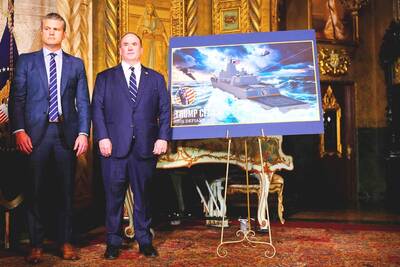
‘TROUBLING’: The firing of Phelan, who was an adviser to a nonprofit that supported the defense of Taiwan, was another example of ‘dysfunction’ under Trump, a US senator said US Secretary of the Navy John Phelan has been fired, a US official and a person familiar with the matter said on Wednesday, in another wartime shakeup at the Pentagon coming just weeks after US Secretary of Defense Pete Hegseth ousted the Army’s top general. The Pentagon announced his departure in a brief statement, saying he was leaving the administration “effective immediately,” but it did not provide a reason or say whether it was his decision to go. The sources, who spoke on condition of anonymity, said Phelan was dismissed in part because he was moving too slowly to implement reforms to


 RSS
RSS