


Relatives of hostages held by Colombia's largest rebel group sought assistance on Friday from Venezuelan President Hugo Chavez, who helped secure the release of two captives last week.
Jaime Felipe Lozada, whose mother is among dozens of high-profile hostages held by the Revolutionary Armed Forces of Colombia, or FARC, called Chavez's efforts "a big door that has opened for us, a door we must continue pushing open."
Many hostages' families see Chavez as their best hope for a prisoner swap, but deteriorating diplomatic relations between Colombia's US-allied government and Venezuela could undermine his efforts.
Relatives of the captives brought the socialist leader a sealed letter from their loved ones, brought out of the jungle by the two recently freed hostages, said Deyanira Ortiz, whose husband Orlando Beltran has been held for about seven years.
"Our relatives are living in very precarious situations," she said.
Chavez met on Friday with US Representative William Delahunt, who supports the president's efforts to broker another prisoner swap.
Delahunt was one of three US lawmakers to write a letter to FARC leader Manuel Marulanda, welcoming the release of "proof-of-life" videos of three American defense contractors held captive since 2003.
"It's only a beginning and I would hope that the leadership of the FARC would continue to release the hostages," said Delahunt, a Massachusetts Democrat.
Caracas and Washington need to build a new relationship based on "mutual respect," he added.
"If we can achieve that, there are a number of issues that we may be able to move forward on," including counter-drug efforts, he said.
Venezuelan Foreign Minister Nicolas Maduro welcomed his comments, saying he was optimistic that US-Venezuelan relations, tense for years, could improve in coming weeks.
"A new era and a new relationship in terms of equality and respect could begin soon," he said.
Maduro meanwhile reproached Peru's foreign minister, Jose Garcia Belaunde, for echoing Colombian objections to Chavez's calls for the FARC to be removed from terrorist lists, saying diplomatic relations between the countries could suffer as a result of Peru's stance.
Colombian President Alvaro Uribe had initially thanked Chavez for helping broker the Jan. 10 release of Clara Rojas and Consuelo Gonzalez.
However, his government was outraged when Chavez then urged world leaders to remove the Colombian guerrillas from lists of terrorist groups.
Colombia's government accused Chavez of ignoring the rebels' crimes, claiming he had taken the guerrillas' side.
Colombia accuses the FARC of holding more than 700 hostages, many kept for years in the jungle.
The EU joined the US in listing the group -- Latin America's largest rebel force, with roughly 14,000 fighters -- as a terrorist group in 2002, outlawing economic support.
Chavez denies supporting the FARC and insists that he is only seeking a peaceful end to Colombia's decades-long conflict.
On Thursday, Venezuela accused Uribe of "sabotaging" his efforts and ignoring the hostages' plight.
That same day, he met with the father of a Colombian soldier captured in 1997 at the age of 19. Gustavo Moncayo had walked for two-months and 1,600km from Bogota to Caracas to raise awareness about the hostages.
Moncayo, a 55-year-old school teacher asked Colombian and FARC leaders to be flexible and consider "more than anything that there are human beings who are dying."
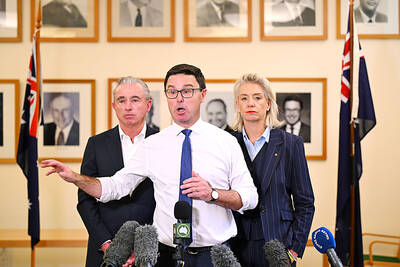
BACKLASH: The National Party quit its decades-long partnership with the Liberal Party after their election loss to center-left Labor, which won a historic third term Australia’s National Party has split from its conservative coalition partner of more than 60 years, the Liberal Party, citing policy differences over renewable energy and after a resounding loss at a national election this month. “Its time to have a break,” Nationals leader David Littleproud told reporters yesterday. The split shows the pressure on Australia’s conservative parties after Prime Minister Anthony Albanese’s center-left Labor party won a historic second term in the May 3 election, powered by a voter backlash against US President Donald Trump’s policies. Under the long-standing partnership in state and federal politics, the Liberal and National coalition had shared power

CONTROVERSY: During the performance of Israel’s entrant Yuval Raphael’s song ‘New Day Will Rise,’ loud whistles were heard and two people tried to get on stage Austria’s JJ yesterday won the Eurovision Song Contest, with his operatic song Wasted Love triumphing at the world’s biggest live music television event. After votes from national juries around Europe and viewers from across the continent and beyond, JJ gave Austria its first victory since bearded drag performer Conchita Wurst’s 2014 triumph. After the nail-biting drama as the votes were revealed running into yesterday morning, Austria finished with 436 points, ahead of Israel — whose participation drew protests — on 357 and Estonia on 356. “Thank you to you, Europe, for making my dreams come true,” 24-year-old countertenor JJ, whose

A documentary whose main subject, 25-year-old photojournalist Fatima Hassouna, was killed in an Israeli airstrike in Gaza weeks before it premiered at Cannes stunned viewers into silence at the festival on Thursday. As the cinema lights came back on, filmmaker Sepideh Farsi held up an image of the young Palestinian woman killed with younger siblings on April 16, and encouraged the audience to stand up and clap to pay tribute. “To kill a child, to kill a photographer is unacceptable,” Farsi said. “There are still children to save. It must be done fast,” the exiled Iranian filmmaker added. With Israel
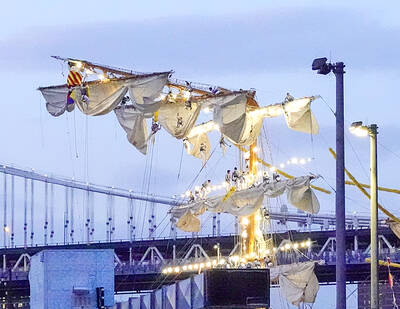
Two people died and 19 others were injured after a Mexican Navy training ship hit the Brooklyn Bridge, New York City Mayor Eric Adams said yesterday. The ship snapped all three of its masts as it collided with the New York City landmark late on Saturday, while onlookers enjoying the balmy spring evening watched in horror. “At this time, of the 277 on board, 19 sustained injuries, 2 of which remain in critical condition, and 2 more have sadly passed away from their injuries,” Adams posted on X. Footage shared online showed the Mexican Navy ship Cuauhtemoc, its sails furled


 RSS
RSS