


Brazil this week imposed a ban on popular role-playing computer games Counter-Strike and EverQuest, claiming they incited violence and were harmful to consumers' health.
The federal prohibition on the sale of the games was being applied across the country, the official consumer protection agency in the central state of Goias said on its Web site on Thursday.
Both games allow players, typically teenage boys, to connect online to fantasy worlds where they interact with other players, form groups and carry out joint missions usually involving combat.
`COUNTER-STRIKE'
Counter-Strike, a game with a first-person-view and shoot-'em-up objective based on the motor powering the popular Half-Life game, requires participants to choose a role as either a terrorist in a mask or an anti-terrorist officer before going forth with an ever-sophisticated array of weapons.
An adapted version in Brazil permitted players to take on the perspective of either a police officer or a narcotrafficker in Rio de Janeiro's infamously crime-ridden slums.
`EVERQUEST'
EverQuest is a swords-and-spells game in the mold of Lord of the Rings in which human or elvish or other imaginary characters go on joint adventures to gain treasure and increase their avatar's abilities.
Both began in 1999 and have since developed huge worldwide followings.
Some psychologists have described them as addictive as drugs.
A few players have turned professional, earning money from powerful characters they sell, or from the auction of hard-to-win virtual items.
The ban was ordered in October last year by a Brazilian federal court, but was not immediately implemented.
The judge, Carlos Alberto Simoes, ruled that the games encouraged the subversion of public order, were an attack against the democratic state and the law and against public security.
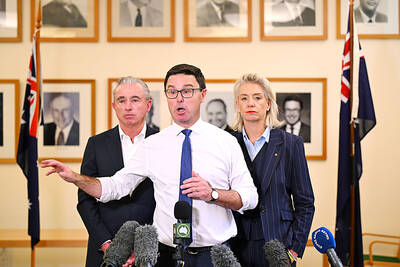
BACKLASH: The National Party quit its decades-long partnership with the Liberal Party after their election loss to center-left Labor, which won a historic third term Australia’s National Party has split from its conservative coalition partner of more than 60 years, the Liberal Party, citing policy differences over renewable energy and after a resounding loss at a national election this month. “Its time to have a break,” Nationals leader David Littleproud told reporters yesterday. The split shows the pressure on Australia’s conservative parties after Prime Minister Anthony Albanese’s center-left Labor party won a historic second term in the May 3 election, powered by a voter backlash against US President Donald Trump’s policies. Under the long-standing partnership in state and federal politics, the Liberal and National coalition had shared power

CONTROVERSY: During the performance of Israel’s entrant Yuval Raphael’s song ‘New Day Will Rise,’ loud whistles were heard and two people tried to get on stage Austria’s JJ yesterday won the Eurovision Song Contest, with his operatic song Wasted Love triumphing at the world’s biggest live music television event. After votes from national juries around Europe and viewers from across the continent and beyond, JJ gave Austria its first victory since bearded drag performer Conchita Wurst’s 2014 triumph. After the nail-biting drama as the votes were revealed running into yesterday morning, Austria finished with 436 points, ahead of Israel — whose participation drew protests — on 357 and Estonia on 356. “Thank you to you, Europe, for making my dreams come true,” 24-year-old countertenor JJ, whose

A documentary whose main subject, 25-year-old photojournalist Fatima Hassouna, was killed in an Israeli airstrike in Gaza weeks before it premiered at Cannes stunned viewers into silence at the festival on Thursday. As the cinema lights came back on, filmmaker Sepideh Farsi held up an image of the young Palestinian woman killed with younger siblings on April 16, and encouraged the audience to stand up and clap to pay tribute. “To kill a child, to kill a photographer is unacceptable,” Farsi said. “There are still children to save. It must be done fast,” the exiled Iranian filmmaker added. With Israel
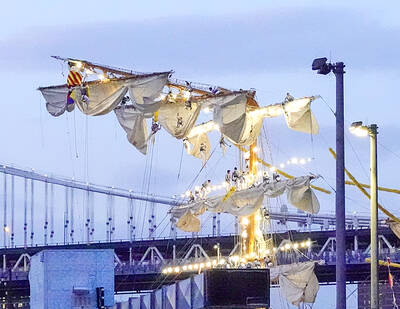
Two people died and 19 others were injured after a Mexican Navy training ship hit the Brooklyn Bridge, New York City Mayor Eric Adams said yesterday. The ship snapped all three of its masts as it collided with the New York City landmark late on Saturday, while onlookers enjoying the balmy spring evening watched in horror. “At this time, of the 277 on board, 19 sustained injuries, 2 of which remain in critical condition, and 2 more have sadly passed away from their injuries,” Adams posted on X. Footage shared online showed the Mexican Navy ship Cuauhtemoc, its sails furled


 RSS
RSS