


Indonesia's former dictator Suharto was fully conscious and indicated he felt well yesterday, but he remained weak and in an unstable condition, doctors treating him in hospital said.
Suharto, who ruled the world's fourth most populous nation with an iron grip for more than three decades, has been clinging to life since he suffered multiple organ failure last week and was hooked up to a ventilator.
Doctors said yesterday they had begun to wean him off the ventilator, but warned his general condition remained unstable.
"This morning I saw he was fully conscious despite being weak," said Mardjo Soebiandono, who heads the large team of specialist doctors assembled to treat Suharto.
He told reporters that when asked whether he felt well, the 86-year-old had replied, "Yes."
But in a statement read out at a press conference, Soebiandono warned that "the functions of the heart and lungs are not yet stable, there is still an accumulation of fluid in the lungs and there are signs of systemic infection," adding that Suharto continued to receive blood transfusions.
The threat of sepsis -- a potentially fatal poisoning that can result from infection -- was still critical, said another doctor, Haryanto Reksodipuro, who added though that "there have clearly been improvements."
A third doctor, Muhammad Munawar, told ElShinta radio the process of taking Suharto off his ventilator had begun.
"Judging from the condition of the heart, kidneys and so on, it won't be possible to do it in a short time ... We started the process, but we don't know exactly when it will be finished," he said.
Doctors cranked up Suharto's drug dosage to maximum level on Tuesday as his condition took another turn for the worse earlier in the day and he struggled to fight off infection. He has been on dialysis and was being kept sedated as doctors fought to keep his lungs clear of fluid.
The authoritarian ruler, one of Asia's great political giants, stepped down in 1998 amid bloody nationwide riots and burgeoning student protests triggered initially by the 1997 Asian economic crisis.
He retreated to his family home in an upmarket Jakarta suburb, rarely venturing outside and managing to avoid criminal trial for massive corruption allegations by citing poor health.
Attempts to bring Suharto to justice for alleged human rights atrocities, particularly in East Timor, which he invaded in 1975, and far-flung Aceh and Papua, have also been stymied.
Suharto's immediate successor as president, BJ Habibie, flew from Germany to see Suharto late on Tuesday but was not allowed to see him as the former strongman was being treated by doctors, he told reporters at the hospital.
"I have come directly from Germany with my wife to visit Pak Harto but when I came up he was still under intensive care so I could only pray in the next room ... for him to get well soon," he said.
Relations between the two soured after Habibie took the nation's helm.
Doctors said yesterday that visitors were not allowed to see Suharto for the time being. A flurry of well-wishers have rushed to his side since he was first admitted to hospital on Jan. 4, including Singapore's founding father Lee Kuan Yew and Malaysia's former prime minister Mahathir Mohamad.

‘IN A DIFFERENT PLACE’: The envoy first visited Shanghai, where he attended a Chinese basketball playoff match, and is to meet top officials in Beijing tomorrow US Secretary of State Antony Blinken yesterday arrived in China on his second visit in a year as the US ramps up pressure on its rival over its support for Russia while also seeking to manage tensions with Beijing. The US diplomat tomorrow is to meet China’s top brass in Beijing, where he is also expected to plead for restraint as Taiwan inaugurates president-elect William Lai (賴清德), and to raise US concerns on Chinese trade practices. However, Blinken is also seeking to stabilize ties, with tensions between the world’s two largest economies easing since his previous visit in June last year. At the

UNSETTLING IMAGES: The scene took place in front of TV crews covering the Trump trial, with a CNN anchor calling it an ‘emotional and unbelievably disturbing moment’ A man who doused himself in an accelerant and set himself on fire outside the courthouse where former US president Donald Trump is on trial has died, police said yesterday. The New York City Police Department (NYPD) said the man was declared dead by staff at an area hospital. The man was in Collect Pond Park at about 1:30pm on Friday when he took out pamphlets espousing conspiracy theories, tossed them around, then doused himself in an accelerant and set himself on fire, officials and witnesses said. A large number of police officers were nearby when it happened. Some officers and bystanders rushed

Beijing is continuing to commit genocide and crimes against humanity against Uyghurs and other Muslim minorities in its western Xinjiang province, U.S. Secretary of State Antony Blinken said in a report published on Monday, ahead of his planned visit to China this week. The State Department’s annual human rights report, which documents abuses recorded all over the world during the previous calendar year, repeated language from previous years on the treatment of Muslims in Xinjiang, but the publication raises the issue ahead of delicate talks, including on the war in Ukraine and global trade, between the top U.S. diplomat and Chinese
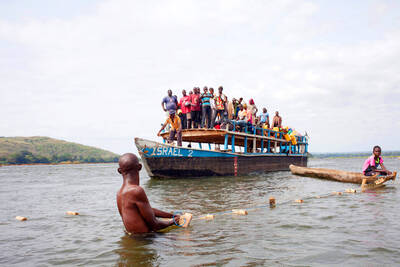
RIVER TRAGEDY: Local fishers and residents helped rescue people after the vessel capsized, while motorbike taxis evacuated some of the injured At least 58 people going to a funeral died after their overloaded river boat capsized in the Central African Republic’s (CAR) capital, Bangui, the head of civil protection said on Saturday. “We were able to extract 58 lifeless bodies,” Thomas Djimasse told Radio Guira. “We don’t know the total number of people who are underwater. According to witnesses and videos on social media, the wooden boat was carrying more than 300 people — some standing and others perched on wooden structures — when it sank on the Mpoko River on Friday. The vessel was heading to the funeral of a village chief in


 RSS
RSS