


US Secretary of State Condoleezza Rice visited Iraq yesterday for meetings with the Iraqi government, which last week passed the first in a series of long-awaited laws aimed at reconciling Iraqis, officials said.
Rice was sent to Baghdad on a mission to try to build on what US President George W. Bush's administration sees as progress on political reconciliation, the White House said.
Bush and Rice decided that she should break away from his visit to Saudi Arabia and make an unannounced stop in Iraq, White House spokesman Gordon Johndroe told reporters in Riyadh.
Rice's trip followed the Iraqi parliament's long-awaited passage of a de-Baathification reform law earlier this week, seen as one the key steps needed to bridge the country's sectarian divide.
"President Bush and Secretary Rice decided this would be a good opportunity for the secretary to go to Baghdad to build on progress made and to encourage additional political reconciliation and legislative action," Johndroe said.
NEEDS
A day earlier, the Iraqi defense minister said his country would need foreign military help to defend its borders for another 10 years and would not be able to maintain internal security until 2012.
Abdul Qadir's remarks, in an interview with the New York Times posted on the newspaper's Internet site, could become an issue in the US presidential campaign.
"According to our calculations and our timelines, we think that from the first quarter of 2009 until 2012 we will be able to take full control of the internal affairs of the country," Qadir said.
"In regard to the borders, regarding protection from any external threats, our calculation appears that we are not going to be able to answer to any external threats until 2018 to 2020," he said.
Bush has said US troops may have to stay in Iraq for years but most presidential candidates, especially Democrats, would like them to withdraw much faster.
Qadir is currently visiting the US. On his agenda is weapons acquisitions for the new, US-trained Iraqi army. The Times said that these included ground vehicles, helicopters, tanks, artillery and armored personnel carriers.
The US disbanded the country's previous armed forces built by former Iraqi president Saddam Hussein.
The US and Iraq have said they would negotiate a formal agreement governing the legal status of US military forces in Iraq but talks have not yet formally begun.
ASSASSINATION
Meanwhile, gunmen assassinated a high-ranking Sunni judge as he headed to work in Baghdad on Monday, the latest of thousands of professionals killed in unsolved cases since 2003.
Appeals Court Judge Amir Jawdat al-Naeib was slain a week after police arrested a group of militants who specialized in intimidating or killing doctors, academics and judges, an Interior Ministry official said.
The aim of such attacks is to empty the country of professionals and scientists, said the official, who spoke on condition of anonymity because he was not authorized to talk to the media.
Under Saddam's Sunni-led regime, members of the now-dissolved Baath party comprised much of Iraq's professional class, including senior bureaucrats who knew how to run ministries, university departments and state companies.
After his overthrow, senior Baathists were purged from their jobs, some were assassinated and many fled the country.
A key piece of legislation adopted on Sunday by the Iraqi parliament would allow thousands of low-ranking former Baathists to return to government jobs. But many former Baathists say they would not take such positions back, fearing Shiite death squads would hunt them down.

‘IN A DIFFERENT PLACE’: The envoy first visited Shanghai, where he attended a Chinese basketball playoff match, and is to meet top officials in Beijing tomorrow US Secretary of State Antony Blinken yesterday arrived in China on his second visit in a year as the US ramps up pressure on its rival over its support for Russia while also seeking to manage tensions with Beijing. The US diplomat tomorrow is to meet China’s top brass in Beijing, where he is also expected to plead for restraint as Taiwan inaugurates president-elect William Lai (賴清德), and to raise US concerns on Chinese trade practices. However, Blinken is also seeking to stabilize ties, with tensions between the world’s two largest economies easing since his previous visit in June last year. At the

UNSETTLING IMAGES: The scene took place in front of TV crews covering the Trump trial, with a CNN anchor calling it an ‘emotional and unbelievably disturbing moment’ A man who doused himself in an accelerant and set himself on fire outside the courthouse where former US president Donald Trump is on trial has died, police said yesterday. The New York City Police Department (NYPD) said the man was declared dead by staff at an area hospital. The man was in Collect Pond Park at about 1:30pm on Friday when he took out pamphlets espousing conspiracy theories, tossed them around, then doused himself in an accelerant and set himself on fire, officials and witnesses said. A large number of police officers were nearby when it happened. Some officers and bystanders rushed

Beijing is continuing to commit genocide and crimes against humanity against Uyghurs and other Muslim minorities in its western Xinjiang province, U.S. Secretary of State Antony Blinken said in a report published on Monday, ahead of his planned visit to China this week. The State Department’s annual human rights report, which documents abuses recorded all over the world during the previous calendar year, repeated language from previous years on the treatment of Muslims in Xinjiang, but the publication raises the issue ahead of delicate talks, including on the war in Ukraine and global trade, between the top U.S. diplomat and Chinese
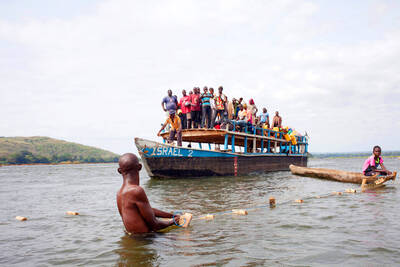
RIVER TRAGEDY: Local fishers and residents helped rescue people after the vessel capsized, while motorbike taxis evacuated some of the injured At least 58 people going to a funeral died after their overloaded river boat capsized in the Central African Republic’s (CAR) capital, Bangui, the head of civil protection said on Saturday. “We were able to extract 58 lifeless bodies,” Thomas Djimasse told Radio Guira. “We don’t know the total number of people who are underwater. According to witnesses and videos on social media, the wooden boat was carrying more than 300 people — some standing and others perched on wooden structures — when it sank on the Mpoko River on Friday. The vessel was heading to the funeral of a village chief in


 RSS
RSS