


US President George W. Bush yesterday visited the US Navy's Fifth Fleet amid new tensions with Iran over an incident in which the US says its ships were harassed in the Strait of Hormuz.
Bush entered a mess hall at the sprawling US naval complex in Bahrain to loud applause and shouted "good morning" to sailors, Marines and soldiers assembled for breakfast.
He joined the chow line, picking up some pancakes with syrup and bacon, then sat down with military personnel to eat breakfast.
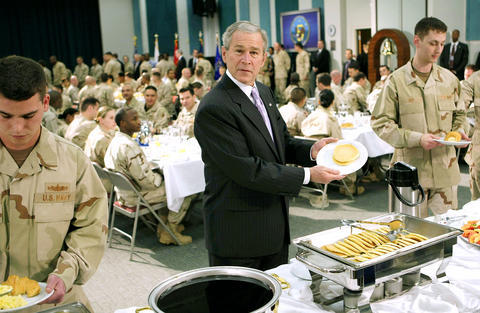
PHOTO: AP
Bush visited Bahrain, which hosts the Fifth Fleet, on the second stop in his tour of US-allied Arab states aimed in part at rallying support against Iran.
Bush's visit came amid heightened tensions over a US-Iranian naval incident in the strait, between the Gulf of Oman and the Persian Gulf, a week earlier.
Washington says its warships were threatened by Iranian craft in the Strait of Hormuz, a vital route for crude oil shipments from the world's biggest producing region.
Tehran dismissed the incident as a routine contact and accused the US of exaggerating for propaganda purposes.
Bush discussed the Strait of Hormuz incident with Vice Admiral Kevin Cosgriff, the commander of the Fifth Fleet, who made clear that his forces took it "deadly seriously," White House spokeswoman Dana Perino told reporters traveling with Bush.
Perino said Bush did not raise the showdown in the strait when he spoke with Cosgriff. But Perino said Cosgriff told the president that he took it very seriously when an Iranian fleet of high-speed boats charged at and threatened to blow up a three-ship US Navy convoy passing near Iranian waters.
The Iranian naval forces vanished as the US ship commanders were preparing to open fire.
"All the military people remember what happened in the past, such as the USS Cole,'' Perino said, referring to the October 2000 terrorist attack on a US warship, the USS Cole. The attack in Yemen's Aden harbor by a small boat laden with explosives killed 17 sailors and nearly sank the Cole.
During a stop in Israel at the start of the Middle East trip last week, Bush warned Iran of "serious consequences" if it attacked US ships, and said all options were on the table.
Washington is leading efforts to isolate Iran over its nuclear ambitions, and Bush said late last year that a nuclear-armed Iran could mean "World War III."
The Bush administration has kept up a campaign of harsh rhetoric despite a US intelligence report last month that concluded Iran had halted its nuclear weapons program in 2003, contradicting the president's longstanding assertion that Tehran was actively pursuing development of a bomb.
Bush has insisted that Iran remains a danger. Tehran says it wants nuclear technology for strictly civilian purposes.
But the National Intelligence Estimate has left Washington's Arab allies worried and confused. They share US concerns about Tehran's growing regional influence but want efforts at containment to be done without resorting to military means.
Kuwait, the first stop on Bush's Gulf tour, has said it will not allow the US to use its territory for any strike against Iran.
Bush was scheduled to visit the United Arab Emirates later yesterday, where he would give his "signature" speech of the trip on advancing democracy.
He will also visit Saudi Arabia and Egypt this week as he tries to rally Arab support for his Israeli-Palestinian peacemaking efforts.
Archeologists in Peru on Thursday said they found the 5,000-year-old remains of a noblewoman at the sacred city of Caral, revealing the important role played by women in the oldest center of civilization in the Americas. “What has been discovered corresponds to a woman who apparently had elevated status, an elite woman,” archeologist David Palomino said. The mummy was found in Aspero, a sacred site within the city of Caral that was a garbage dump for more than 30 years until becoming an archeological site in the 1990s. Palomino said the carefully preserved remains, dating to 3,000BC, contained skin, part of the

‘WATER WARFARE’: A Pakistani official called India’s suspension of a 65-year-old treaty on the sharing of waters from the Indus River ‘a cowardly, illegal move’ Pakistan yesterday canceled visas for Indian nationals, closed its airspace for all Indian-owned or operated airlines, and suspended all trade with India, including to and from any third country. The retaliatory measures follow India’s decision to suspend visas for Pakistani nationals in the aftermath of a deadly attack by shooters in Kashmir that killed 26 people, mostly tourists. The rare attack on civilians shocked and outraged India and prompted calls for action against their country’s archenemy, Pakistan. New Delhi did not publicly produce evidence connecting the attack to its neighbor, but said it had “cross-border” links to Pakistan. Pakistan denied any connection to

TRUMP EFFECT: The win capped one of the most dramatic turnarounds in Canadian political history after the Conservatives had led the Liberals by more than 20 points Canadian Prime Minister Mark Carney yesterday pledged to win US President Donald Trump’s trade war after winning Canada’s election and leading his Liberal Party to another term in power. Following a campaign dominated by Trump’s tariffs and annexation threats, Carney promised to chart “a new path forward” in a world “fundamentally changed” by a US that is newly hostile to free trade. “We are over the shock of the American betrayal, but we should never forget the lessons,” said Carney, who led the central banks of Canada and the UK before entering politics earlier this year. “We will win this trade war and

Armed with 4,000 eggs and a truckload of sugar and cream, French pastry chefs on Wednesday completed a 121.8m-long strawberry cake that they have claimed is the world’s longest ever made. Youssef El Gatou brought together 20 chefs to make the 1.2 tonne masterpiece that took a week to complete and was set out on tables in an ice rink in the Paris suburb town of Argenteuil for residents to inspect. The effort overtook a 100.48m-long strawberry cake made in the Italian town of San Mauro Torinese in 2019. El Gatou’s cake also used 350kg of strawberries, 150kg of sugar and 415kg of


 RSS
RSS