


Kennedy Tsambo's faith in Zimbabwe's banking system finally hit breaking point over Christmas when he spent an ultimately fruitless three days queuing to withdraw cash in order to buy a bus fare home.
"This was not a donation that I was queuing for, it's my own money which I should be able to withdraw as and when I like," said the 37-year-old, who works as a mechanic in Harare but whose family lives in eastern Nyanyadzi district.
"Now I am thinking of taking out all my money. I won't deposit any more in the bank until this chaos is over."
Tsambo is among tens of thousands of casualties of a cash crisis in inflation-ravaged Zimbabwe which has seen banks regularly run out of notes since mid-October.
Central bank chief Gideon Gono blames the crisis on cash barons he says have been hoarding Zimbabwe dollars and exchanging them for scarce foreign currency.
Despite unveiling three new currency denominations last month in a bid to ease the shortages, winding queues are still a common feature at banks as the cash crisis persists.
Mairos Chigwada, an upholsterer who is self-employed, vowed he would "never repeat that mistake again" after depositing all the money he had earned during the peak month of November into his bank account.
"Now I can't withdraw the money," says Chigwada standing near the tail-end of a queue outside a bank in Harare's Samora Machel Avenue.
"It's just not fair. It's hard enough working for that money and it shouldn't be another pain taking it out of the bank where I put it in the first place."
With the cash crisis showing no sign of abating, many Zimbabweans are losing faith in the banking system, according to analysts, and could revert to the old days of stashing vast sums of money in pillow cases.
"Nobody in their sense would sell their goat, for example, and take the money to the bank when they are not sure they can withdraw it when they want it," Daniel Ndlela, an independent economist, said.
Godfrey Kanyenze, chief economist of the Zimbabwe Congress said depositors had no incentive to keep money in the bank.
"There is no incentive of keeping money in the bank any more," Kanyenze said.
"There is a crisis, everything is now collapsing on its face. Ultimately, this is a national problem," he said.
A banking executive painted a gloomy picture of the sector, predicting massive withdrawals while potential depositors stashed their earnings at home.
"The sector is bound to face serious problems when it comes to deposits," the executive said on condition of anonymity.
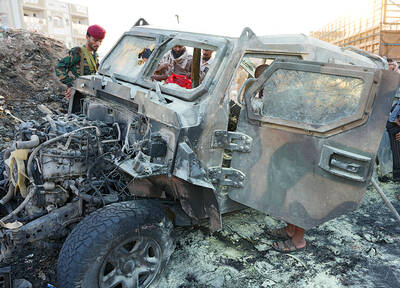
‘TERRORIST ATTACK’: The convoy of Brigadier General Hamdi Shukri resulted in the ‘martyrdom of five of our armed forces,’ the Presidential Leadership Council said A blast targeting the convoy of a Saudi Arabian-backed armed group killed five in Yemen’s southern city of Aden and injured the commander of the government-allied unit, officials said on Wednesday. “The treacherous terrorist attack targeting the convoy of Brigadier General Hamdi Shukri, commander of the Second Giants Brigade, resulted in the martyrdom of five of our armed forces heroes and the injury of three others,” Yemen’s Saudi Arabia-backed Presidential Leadership Council said in a statement published by Yemeni news agency Saba. A security source told reporters that a car bomb on the side of the road in the Ja’awla area in
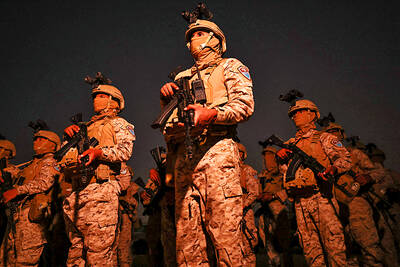
PRECARIOUS RELATIONS: Commentators in Saudi Arabia accuse the UAE of growing too bold, backing forces at odds with Saudi interests in various conflicts A Saudi Arabian media campaign targeting the United Arab Emirates (UAE) has deepened the Gulf’s worst row in years, stoking fears of a damaging fall-out in the financial heart of the Middle East. Fiery accusations of rights abuses and betrayal have circulated for weeks in state-run and social media after a brief conflict in Yemen, where Saudi airstrikes quelled an offensive by UAE-backed separatists. The United Arab Emirates is “investing in chaos and supporting secessionists” from Libya to Yemen and the Horn of Africa, Saudi Arabia’s al-Ekhbariya TV charged in a report this week. Such invective has been unheard of
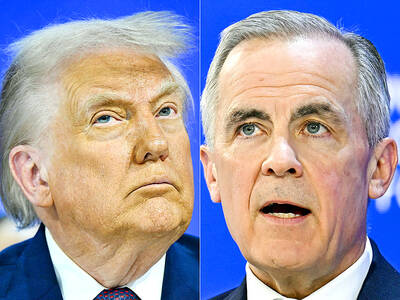
US President Donald Trump on Saturday warned Canada that if it concludes a trade deal with China, he would impose a 100 percent tariff on all goods coming over the border. Relations between the US and its northern neighbor have been rocky since Trump returned to the White House a year ago, with spats over trade and Canadian Prime Minister Mark Carney decrying a “rupture” in the US-led global order. During a visit to Beijing earlier this month, Carney hailed a “new strategic partnership” with China that resulted in a “preliminary, but landmark trade agreement” to reduce tariffs — but
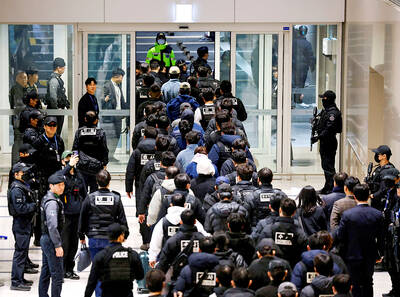
SCAM CLAMPDOWN: About 130 South Korean scam suspects have been sent home since October last year, and 60 more are still waiting for repatriation Dozens of South Koreans allegedly involved in online scams in Cambodia were yesterday returned to South Korea to face investigations in what was the largest group repatriation of Korean criminal suspects from abroad. The 73 South Korean suspects allegedly scammed fellow Koreans out of 48.6 billion won (US$33 million), South Korea said. Upon arrival in South Korea’s Incheon International Airport aboard a chartered plane, the suspects — 65 men and eight women — were sent to police stations. Local TV footage showed the suspects, in handcuffs and wearing masks, being escorted by police officers and boarding buses. They were among about 260 South


 RSS
RSS