


The health of Indonesia's former-dictator Suharto has improved slightly but the 86-year-old remains dependent on a slew of machines and in critical condition, his doctors said yesterday.
Suharto was admitted to hospital last week with anaemia and low blood pressure, as well as problems with his heart, kidneys and lungs. He slid into critical condition, and has since improved and relapsed several times.
"The condition of Suharto this morning is still weak, but he is conscious. It is better than yesterday [Tuesday]," said Marjo Soebiandono, one of the large team of doctors assembled to treat the former president.
He said the results of heart examinations on Tuesday showed that some damage had been sustained to the organ's tissue and that "a general weakening has taken place".
"The catch-22 is that the heart, the lungs and the kidneys are all weak so that bodily liquids accumulate," he told a press briefing, adding that installing a new pacemaker would allow the heart to strengthen as a first step.
Doctors have said that Suharto must stabilize before they can perform such an operation. In the meantime, the patient remained on dialysis and was continuing to receive blood transfusions, Soebiandono said.
"For the time being, he is still dependent on machines ... We hope to slowly disconnect these," he added.
Djoko Rahardjo, a urology expert, told the briefing that Suharto's bodily fluids had built up on Tuesday when he was taken off dialysis for tests on his heart, causing swelling and a general worsening in his condition.
"We tried to overcome this by taking off as much liquid as possible... Suharto's recovery is still dependent on machinery absorbing his bodily liquids and on medication," he said. "We are assessing his condition by the hour."
Rahardjo said dialysis could damage red blood cells so transfusions were being given to overcome that, but there was no internal bleeding from other causes.
Suharto held Indonesia in an iron grip for 32 years, ruthlessly crushing dissent and political opponents until bloody street riots and protests amid an economic crisis forced him to step down in 1998.
He has been accused of siphoning off billions of dollars in state assets to his family and cronies while in power, as well as trampling over human rights, particularly in areas that had restive separatist movements, such as East Timor, Aceh and Papua.
Persistent poor health over the past decade, during which he has lived largely as a recluse, meant that a criminal corruption trial against him was dropped in 2006.

‘IN A DIFFERENT PLACE’: The envoy first visited Shanghai, where he attended a Chinese basketball playoff match, and is to meet top officials in Beijing tomorrow US Secretary of State Antony Blinken yesterday arrived in China on his second visit in a year as the US ramps up pressure on its rival over its support for Russia while also seeking to manage tensions with Beijing. The US diplomat tomorrow is to meet China’s top brass in Beijing, where he is also expected to plead for restraint as Taiwan inaugurates president-elect William Lai (賴清德), and to raise US concerns on Chinese trade practices. However, Blinken is also seeking to stabilize ties, with tensions between the world’s two largest economies easing since his previous visit in June last year. At the

UNSETTLING IMAGES: The scene took place in front of TV crews covering the Trump trial, with a CNN anchor calling it an ‘emotional and unbelievably disturbing moment’ A man who doused himself in an accelerant and set himself on fire outside the courthouse where former US president Donald Trump is on trial has died, police said yesterday. The New York City Police Department (NYPD) said the man was declared dead by staff at an area hospital. The man was in Collect Pond Park at about 1:30pm on Friday when he took out pamphlets espousing conspiracy theories, tossed them around, then doused himself in an accelerant and set himself on fire, officials and witnesses said. A large number of police officers were nearby when it happened. Some officers and bystanders rushed
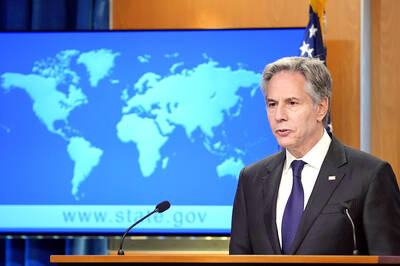
Beijing is continuing to commit genocide and crimes against humanity against Uyghurs and other Muslim minorities in its western Xinjiang province, U.S. Secretary of State Antony Blinken said in a report published on Monday, ahead of his planned visit to China this week. The State Department’s annual human rights report, which documents abuses recorded all over the world during the previous calendar year, repeated language from previous years on the treatment of Muslims in Xinjiang, but the publication raises the issue ahead of delicate talks, including on the war in Ukraine and global trade, between the top U.S. diplomat and Chinese
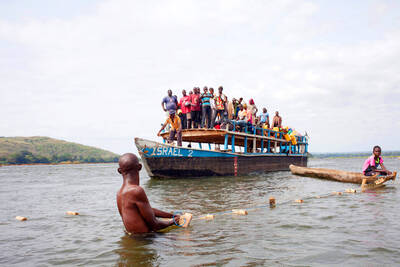
RIVER TRAGEDY: Local fishers and residents helped rescue people after the vessel capsized, while motorbike taxis evacuated some of the injured At least 58 people going to a funeral died after their overloaded river boat capsized in the Central African Republic’s (CAR) capital, Bangui, the head of civil protection said on Saturday. “We were able to extract 58 lifeless bodies,” Thomas Djimasse told Radio Guira. “We don’t know the total number of people who are underwater. According to witnesses and videos on social media, the wooden boat was carrying more than 300 people — some standing and others perched on wooden structures — when it sank on the Mpoko River on Friday. The vessel was heading to the funeral of a village chief in


 RSS
RSS