


In the autumn of 1977, as relative calm returned to China after the decade-long chaos of the Cultural Revolution, An Ping was laboring in the countryside where she had been sent, like millions of other young people from the cities, to learn from the peasants.
For two years An, an army general's daughter, fed pigs and chickens and tended crops on a commune outside Beijing, while living in unheated dormitories and going hungry.
Though Mao Zedong (
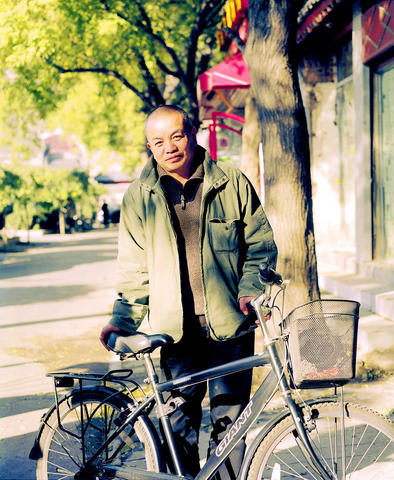
PHOTO: NY TIMES
"For the first time I felt life was not worth it," said An, who was 19 then. "If you had asked me to go on living this kind of life, I would rather die."
Then, in late October 1977, village authorities relayed the news that China would hold its first nationwide university entrance examination since 1965, shortly before academic pursuits were subordinated to political struggle. In acknowledgment of more than a decade of missed opportunity, candidates ranging in age from 13 to 37 were allowed to take the exam.
For An and a whole generation consigned to the countryside, it was the first chance to escape what seemed like a life sentence of tedium and hardship.
A pent-up reservoir of talent and ambition was released as 5.7 million people took the two-day exam in November and December 1977, in what may have been the most competitive scholastic test in modern Chinese history.
The 4.7 percent of test-takers who won admission to universities -- 273,000 people -- became known as the class of 1977, widely regarded in China as the best and brightest of their time.
By comparison, 58 percent of the 9 million exam-takers last year won admission to universities, as educational opportunities have greatly expanded.
Now, three decades later, the powerful combination of intellect and determination has taken many in this elite group to the top in such fields as politics, education, art and business.
Last October, one successful applicant who had gone on to study law and economics at Peking University, Li Keqiang (李克強), was brought into the Chinese Communist Party's decision-making Politburo Standing Committee, where he is being watched as a possible successor to President Hu Jintao (胡錦濤) or Prime Minister Wen Jiabao (溫家寶).
"They were a very bright bunch and they knew it," said Robin Munro, research director for the Hong Kong-based China Labor Bulletin, who was a British exchange student at Peking University in 1978, when those freshmen arrived. "They were the first students in 10 years let into university on merit -- and they were going places."
But back in 1977, most had only a few desperate weeks to prepare for the examination that would change their lives. The timing was especially daunting for those who had been cut off from schooling for years. All over China, students found themselves scrambling to find textbooks, seeking out former tutors and straining to recall half-forgotten formulas.
An, who now works in New York as the director of public relations for Committee of 100, a Chinese-American advocacy group, exaggerated the seriousness of a back injury and took a month's medical leave, which she devoted to studying.
"I had to succeed," she said.
The examination tested not only academic subjects, but also political correctness.
Han Ximing, now 50 and a Chinese literature professor at Nanjing Audit University, said she felt she was already well prepared to handle political questions from careful study of the party line in official newspapers in rural Jiangsu Province.
For years, the papers had been filled with scathing criticism of Deng Xiaoping (
"That was a big topic," she said. "Actually, I had no idea why Deng was supposed to be so bad."
In reality, it was the return of Deng, the veteran Communist leader, to a position of power in Beijing after the fall of the Gang of Four that led to the reinstatement of the annual exam and a return to the pragmatism that would soon ignite decades of explosive economic growth.
Among those who have assumed positions of power, aside from Li of the Politburo, are Zhou Qiang (
Artistic talent to emerge from the class of 1977 includes the filmmakers Zhang Yimou (
"To be immodest, it was a phenomenal generation," said Fan Haoyi, now 50, who earned a chance to study French at the Beijing Institute of Foreign Languages (now the Beijing Foreign Studies University), a stepping stone to a business career in Africa and Europe. "We had a rage to learn."
Many successful candidates said they felt they had been given a priceless opportunity and were determined to make the most of it.
"We were not just gifted, we also worked really hard," Han said.
Still, not everyone jumped at the chance to take the exam.
After years when privilege and opportunity were reserved for the offspring of senior officials or people with approved class backgrounds, many prospective candidates doubted that the test would be fair. Others were reluctant to give up the security of even menial jobs.
For An, the desire to escape her rural life was tempered by the conviction that taking the exam was risky. Relations between the farmers and students were complex; if she failed and was forced to return to the village, she worried that she would be given all the dirty jobs.
"They didn't like us being there because they had to share their land," she said. "But if we tried to leave, they would think we looked down on them."
Li Xiyue was also part of a rural production team. The work was hard but he found it difficult to imagine any other future for himself.
"By the time I was sent to the rural areas, this policy had been in place for 10 years," said Li, 50, who won a seat at Guangxi University and went on to become a writer and university lecturer.
Hard farm labor "was normal," he said. "Going to college was not normal."
Still, he found time to study in his spare time.
"The problem was, it was difficult to find interesting material," he said. "I would even read the literature that came with farming equipment."
When the time came to take the university entrance exam, some found it difficult to break with the commune.
Han was allowed to return home to study for the exam, but she became alarmed when she heard that she had been criticized at a commune meeting for pursuing personal ambition at the expense of the revolution.
"I ran back to the team, but my father was very angry and brought me home," she said. "He banned all further contact with them."
An said she had taken some French in middle school, but classes were overlaid with politics and broken up by military training and factory work. Less than confident, she went to see a former teacher who assured her that the examiners would not ask overly complicated questions.
But the teacher predicted that she would be asked why she wanted to study French, advising her to say she was doing it to serve the revolution.
"They did ask me that," said An, who qualified to study French at the Beijing Language Institute (now the Beijing Language and Culture University) and later at the Sorbonne in Paris.
When the academic year began in 1978, after the lost decade of the Cultural Revolution, it was an unusually mature freshman class that entered universities across the country. Han said that some of her fellow students at Nanjing Normal University were twice her age.
"I had a classmate who was the father of four kids," she said.
As they began their studies, many were fired by idealism and eagerness to achieve a fresh start for themselves and their country.
"It was a time full of dreams and hopes for the future," Han said.
Thirty years later, many express mixed feelings about the direction events took. While acknowledging the benefits of China's economic development, some voiced disappointment with the pace of political change.
"A lot of things we could not even imagine have become reality," Li Xiyue said. "But it's painful to see so much corruption, especially among high-ranking officials."

GLORY FACADE: Residents are fighting the church’s plan to build a large flight of steps and a square that would entail destroying up to two blocks of homes Barcelona’s eternally unfinished Basilica de la Sagrada Familia has grown to become the world’s tallest church, but a conflict with residents threatens to delay the finish date for the monument designed more than 140 years ago. Swathed in scaffolding on a platform 54m above the ground, an enormous stone slab is being prepared to complete the cross of the central Jesus Christ tower. A huge yellow crane is to bring it up to the summit, which will stand at 172.5m and has snatched the record as the world’s tallest church from Germany’s Ulm Minster. The basilica’s peak will deliberately fall short of the

FRAYED: Strains between the US-European ties have ruptured allies’ trust in Washington, but with time, that could be rebuilt, the Michigan governor said China is providing crucial support for Russia’s aggression in Ukraine and could end the war with a phone call, US Ambassador to NATO Matthew Whitaker said. “China could call [Russian President] Vladimir Putin and end this war tomorrow and cut off his dual-purpose technologies that they’re selling,” Whitaker said during a Friday panel at the Munich Security Conference. “China could stop buying Russian oil and gas.” “You know, this war is being completely enabled by China,” the US envoy added. Beijing and Moscow have forged an even tighter partnership since the start of the war, and Russia relies on China for critical parts
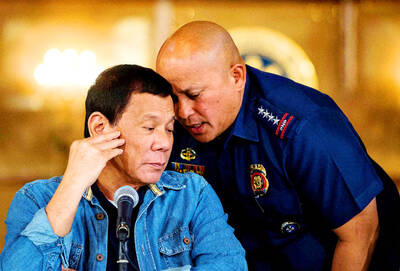
Two sitting Philippine senators have been identified as “coperpetrators” in former Philippine president Rodrigo Duterte’s crimes against humanity trial at the International Criminal Court (ICC), documents released by prosecutors showed. Philippine senators Ronald Dela Rosa and Christopher Go are among eight current and former officials named in a document dated Feb. 13 and posted to the court’s Web site. ICC prosecutors have charged Duterte with three counts of crimes against humanity, alleging his involvement in at least 76 murders as part of his “war on drugs.” “Duterte and his coperpetrators shared a common plan or agreement to ‘neutralize’ alleged criminals in the Philippines

Venezuelan Nobel peace laureate Maria Corina Machado yesterday said that armed men “kidnapped” a close ally shortly after his release by authorities, following former Venezuelan president Nicolas Maduro’s capture. The country’s Public Prosecutor’s Office confirmed later yesterday that former National Assembly vice president Juan Pablo Guanipa, 61, was again taken into custody and was to be put under house arrest, arguing that he violated the conditions of his release. Guanipa would be placed under house arrest “in order to safeguard the criminal process,” the office said in a statement. The conditions of Guanipa’s release have yet to be made public. Machado claimed that


 RSS
RSS