


Every night in the quiet western Indian city of Anand, 15 pregnant women prepare for sleep in the spacious house they share, ascending the stairs in a procession of ballooned bellies, to bedrooms that become a landscape of soft hills.
A team of maids, cooks and doctors looks after the women, whose pregnancies would be unusual anywhere else but are common here. The young mothers of Anand are pregnant with the children of infertile couples from around the world.
The small clinic at Kaival Hospital matches infertile couples with local women, cares for the women during pregnancy and delivery, and counsels them afterward. Anand's surrogate mothers, pioneers in the growing field of outsourced pregnancies, have given birth to roughly 40 babies.

PHOTO: AP
More than 50 women in this city are now pregnant with the children of couples from the US, Taiwan, Britain and beyond. The women earn more than many would make in 15 years. But the program raises a host of uncomfortable questions that touch on morals and modern science, exploitation and globalization, and that most natural of desires: to have a family.
Nayna Patel, the woman behind Anand's baby boom, defends her work as meaningful for everyone involved.
"There is this one woman who desperately needs a baby and cannot have her own child without the help of a surrogate. And at the other end there is this woman who badly wants to help her [own] family," Patel said. "If this female wants to help the other one ... why not allow that? ... It's not for any bad cause. They're helping one another to have a new life in this world."
Experts say commercial surrogacy -- or what has been called "wombs for rent" -- is growing in India. The women are impregnated in-vitro with the egg and sperm of couples unable to conceive on their own. India is the leader in making commercial surrogacy a viable industry rather than a rare fertility treatment. Experts say it could take off for the same reasons outsourcing in other industries has been successful: a wide labor pool working for relatively low rates.
Critics say the couples are exploiting poor women in India by hiring them at a cut-price cost to undergo the hardship, pain and risks of labor.
Patel's surrogates are aware of the risks because they've watched others go through them. Many of the mothers know one another, or are even related.
Ritu Sodhi from Los Angeles, spent US$200,000 trying to get pregnant through in-vitro fertilization. Then, on the Internet, she found Patel's clinic. Sodhi and her husband now have a four-month-old baby and plan to return to Anand for a second child.
"Even if it cost US$1 million, the joy that they had delivered to me is so much more than any money that I have given them," Sodhi said.
Patel's center is believed to be unique in offering one-stop service. Other clinics may request that the couple bring in their own surrogate and some place classified ads. But in Anand the couple just provides the egg and sperm and the clinic does the rest.
Patel said she carefully chooses which couples to help and which women to hire as surrogates.
The surrogate mothers and the parents sign a contract that promises the couple will cover all medical expenses in addition to the woman's payment, and the surrogate mother will hand over the baby after birth. The couples fly to Anand for the in-vitro fertilization and again for the birth.
Counseling is a major part of the process and Patel tells the women to think of the pregnancy as "someone's child comes to stay at your place for nine months."
For now, the surrogate mothers in Anand seem as pleased with the arrangement as the new parents.
"I know this isn't mine," said Jagrudi Sharma, 34, pointing to her belly. "But I'm giving happiness to another couple. And it's great for me."

Hungarian authorities temporarily detained seven Ukrainian citizens and seized two armored cars carrying tens of millions of euros in cash across Hungary on suspicion of money laundering, officials said on Friday. The Ukrainians were released on Friday, following their detention on Thursday, but Hungarian officials held onto the cash, prompting Ukraine to accuse Hungary’s Russia-friendly government of illegally seizing the money. “We will not tolerate this state banditism,” Ukrainian Minister of Foreign Affairs Andrii Sybiha said. The seven detained Ukrainians were employees of the Ukrainian state-owned Oschadbank, who were traveling in the two armored cars that were carrying the money between Austria and

Kosovar President Vjosa Osmani on Friday after dissolving the Kosovar parliament said a snap election should be held as soon as possible to avoid another prolonged political crisis in the Balkan country at a time of global turmoil. Osmani said it is important for Kosovo to wrap up the upcoming election process and form functional institutions for political stability as the war rages in the Middle East. “Precisely because the geopolitical situation is that complex, it is important to finish this electoral process which is coming up,” she said. “It is very hard now to imagine what will happen next.” Kosovo, which declared

MORE BANS: Australia last year required sites to remove accounts held by under-16s, with a few countries pushing for similar action at an EU level and India considering its own ban Indonesia on Friday said it would ban social media access for children under 16, citing threats from online pornography, cyberbullying, online fraud and Internet addiction. “Accounts belonging to children under 16 on high-risk platforms will start to be deactivated, beginning with YouTube, TikTok, Facebook, Instagram, Threads, X, Bigo Live and Roblox,” Indonesian Minister of Communications and Digital Meutya Hafid said. “The government is stepping in so that parents no longer have to fight alone against the giants of the algorithm. Implementation will begin on March 28, 2026,” she said. The social media ban would be introduced in stages “until all platforms fulfill their
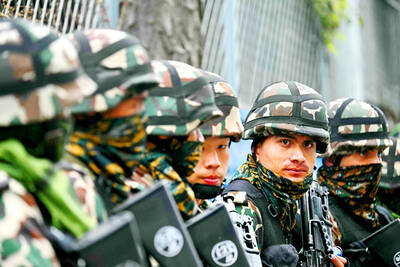
Counting was under way in Nepal yesterday, after a high-stakes parliamentary election to reshape the country’s leadership following protests last year that toppled the government. Key figures vying for power include former Nepalese prime minister K. P. Sharma Oli, rapper-turned-mayor Balendra Shah, who is bidding for the youth vote, and newly elected Nepali Congress party leader Gagan Thapa. In Kathmandu’s tea shops and city squares, people were glued to their phones, checking results as early trends flashed up — suggesting Shah’s centrist Rastriya Swatantra Party (RSP) was ahead. Nepalese Election Commission spokesman Prakash Nyupane said the counting was ongoing “in a peaceful manner”


 RSS
RSS