


The assassination of opposition leader Benazir Bhutto has pitched Pakistan into a political freefall and raised fears that increasingly bitter divisions in the society are turning the country into another Iraq.
Citizens blame the deepening turmoil on President Pervez Musharraf and his US-backed crackdown on Islamic extremists. Overwhelmingly poor and more concerned with survival than anti-Western terrorism, most crave stability above all, and many believe things will only get better if Musharraf resigns.
"The government of Musharraf has created an Afghanistan and Iraq-like situation in our country," said Zaheer Ahmad, 47, who works at a private clinic in Multan. "I don't know who killed Benazir Bhutto. But I do know that it is the result of Musharraf's wrong and bad policies."
While many Pakistanis want him gone, there is no consensus on who could replace Musharraf -- or whether anyone can unify the country's bickering political factions.
The suicide attack that killed Bhutto on Thursday has unleashed a maelstrom of anger among her supporters and three days of unrest have left more than 40 dead and tens of millions of dollars in damage. In some cities, security forces are now authorized to shoot rioters on sight.
Bhutto's killing has also deepened the sense that the rule of law, let alone prospects for democracy after years of authoritarian rule under Musharraf, are now in danger.
She was the leader of the biggest secular political party and lionized by the rural poor.
Although her strongest support came from her home province of Sindh, she was perhaps unique in Pakistan for having national appeal across ethnic and religious divides, including among the moderate Muslim majority and minority Christians and Hindus.
There is an alarming gap between Pakistan's rich elite -- which she belonged to -- and the majority of the 160 million people with a per capita annual income of just US$720.
Critics derided her a political opportunist, tainted by corruption allegations during her two terms in office. Nevertheless, her passing has left a vacuum in Pakistani politics.
The most natural successor to Bhutto is former prime minister Nawaz Sharif, who leads the other main opposition party.
Sharif is more conservative than Bhutto and rose to political prominence under a former military regime. It appears very unlikely he could coexist with Musharraf, who toppled him in a 1999 coup.
He has demanded Musharraf's resignation and has vowed to take vengeance against the "rulers" for Bhutto's killing.
The US is pressing for Jan. 8 parliamentary elections to be held on time, but few in Pakistan believe that is a panacea for the current crisis.
"The most important question in Pakistan's politics is how to overcome the menace of religious extremists who want to impose themselves on society by force," journalism professor Mehdi Hasan said. "Unless there is a consensus on that, holding elections and democracy cannot change the situation in Pakistan."
Musharraf's Western allies have supported his leadership as a stabilizing force because of his control of the powerful military and his willingness to take on Islamic extremists. But he is now a divisive figure among his countrymen, unlikely to achieve national reconciliation.
He has largely alienated mainstream secular parties, whose support he needs to fight militancy. And with violence skyrocketing, he has lost the confidence of the public.
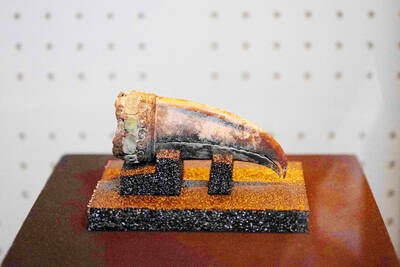
Archeologists in Peru on Thursday said they found the 5,000-year-old remains of a noblewoman at the sacred city of Caral, revealing the important role played by women in the oldest center of civilization in the Americas. “What has been discovered corresponds to a woman who apparently had elevated status, an elite woman,” archeologist David Palomino said. The mummy was found in Aspero, a sacred site within the city of Caral that was a garbage dump for more than 30 years until becoming an archeological site in the 1990s. Palomino said the carefully preserved remains, dating to 3,000BC, contained skin, part of the
‘WATER WARFARE’: A Pakistani official called India’s suspension of a 65-year-old treaty on the sharing of waters from the Indus River ‘a cowardly, illegal move’ Pakistan yesterday canceled visas for Indian nationals, closed its airspace for all Indian-owned or operated airlines, and suspended all trade with India, including to and from any third country. The retaliatory measures follow India’s decision to suspend visas for Pakistani nationals in the aftermath of a deadly attack by shooters in Kashmir that killed 26 people, mostly tourists. The rare attack on civilians shocked and outraged India and prompted calls for action against their country’s archenemy, Pakistan. New Delhi did not publicly produce evidence connecting the attack to its neighbor, but said it had “cross-border” links to Pakistan. Pakistan denied any connection to

TRUMP EFFECT: The win capped one of the most dramatic turnarounds in Canadian political history after the Conservatives had led the Liberals by more than 20 points Canadian Prime Minister Mark Carney yesterday pledged to win US President Donald Trump’s trade war after winning Canada’s election and leading his Liberal Party to another term in power. Following a campaign dominated by Trump’s tariffs and annexation threats, Carney promised to chart “a new path forward” in a world “fundamentally changed” by a US that is newly hostile to free trade. “We are over the shock of the American betrayal, but we should never forget the lessons,” said Carney, who led the central banks of Canada and the UK before entering politics earlier this year. “We will win this trade war and

Armed with 4,000 eggs and a truckload of sugar and cream, French pastry chefs on Wednesday completed a 121.8m-long strawberry cake that they have claimed is the world’s longest ever made. Youssef El Gatou brought together 20 chefs to make the 1.2 tonne masterpiece that took a week to complete and was set out on tables in an ice rink in the Paris suburb town of Argenteuil for residents to inspect. The effort overtook a 100.48m-long strawberry cake made in the Italian town of San Mauro Torinese in 2019. El Gatou’s cake also used 350kg of strawberries, 150kg of sugar and 415kg of


 RSS
RSS