


Hong Kong's pro-democracy camp yesterday condemned China's decision to delay the direct election of the city's leader until at least 2017, but some analysts and media gave it a cautious welcome.
Albert Chan (陳偉業), a lawmaker with the League of Social Democrats, said the democracy movement now needed to adopt a radical approach and called for a campaign of non-cooperation, with a blanket vote against all government bills.
"We need to disrupt our administration and force them to rethink the consequences of depriving Hong Kong people's political rights," he said on local broadcaster RTHK's Letter to Hong Kong.
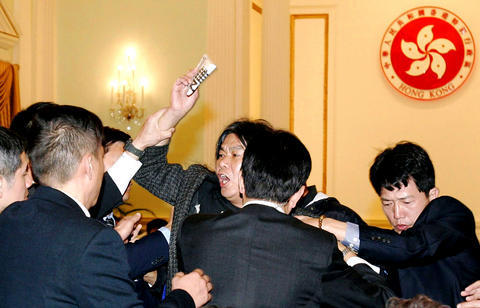
PHOTO: EPA
"Without changes, in another 20 years, we will be still waiting for democracy, but this time, in our grave," he said.
Beijing's announcement on Saturday to give a tentative green light to the election of the former British colony's chief executive in 2017 was the clearest indication yet of the city's political future.
But the move ignored Chief Executive Donald Tsang's (
Under the existing system, the chief executive is chosen by an 800-member committee of mainly pro-Beijing representatives of business and professional groups.
More than 1,000 protesters marched through the city on Saturday to condemn the announcement.
The English-language Sunday Morning Post said that some comfort should be taken from the decision, but conceded there would be disappointment.
"But it is tempered by a silver lining in the decision, and should now be put aside in favour of following a clear path that has opened up towards democratic development," it said.
Timothy Wong, from the Chinese University's Institute of Asia-Pacific studies, said the move could act as a model for reform in mainland China.
"Compared with democratic elections in Western countries, the election of a chief executive by universal suffrage would be a better reference for democratic reform on the mainland," the Post quoted him as saying.
Universal suffrage for both the chief executive and the legislature was guaranteed when Hong Kong was returned to China in 1997, but no timetable was set.
At present, only half of 60 legislators are directly elected, while the remaining seats are held by representatives of business and professional groups mostly loyal to Beijing.

Nauru has started selling passports to fund climate action, but is so far struggling to attract new citizens to the low-lying, largely barren island in the Pacific Ocean. Nauru, one of the world’s smallest nations, has a novel plan to fund its fight against climate change by selling so-called “Golden Passports.” Selling for US$105,000 each, Nauru plans to drum up more than US$5 million in the first year of the “climate resilience citizenship” program. Almost six months after the scheme opened in February, Nauru has so far approved just six applications — covering two families and four individuals. Despite the slow start —

YELLOW SHIRTS: Many protesters were associated with pro-royalist groups that had previously supported the ouster of Paetongtarn’s father, Thaksin, in 2006 Protesters rallied on Saturday in the Thai capital to demand the resignation of court-suspended Thai Prime Minister Paetongtarn Shinawatra and in support of the armed forces following a violent border dispute with Cambodia that killed more than three dozen people and displaced more than 260,000. Gathered at Bangkok’s Victory Monument despite soaring temperatures, many sang patriotic songs and listened to speeches denouncing Paetongtarn and her father, former Thai prime minister Thaksin Shinawatra, and voiced their backing of the country’s army, which has always retained substantial power in the Southeast Asian country. Police said there were about 2,000 protesters by mid-afternoon, although

MOGAMI-CLASS FRIGATES: The deal is a ‘big step toward elevating national security cooperation with Australia, which is our special strategic partner,’ a Japanese official said Australia is to upgrade its navy with 11 Mogami-class frigates built by Japan’s Mitsubishi Heavy Industries, Australian Minister for Defence Richard Marles said yesterday. Billed as Japan’s biggest defense export deal since World War II, Australia is to pay US$6 billion over the next 10 years to acquire the fleet of stealth frigates. Australia is in the midst of a major military restructure, bolstering its navy with long-range firepower in an effort to deter China. It is striving to expand its fleet of major warships from 11 to 26 over the next decade. “This is clearly the biggest defense-industry agreement that has ever

DEADLY TASTE TEST: Erin Patterson tried to kill her estranged husband three times, police said in one of the major claims not heard during her initial trial Australia’s recently convicted mushroom murderer also tried to poison her husband with bolognese pasta and chicken korma curry, according to testimony aired yesterday after a suppression order lapsed. Home cook Erin Patterson was found guilty last month of murdering her husband’s parents and elderly aunt in 2023, lacing their beef Wellington lunch with lethal death cap mushrooms. A series of potentially damning allegations about Patterson’s behavior in the lead-up to the meal were withheld from the jury to give the mother-of-two a fair trial. Supreme Court Justice Christopher Beale yesterday rejected an application to keep these allegations secret. Patterson tried to kill her


 RSS
RSS