


Egypt is considering copyrighting its pharaonic antiquities, from the pyramids to scarab beetles, in an attempt to get a cut from trinkets sold around the world, antiquities chief Zahi Hawass said on Thursday.
It was unclear whether such a copyright would be recognized internationally -- and Hawass said it would apply only on exact replicas of antiquities, including scale, meaning someone would have to build a full-scale replica of the giant pyramids for it to violate the copyright.
"If you [want to] build an exact copy of the Great Pyramid we will stop you," Hawass said.
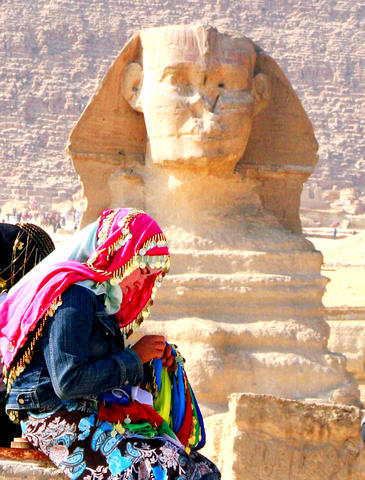
PHOTO: AP
The provision is part of a new draft antiquities law that Hawass has put before the Egyptian parliament that would also mandate life imprisonment for antiquities smugglers, an attempt to crack down on theft of Egypt's heritage.
Under the law, anyone seeking to make an exact replica of a copyrighted pharaonic artifact would have to seek permission -- and pay a fee to -- Egypt's Supreme Council of Antiquities.
"The New York Metropolitan Museum of Art makes replicas of the King Tut exhibit from 20 years ago and they are still selling it everywhere and Egypt gets nothing!" said SCA chairman Hawass.
The "Chinese are making lots of money selling [replicas of] our antiquities," he said, referring to the fact that many of the souvenirs sold to tourists in Egypt are actually made in China.
The draft bill comes amid recent complaints in Egyptian media about money being made by the pyramid-shaped Las Vegas Luxor casino in the US.
But Hawass said Las Vegas' Luxor -- and other parks and malls around the world with ancient Egyptian themes -- would not be affected by the copyright law.
"It is a resort that doesn't look like anything from antiquity, it is a replica of imagination, I can't stop them from doing that," he said.
Besides, "it is an ugly pyramid with fake hieroglyphics inside," he said.
The law will also cover images of the Pyramids, King Tutankhamun and several other famous sites around the country, whose use for commercial purposes would have to be permitted by the SCA, including a fee.
Egyptian lawyer Hossam Lufti, an expert with the UN's World Intellectual Property Organization, said the draft may be baffling since so far the term copyright has not been applied to cultural heritage because authors of the work in question are long gone.
However, UNESCO and Lufti's organization are trying to develop the idea -- which still hasn't won wide backing -- that a nation has the right to defend how its folklore and intangible heritage is used internationally.
"What we are defending is the integrity of the nation," Lufti said. "We are establishing this idea based on our right to bring protection to the expression of folklore."
Hawass, who became head of Egyptian antiquities in 2002, has achieved global prominence by appearing in a number of television specials heralding new Egyptology discoveries.
His media-savvy approach has helped his department acquire new funding, such as Egypt's new US$5 million DNA testing lab, paid for by the Discovery Channel in exchange for exclusive rights to film the process of identifying the mummy said to be that of Queen Hatshepsut.
Hawass said he's offering other companies a similar deal in exchange for a second lab.
Jeffrey Weingart, lawyer with New York-based Thelen Ried Brown Raysman & Steiner LLP, said the scope of the new Egyptian draft bill is unclear "in terms what it seeks to prohibit and what exceptions apply."
"It's also unclear how a novel law such as this one would play in terms of international copyright treaties, enforcement and subject matter," said Weingart, who has long experience with copyright laws in the US.
"Anytime someone seeks to promote and profit from artistic or photographic expression, one walks a fine line between promoting its use on the one hand and protecting material on the other," Weingart said.
The copyright proposal is part of a wider law whose main purpose is to protect the country's antiquities from smugglers by stiffening punishments. It would also increase penalties for building on archeological sites.
The draft bill is the result of five years of consultations among lawyers, experts and Egyptologists on ways to protect the monuments, Hawass said.
"The most important thing is that those who steal antiquities will be put in prison for good," he said.
The law calls for five-year prison sentences for those building on archeological sites, which until now were only minimally fined. There are 6,000 such cases pending in Egypt.
Rules would also change for dozens of foreign archeological missions excavating sites in Egypt, which in the past were allowed to take 10 percent of their finds out of the country.
"I canceled that. I feel it is an honor for any expert just to work in Egypt ... not to take things outside," Hawass said.
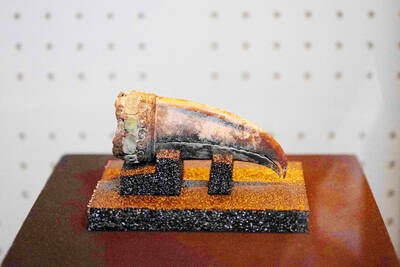
Archeologists in Peru on Thursday said they found the 5,000-year-old remains of a noblewoman at the sacred city of Caral, revealing the important role played by women in the oldest center of civilization in the Americas. “What has been discovered corresponds to a woman who apparently had elevated status, an elite woman,” archeologist David Palomino said. The mummy was found in Aspero, a sacred site within the city of Caral that was a garbage dump for more than 30 years until becoming an archeological site in the 1990s. Palomino said the carefully preserved remains, dating to 3,000BC, contained skin, part of the

‘WATER WARFARE’: A Pakistani official called India’s suspension of a 65-year-old treaty on the sharing of waters from the Indus River ‘a cowardly, illegal move’ Pakistan yesterday canceled visas for Indian nationals, closed its airspace for all Indian-owned or operated airlines, and suspended all trade with India, including to and from any third country. The retaliatory measures follow India’s decision to suspend visas for Pakistani nationals in the aftermath of a deadly attack by shooters in Kashmir that killed 26 people, mostly tourists. The rare attack on civilians shocked and outraged India and prompted calls for action against their country’s archenemy, Pakistan. New Delhi did not publicly produce evidence connecting the attack to its neighbor, but said it had “cross-border” links to Pakistan. Pakistan denied any connection to

TRUMP EFFECT: The win capped one of the most dramatic turnarounds in Canadian political history after the Conservatives had led the Liberals by more than 20 points Canadian Prime Minister Mark Carney yesterday pledged to win US President Donald Trump’s trade war after winning Canada’s election and leading his Liberal Party to another term in power. Following a campaign dominated by Trump’s tariffs and annexation threats, Carney promised to chart “a new path forward” in a world “fundamentally changed” by a US that is newly hostile to free trade. “We are over the shock of the American betrayal, but we should never forget the lessons,” said Carney, who led the central banks of Canada and the UK before entering politics earlier this year. “We will win this trade war and

Armed with 4,000 eggs and a truckload of sugar and cream, French pastry chefs on Wednesday completed a 121.8m-long strawberry cake that they have claimed is the world’s longest ever made. Youssef El Gatou brought together 20 chefs to make the 1.2 tonne masterpiece that took a week to complete and was set out on tables in an ice rink in the Paris suburb town of Argenteuil for residents to inspect. The effort overtook a 100.48m-long strawberry cake made in the Italian town of San Mauro Torinese in 2019. El Gatou’s cake also used 350kg of strawberries, 150kg of sugar and 415kg of


 RSS
RSS