


An outspoken Hong Kong lawmaker said he tried to travel yesterday to Beijing to press the country's communist leaders to allow greater political freedoms in the former British colony but was turned back at the border.
Leung Kwok-hung (
Leung -- known for his waist-length ponytail and trademark Che Guevara T-shirts -- has been banned from visiting mainland China because of his outspoken criticism of Beijing's heavy-handed crackdown on Tiananmen Square protesters in 1989.
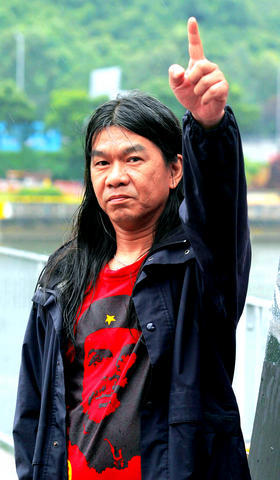
PHOTO: AFP
Like many pro-democracy activists, he has been refused a "home-return permit" -- a document that allows Hong Kong Chinese to travel to the mainland without a visa.
Together with three colleagues, Leung had intended to petition the Standing Committee of the National People's Congress -- the lawmaking arm of the Chinese government -- for direct elections in Hong Kong by 2012.
"It is our responsibility to display and reflect the conscience of the Hong Kong people with regards to universal suffrage," Leung said by telephone after his failed attempt to travel to China.
Local TV showed a scuffle as security officials tried to stop a cameraman from filming Leung being taken away by plainclothes police.
The government in Beijing has been debating Hong Kong's political development and is expected to make an announcement tomorrow. Many fear it will stop short of public demands for full democracy, which one lawmaker suggested could spark street protests.
When Hong Kong returned to Chinese rule in 1997 it was granted a wide degree of autonomy and a pledge that it would ultimately be allowed to directly elect all of its legislators and its leader, although no date was ever given.
A decade on, still only half of the 60-seat legislature is elected, and the territory's top leader, or chief executive, is chosen by an 800-strong committee full of Beijing loyalists.
Democrats say the city is mature enough to choose its own government. Beijing and its allies want a more gradual approach.
Pro-democracy activists, however, are losing patience with Bei-jing, and any more foot-dragging on the pace of political reform could see them take to the streets, Civic Party Legislator Ronny Tong (湯家驊) told government-run RTHK radio.
"Moderate democrats are not getting anywhere, especially on this issue of political reform. Our voices are simply not being heard," he said.
"If things are not working in the legislature, and if things are not working out officially, then I think people will turn underground and it will go back to the streets," he said.
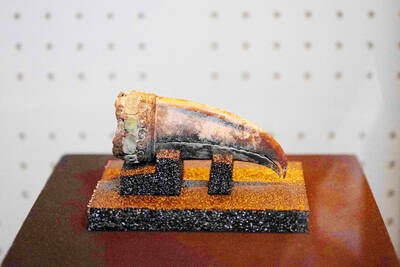
Archeologists in Peru on Thursday said they found the 5,000-year-old remains of a noblewoman at the sacred city of Caral, revealing the important role played by women in the oldest center of civilization in the Americas. “What has been discovered corresponds to a woman who apparently had elevated status, an elite woman,” archeologist David Palomino said. The mummy was found in Aspero, a sacred site within the city of Caral that was a garbage dump for more than 30 years until becoming an archeological site in the 1990s. Palomino said the carefully preserved remains, dating to 3,000BC, contained skin, part of the

‘WATER WARFARE’: A Pakistani official called India’s suspension of a 65-year-old treaty on the sharing of waters from the Indus River ‘a cowardly, illegal move’ Pakistan yesterday canceled visas for Indian nationals, closed its airspace for all Indian-owned or operated airlines, and suspended all trade with India, including to and from any third country. The retaliatory measures follow India’s decision to suspend visas for Pakistani nationals in the aftermath of a deadly attack by shooters in Kashmir that killed 26 people, mostly tourists. The rare attack on civilians shocked and outraged India and prompted calls for action against their country’s archenemy, Pakistan. New Delhi did not publicly produce evidence connecting the attack to its neighbor, but said it had “cross-border” links to Pakistan. Pakistan denied any connection to

TRUMP EFFECT: The win capped one of the most dramatic turnarounds in Canadian political history after the Conservatives had led the Liberals by more than 20 points Canadian Prime Minister Mark Carney yesterday pledged to win US President Donald Trump’s trade war after winning Canada’s election and leading his Liberal Party to another term in power. Following a campaign dominated by Trump’s tariffs and annexation threats, Carney promised to chart “a new path forward” in a world “fundamentally changed” by a US that is newly hostile to free trade. “We are over the shock of the American betrayal, but we should never forget the lessons,” said Carney, who led the central banks of Canada and the UK before entering politics earlier this year. “We will win this trade war and
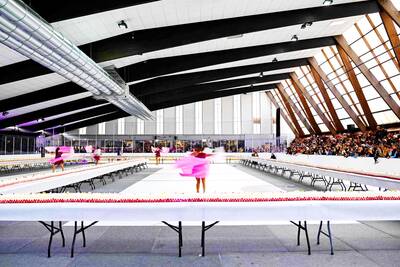
Armed with 4,000 eggs and a truckload of sugar and cream, French pastry chefs on Wednesday completed a 121.8m-long strawberry cake that they have claimed is the world’s longest ever made. Youssef El Gatou brought together 20 chefs to make the 1.2 tonne masterpiece that took a week to complete and was set out on tables in an ice rink in the Paris suburb town of Argenteuil for residents to inspect. The effort overtook a 100.48m-long strawberry cake made in the Italian town of San Mauro Torinese in 2019. El Gatou’s cake also used 350kg of strawberries, 150kg of sugar and 415kg of


 RSS
RSS