


Allies of ousted Thai prime minister Thaksin Shinawatra began hard bargaining yesterday in a bid to form a coalition government after falling short of a majority in the first polls since last year's coup.
The generals who toppled Thaksin's twice-elected government have made little secret that they want to keep supporters of the exiled self-made billionaire out of power after trying for more than a year to erase his legacy.
But the pro-Thaksin People Power Party (PPP) looked set to win 228 of the 480 parliament seats up for grabs in Sunday's election, unofficial results from the Election Commission showed.
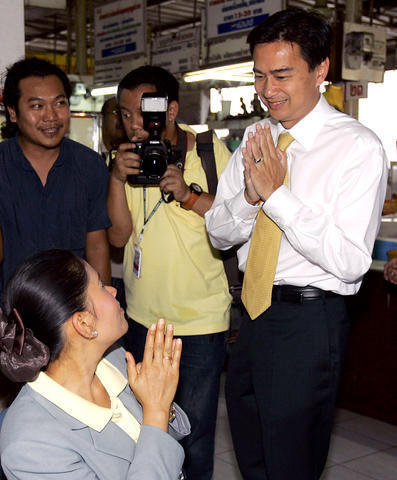
PHOTO: AP
The commission said voter turnout was about 70 percent and a complete count of the ballots was expected later yesterday.
PPP leader Samak Sundaravej declared late on Sunday he would become the next prime minister "for sure," but his failure to win an absolute majority has forced the PPP to woo small parties to set up a new government.
"Now hard negotiations begin after the election. Although the PPP is a top winner, it has to invite small parties to launch a coalition government," said Ukrist Pathmanand, a professor of political science at Bangkok's Chulalongkorn University. "We are going to see intense negotiations between the PPP and small parties."
The PPP's closest rival, the Democrat Party, was set to win 166 seats, with five smaller parties dividing up the rest.
The Democrats' leader Abhisit Vejjajiva has refused to bow out, saying he was prepared to form a coalition government if the PPP fails to do so.
The result left the shape of the new government in the hands of five smaller parties, who are certain to face pressure from the royalist generals who ousted Thaksin.
Two of the minor parties -- Chart Thai and Puea Pandin, which together have 65 seats -- have discussed forming an alliance that could turn them into crucial power brokers.
But analysts said it was difficult to predict which way any of the minor parties were leaning.
Also hanging over the polls are a slate of fraud claims filed with the Election Commission.
If even a handful of them are found to have merit, authorities have 30 days to order by-elections that could shuffle the balance among the parties.
Despite the political jockeying, the PPP's strong lead in the election was seen as a repudiation of the coup.
Thais "want to put the past 15 months of military rule behind them and turn back to the democratic path," the Bangkok Post said in an editorial.
A PPP-led coalition government could set the stage for Thaksin's political comeback. Since the coup, the former prime minister has been in self-imposed exile in Britain, where he bought Manchester City Football Club.
The junta dissolved Thaksin's Thai Rak Thai (Thais Love Thais) party and banned him from political office, but the man who made a fortune in telecoms has remained a dominant and divisive figure in Thai politics.
The PPP campaigned on promises to bring back Thaksin's populist economic policies and to bring him back to Thailand.
But few analysts believe that the election will resolve the deep divisions between anti-Thaksin urban dwellers and the rural masses, who remain loyal to the deposed leader.
The PPP draws most of its support from farmers, the majority of the nation's 64 million population, who remember Thaksin's efforts to boost the rural economy during his five-year rule.
The Democrat Party is popular among Bangkok's middle-class, who last year spearheaded anti-Thaksin protests that culminated in the coup.

Australians were downloading virtual private networks (VPNs) in droves, while one of the world’s largest porn distributors said it was blocking users from its platforms as the country yesterday rolled out sweeping online age restriction. Australia in December became the first country to impose a nationwide ban on teenagers using social media. A separate law now requires artificial intelligence (AI)-powered chatbot services to keep certain content — including pornography, extreme violence and self-harm and eating disorder material — from minors or face fines of up to A$49.5 million (US$34.6 million). The country also joined Britain, France and dozens of US states requiring

Hungarian authorities temporarily detained seven Ukrainian citizens and seized two armored cars carrying tens of millions of euros in cash across Hungary on suspicion of money laundering, officials said on Friday. The Ukrainians were released on Friday, following their detention on Thursday, but Hungarian officials held onto the cash, prompting Ukraine to accuse Hungary’s Russia-friendly government of illegally seizing the money. “We will not tolerate this state banditism,” Ukrainian Minister of Foreign Affairs Andrii Sybiha said. The seven detained Ukrainians were employees of the Ukrainian state-owned Oschadbank, who were traveling in the two armored cars that were carrying the money between Austria and

Kosovar President Vjosa Osmani on Friday after dissolving the Kosovar parliament said a snap election should be held as soon as possible to avoid another prolonged political crisis in the Balkan country at a time of global turmoil. Osmani said it is important for Kosovo to wrap up the upcoming election process and form functional institutions for political stability as the war rages in the Middle East. “Precisely because the geopolitical situation is that complex, it is important to finish this electoral process which is coming up,” she said. “It is very hard now to imagine what will happen next.” Kosovo, which declared

MORE BANS: Australia last year required sites to remove accounts held by under-16s, with a few countries pushing for similar action at an EU level and India considering its own ban Indonesia on Friday said it would ban social media access for children under 16, citing threats from online pornography, cyberbullying, online fraud and Internet addiction. “Accounts belonging to children under 16 on high-risk platforms will start to be deactivated, beginning with YouTube, TikTok, Facebook, Instagram, Threads, X, Bigo Live and Roblox,” Indonesian Minister of Communications and Digital Meutya Hafid said. “The government is stepping in so that parents no longer have to fight alone against the giants of the algorithm. Implementation will begin on March 28, 2026,” she said. The social media ban would be introduced in stages “until all platforms fulfill their


 RSS
RSS