


The US military is frequently criticized for not doing enough to reduce civilian casualties or to stabilize the places it is fighting to protect. Yet what happens when the outside experts who can offer such advice are condemned for doing exactly that?
Questions about collaboration between soldiers and academics have been around at least since World War II, but they have arisen with particular urgency in recent months at professional meetings, in journals, on campuses and on the Internet over programs related to Afghanistan and Iraq.
At Harvard, some faculty members have been troubled that the university's Carr Center for Human Rights Policy helped revise the counterinsurgency field manual, even though the center's objective was to reduce civilian casualties.
Members of the American Psychological Association have had fervid exchanges over what role, if any, its members should have in military interrogations. And anthropologists have passionately argued over a Pentagon program that uses these social scientists in war zones.
These sorts of controversies have appeared "in various permutations at different times," said David Wippman, a professor at Cornell Law School who worked on humanitarian affairs for the Bill Clinton administration, mentioning similar debates over participation in humanitarian assistance, the Iraqi war crimes tribunal and the proceedings at Guantanamo's detention camp.
In the Harvard dust-up, the worry is that the essential secretiveness of the military will transform the long-cherished openness and transparency of the university, bringing the campus green a bit too close to the parade ground.
"How could Harvard sit there and put the imprimatur of a human rights center on counterinsurgency?" said Tom Hayden, the Vietnam War-era activist, who has complained about the collaboration in The Nation and on the Huffington Post. "It lends an Ivy League cloak of legitimacy to counterinsurgency, which is inherently secret."
For Hayden and Richard Parker, who now teaches at the Kennedy School at Harvard, the Vietnam War is a touchstone in these debates.
"I'm of a generation that is skeptical about this," Parker said. "Universities aren't innocents."
"In the era of Abu Ghraib," he said, such cooperation "does damage to the university's credibility and autonomy."
Participants may think they are immune to being compromised, Cox said, but human nature being what it is, "I'm not confident that a lot of people who think they can humanize the system can prevent themselves from getting carried away," said Harvey Cox Jr, a faculty member of the Harvard Divinity School for more than 40 years.


When a hiker fell from a 55m waterfall in wild New Zealand bush, rescuers were forced to evacuate the badly hurt woman without her dog, which could not be found. After strangers raised thousands of dollars for a search, border collie Molly was flown to safety by a helicopter pilot who was determined to reunite the pet and the owner. A week earlier, an emergency rescue helicopter found the woman with bruises and lacerations after a fall at a rocky spot at the waterfall on the South Island’s West Coast. She was airlifted on March 24, but they were forced to
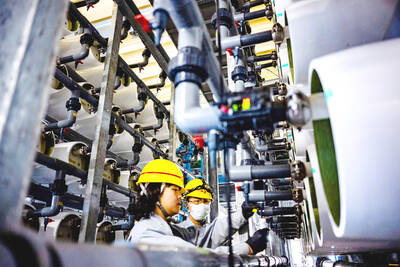
HIGH HOPES: The power source is expected to have a future, as it is not dependent on the weather or light, and could be useful for places with large desalination facilities A Japanese water plant is harnessing the natural process of osmosis to generate renewable energy that could one day become a common power source. The possibility of generating power from osmosis — when water molecules pass from a less salty solution to a more salty one — has long been known. However, actually generating energy from that has proved more complicated, in part due the difficulty of designing the membrane through which the molecules pass. Engineers in Fukuoka, Japan, and their private partners think they might have cracked it, and have opened what is only the world’s second osmotic power plant. It generates
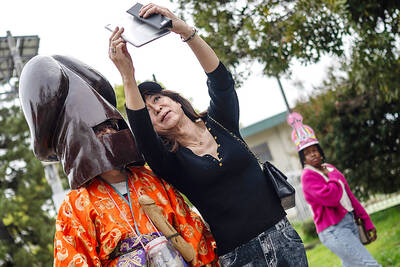
Showcasing phallus-shaped portable shrines and pink penis candies, Japan’s annual fertility festival yesterday teemed with tourists, couples and families elated by its open display of sex. The spring Kanamara Matsuri near Tokyo features colorfully dressed worshipers carrying a trio of giant phallic-shaped objects as they parade through the street with glee. The festival, as legend has it, honors a local blacksmith in the Edo Period (1603-1868) who forged an iron dildo to break the teeth of a sharp-toothed demon inhabiting a woman’s vagina that had been castrating young men on their wedding nights. A 1m black steel phallus sits in the courtyard of
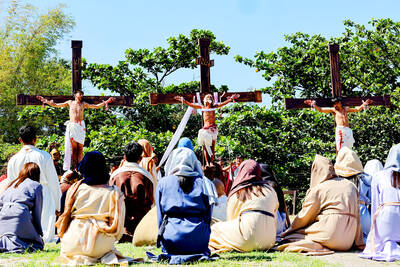
Hundreds of Filipinos and tourists flocked to a sun-bleached field north of Manila yesterday, on Good Friday, to witness one of the country’s most blood-soaked displays of religious fervor, undeterred by rising fuel prices. Scores of bare-chested flagellants with covered faces walked barefoot through the dusty streets of Pampanga Province’s San Fernando as they flogged their backs with bamboo whips in the scorching heat. Agence France-Presse (AFP) journalists said they saw devotees deliberately puncturing their skin with glass shards attached to a small wooden paddle to ensure their bleeding during the ritual, a way to atone for sins and seek miracles from


 RSS
RSS