


As Egyptians increasingly emphasize Islam as the cornerstone of identity, there has been a growing emphasis on displays of piety.
For women, that has rapidly translated into the nearly universal adoption of the hijab, a scarf fitted over the hair and ears and wrapped around the neck. For men, it is more and more popular to have a zebibah.
The zebibah, Arabic for raisin, is a dark circle of callused skin, or in some cases a protruding bump, between the hairline and the eyebrows. It emerges on the spot where worshippers press their foreheads to the ground during their daily prayers.
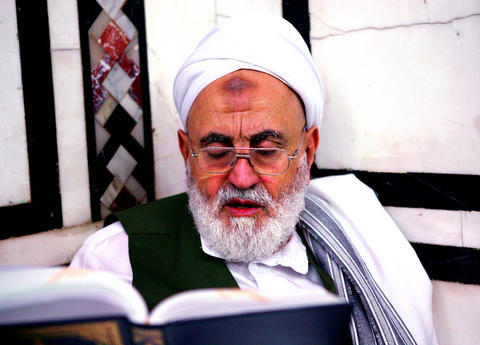
PHOTO: NY TIMES NEWS SERVICE
It may sometimes look like a painful wound, but in Egypt it is worn proudly.
Two decades ago, Egypt was a Muslim country with a relatively secular style. Nationalism and Arabism had been the foundation of identity. But today, Egypt, like much of the Arab Middle East, is experiencing the rise of Islam as the ideology of the day.
With that, religious symbols have become the fashion.
"The zebibah is a way to show how important religion is for us," said Muhammad al-Bikali, a hairstylist in Cairo, in an interview last month.
Bikali had a well-trimmed mustache and an ever-so-subtle brown spot just beneath his hairline.
"It shows how religious we are. It is a mark from God," he said.
Observant Muslims pray five times a day. Each prayer involves kneeling and touching one's forehead and nose to the ground. All five prayers require placing one's head on the ground for a total of 34 times, though many people add prayers and with that, more chances to press their heads to the ground.
Some people say the bump is the inevitable result of so many prayers -- and that is often the point: The person with the mark is broadcasting his observance, his adherence to one of the five pillars of Islam.
"If we just take it for what it is, then it means that people are praying a lot," said Gamal al-Ghitani, editor in chief of the newspaper Akhbar El Yom. "But there is a kind of statement in it. Sometimes as a personal statement to announce that he is a conservative Muslim and sometimes as a way of outbidding others by showing them that he is more religious or to say that they should be like him."
There are many reasons for the Islamic revival that has swept Egypt and the Middle East, from the rise of satellite TV, which offers 24 hours of religious programming a day, to economies that offer little hope of improving people's lives, to the resentment of Western meddling in the Middle East.
But there is also peer pressure, a powerful force in a society where conformity and tradition are aspired to and rewarded.
"I will learn more about someone when I get to know him, but the appearance is the first impression," said Khaled Ashry, 37, a security guard at a private school.
Hanaa el-Guindy, 21, an art student in Cairo, covers her head and wears a long, loose-fitting dress to hide her figure.
"The outward appearance is important," Guindy said. "It says, `I am a good person.' This is a good thing. On judgment day, this sign, the zebibah on their forehead, will shine. It will say, `God is great.' "
In much of the Arab world, symbols of extreme observance are fairly standard and tend to stem from the conservative religious cultures of Persian Gulf nations, like Saudi Arabia.
Those symbols have seeped into Egypt and are growing in popularity. More women, for example, are covering their faces with a niqab, a black mask of cloth that has come to Egypt from the Persian Gulf.
The zebibah, however, is 100 percent Egyptian and does not carry the negative connotation of imported symbols.

‘CROSSING THE LINE’: China’s embassy in Seoul criticized US Forces Korea Commander General Xavier Brunson, asking if his ‘hostile’ remarks were authorized by Washington South Korea and the US are in talks over recent public remarks by the commander of US Forces Korea, Seoul’s presidential office said yesterday, after the comments drew sharp criticism from China. In a recent podcast interview, US Forces Korea Commander General Xavier Brunson described South Korea as “the dagger in the heart of Asia” from China’s east coast, prompting the Chinese embassy in Seoul to say that he had “truly crossed the line.” The interview came amid growing speculation that Washington might seek to expand the role of US Forces Korea in countering the growing regional influence of China, a key

SEEKING ORDER: Rodrigo Paz said that ‘anyone who wants to destroy the nation will have to deal with this president and the full force of the constitution’ Bolivian President Rodrigo Paz on Wednesday said that the nation was at a “breaking point” after nearly a month of protests that have caused shortages of food, fuel and medicine. Paz, who took office six months ago amid the worst economic crisis there in four decades, is battling a groundswell of fury over his policies. The political capital, La Paz, has been besieged by low-income workers and members of the indigenous majority calling for his resignation. “The country needs order and is reaching breaking point,” the 58-year-old said at a public event in La Paz, renewing his appeal for dialogue. On Tuesday, the Bolivian

Through the noise of rushing papers and whirring belts at a print factory in Kyoto, two creators watch their photo essay come to life in broadsheet form — part of an effort to win new audiences in the age of artificial intelligence (AI). Despite the decline of the publishing industry, self-publication and handmade “zine” magazines are growing in popularity in Japan, reflecting the nation’s enduring love of paper in the digital era. While speaking to Agence France-Presse at the plant, his hands black with ink, one of the creators, Kazuma Obara, said: “I think [paper] is a medium that engages all five

Australian researchers have trained lab-grown brain cells on a silicon computer chip to play the 1990s shooter game Doom and said they are just scratching the surface of what the neurons could be capable of doing. It is the science-fiction work of biotech boffins at Cortical Labs, who researched and developed the technology that harnesses the workings of the brain’s networking system. Each so-called “biological computer” contains about 200,000 living human brain cells, grown from stem cells that were harvested from blood donations. Having mastered the simple computer game Pong, where a paddle is moved up and down to send a ball


 RSS
RSS