


The divided Lebanese parliament failed again to elect a president yesterday and voting was postponed until Saturday.
A statement issued by parliament's secretariat general said that Parliament Speaker Nabih Berri decided to postpone Monday's session until Saturday.
Parliament must meet to approve Army Commander General Michel Suleiman for the presidency after he won backing from both the anti-Syrian parliament majority and the opposition led by Hezbollah.
It was the ninth postponement since parliament first tried to elect a new president in September.
Majority MPs said they had struck an overnight deal with parliament speaker Nabih Berri, a leading member of the opposition, on electing the army chief as president without amending the Constitution.
"We will try to reach a solution today," Telecommunication Minister Marwan Hamade said. "A number of legal experts have come up with a formula which could lead to the election of army chief General Michel Suleiman."
MP Antoine Zahra, also from the majority, said the key to resolving the crisis was in the hands of the opposition.
A close aide to Christian opposition leader Michel Aoun doubted a vote would take place.
"Nothing has changed and there is no deal," Simon Abi Ramia said.
Newspapers were divided on the likelihood of a vote.
An-Nahar daily, close to the majority, said: "The white smoke rose overnight and the ninth session will be decisive. The chief of the army [is] to become president without a constitutional amendment."
The election is seen as a crucial step toward ending a long-running crisis that has paralyzed the country and left the presidency vacant since Nov. 23, when incumbent Emile Lahoud stepped down with no elected successor.
Although rival parties have agreed in principle to elect Suleiman, they have been bickering on how to amend the constitution to allow a senior public servant to become president.
They also disagree on the make-up of the new government and on who would be appointed to top security posts.
Washington at the weekend dispatched one of its top envoys to the country to meet the rival leaders and press them to end their standoff, which marks the country's worst political crisis since the end of the 1975 to 1990 civil war.
"The United States believes that it is time now to elect a new president," US Assistant Secretary of State for Near East Affairs David Welch said. "There is no reason for any further delay."
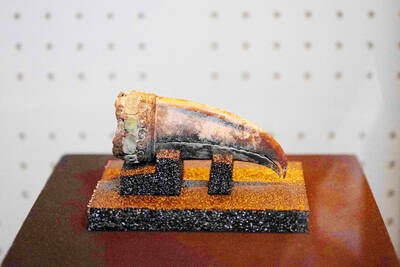
Archeologists in Peru on Thursday said they found the 5,000-year-old remains of a noblewoman at the sacred city of Caral, revealing the important role played by women in the oldest center of civilization in the Americas. “What has been discovered corresponds to a woman who apparently had elevated status, an elite woman,” archeologist David Palomino said. The mummy was found in Aspero, a sacred site within the city of Caral that was a garbage dump for more than 30 years until becoming an archeological site in the 1990s. Palomino said the carefully preserved remains, dating to 3,000BC, contained skin, part of the

TRUMP EFFECT: The win capped one of the most dramatic turnarounds in Canadian political history after the Conservatives had led the Liberals by more than 20 points Canadian Prime Minister Mark Carney yesterday pledged to win US President Donald Trump’s trade war after winning Canada’s election and leading his Liberal Party to another term in power. Following a campaign dominated by Trump’s tariffs and annexation threats, Carney promised to chart “a new path forward” in a world “fundamentally changed” by a US that is newly hostile to free trade. “We are over the shock of the American betrayal, but we should never forget the lessons,” said Carney, who led the central banks of Canada and the UK before entering politics earlier this year. “We will win this trade war and
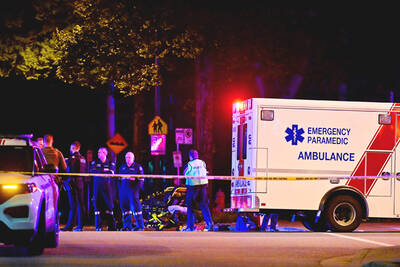
‘BODIES EVERYWHERE’: The incident occurred at a Filipino festival celebrating an anti-colonial leader, with the driver described as a ‘lone suspect’ known to police Canadian police arrested a man on Saturday after a car plowed into a street party in the western Canadian city of Vancouver, killing a number of people. Authorities said the incident happened shortly after 8pm in Vancouver’s Sunset on Fraser neighborhood as members of the Filipino community gathered to celebrate Lapu Lapu Day. The festival, which commemorates a Filipino anti-colonial leader from the 16th century, falls this year on the weekend before Canada’s election. A 30-year-old local man was arrested at the scene, Vancouver police wrote on X. The driver was a “lone suspect” known to police, a police spokesperson told journalists at the
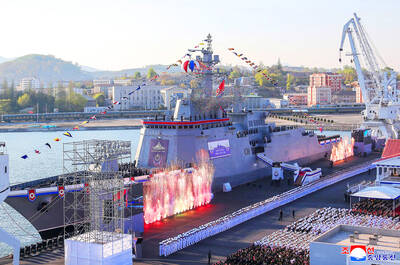
North Korean leader Kim Jong-un has unveiled a new naval destroyer, claiming it as a significant advancement toward his goal of expanding the operational range and preemptive strike capabilities of his nuclear-armed military, state media said yesterday. North Korea’s state-run Korean Central News Agency (KCNA) said Kim attended the launching ceremony for the 5,000-tonne warship on Friday at the western port of Nampo. Kim framed the arms buildup as a response to perceived threats from the US and its allies in Asia, who have been expanding joint military exercises amid rising tensions over the North’s nuclear program. He added that the acquisition


 RSS
RSS