


Afghan and NATO-led forces killed 20 Taliban fighters and wounded another nine in an operation west of the main southern city of Kandahar, the provincial police chief said yesterday.
The Zherai district, west of Kandahar, is a hotbed of Taliban activity that has been fought over many times between insurgents and Afghan and mainly Canadian troops. Some villages have changed hands several times.
Kandahar police chief Sayed Aqa Saqeb said the bodies of 20 Taliban fighters were still at the scene of the fighting in the operation which began four days ago. Nine Taliban were wounded and four of those were captured, he said.
Elsewhere in Afghanistan, a remote-controlled mine killed a man, his wife and three children travelling on a motorcycle in the south central province of Uruzgan on Sunday, the provincial police chief said.
Violence has surged in Afghanistan this year, with more than 20 percent more attacks than last year, killing at least 5,000 people.
The hardline Islamist Taliban relaunched their insurgency to overthrow the pro-Western Afghan government and eject foreign forces two years ago with a campaign of guerrilla war in the south and east, combined with suicide attacks across the country.
The violence has undermined confidence in the government of President Hamid Karzai and his Western allies to provide security and development more than six years after the Taliban were toppled from power for refusing to hand over al Qaeda leaders in the wake of the Sept. 11, 2001 attacks.
Meanwhile, NATO's top operational commander has called for a surge in efforts to provide basic amenities such as roads, healthcare and schools to Afghans to drive a wedge between the majority population and insurgents.
In an interview with Reuters, US Army General John Craddock said he was cautiously optimistic about NATO's mission in Afghanistan but it was vital for long-term success that Afghans believed their government could help in their daily lives.
"The key here is that there must be a governance push," Craddock said on Sunday evening after flying to western and southern Afghanistan to see the work of the 40,000-strong International Security Assistance Force, led by NATO.
Violence has surged in Afghanistan over the past two years with Taliban insurgents fighting a guerrilla war in the south and east, backed by high-profile suicide and car bombings across the country which foster an atmosphere of fear and insecurity.
Also, Afghan security forces shot dead an unarmed man they believed could be a suicide bomber near the entrance to Kabul's international airport, the defence ministry said yesterday.
A search on his body afterward found no sign of explosives, it added.
The civilian was shot after failing to heed repeated demands by troops and police to stop as he was walking on a road near the airport.
Defense ministry spokesman Mohammad Zahir Azimi said the man's bulging waistcoat pockets made it look as if he had something strapped to his waist.
Both forces have launched an investigation into the incident, he said.
The NATO-led International Security Assistance Force said it was not involved in the shooting.
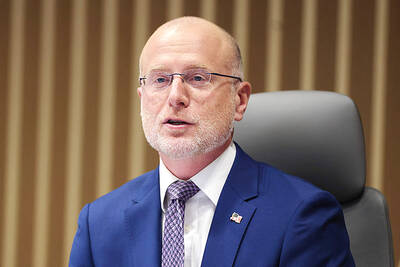
FAKE NEWS? ‘When the government demands the press become a state mouthpiece under the threat of punishment, something has gone very wrong,’ a civic group said The top US broadcast regulator on Saturday threatened media outlets over negative coverage of the Middle East war, after US President Donald Trump slammed critical headlines from the “Fake News Media.” The US president since his first term has derided mainstream media as “fake news” and has sued major outlets over what he sees as unfair coverage. Brendan Carr, head of the US Federal Communications Commission — which oversees the nation’s radio, television and Internet media — said broadcasters risked losing their licenses over news coverage. “The law is clear. Broadcasters must operate in the public interest, and they will
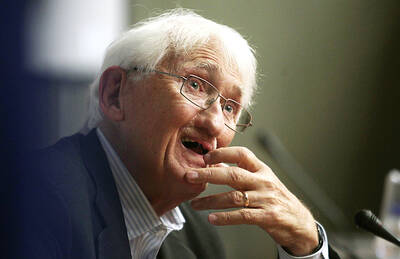
INFLUTENTIAL THEORIST: Habermas was particularly critical of the ‘limited interest’ shown by German politicians in ‘shaping a politically effective Europe Jurgen Habermas, whose work on communication, rationality and sociology made him one of the world’s most influential philosophers and a key intellectual figure in his native Germany, has died. He was 96. Habermas’ publisher, Suhrkamp, said he died on Saturday in Starnberg, near Munich. Habermas frequently weighed in on political matters over several decades. His extensive writing crossed the boundaries of academic and philosophical disciplines, providing a vision of modern society and social interaction. His best-known works included the two-volume Theory of Communicative Action. Habermas, who was 15 at the time of Nazi Germany’s defeat, later recalled the dawn of

The Chinese public maintains relatively warm sentiments toward Taiwan and strongly prefers non-military paths to improving cross-strait relations, a recent survey conducted by the Atlanta, Georgia-based Carter Center and Emory University showed. The “China Pulse” research project, which polled 2,506 adults between Oct. 27 last year and Jan. 1 this year, found that 86 percent of respondents support strengthening cultural ties, while 81 percent favor deepening economic interaction. The report, co-authored by political scientists at Emory University and advisors at the Carter Center, indicates that the Chinese public views Taiwan’s importance through a lens of shared history and culture rather than geopolitical

Cannabis-based medicines have shown little evidence of effectiveness for treating most mental health and substance-use disorders, according to a large review of past studies published in a major medical journal on Monday. Medical use of cannabinoids has been expanding, including in the US, Canada and Australia, where many patients report using cannabis products to manage conditions such as anxiety, post-traumatic stress disorder and sleep problems. Researchers reviewed data from 54 randomized clinical trials conducted between 1980 and May last year involving 2,477 participants for their analysis published in The Lancet. The studies assessed cannabinoids as a primary treatment for mental disorders or substance-use


 RSS
RSS