


The Senate passed a trimmed-back energy bill that would bring higher-gas mileage cars into showrooms in the coming decade and fill their tanks with ethanol.
The measure was approved on Thursday with strong bipartisan support 86-8 after Democrats abandoned efforts to impose billions of dollars in new taxes on the biggest oil companies, unable to overcome Republican delaying tactics against the new taxes by one vote.
The bill now goes to the House, where a vote is expected next week. The White House issued a statement saying US President George W. Bush will sign the legislation if it reaches his desk, as is expected. Bush had promised a veto if the oil industry taxes were not removed.
The measure calls for the first major increase by Congress in required automobile fuel efficiency in 32 years, something the auto companies have fought for two decades.
The car companies will have to achieve an industrywide average of 35mpg (15km per liter) for cars, small trucks and SUVs over the next 13 years, an increase of 10 mpg over what the entire fleet averages today.
And it would boost use of ethanol to 136 billion liters a year by 2022, a nearly sixfold increase, and impose an array of new requirements to promote efficiency in appliances, lighting and buildings.
This bill "will begin to reverse our addiction to oil. It's a step to fight global warming," said Majority Leader Harry Reid, a Democrat.
The increased efficiency by 2020 will save 1.1 million barrels of oil a day, equal to half the oil now imported from the Persian Gulf, save consumers US$22 billion at the pump, and reduce annual greenhouse gases emissions by 181 million tonnes, said Democratic Senator Daniel Inouye, whose committee crafted the measure.
"It demonstrates to the world that America is a leader in fighting global warming," he said.
Democratic Senator Carl Levin, a longtime protector of the auto industry that is so important to his state of Michigan, called the fuel economy measure "ambitious but achievable."
For consumers, the legislation will mean that over the next dozen years auto companies will likely build more diesel-powered SUVs and gas-electric hybrid cars as well as vehicles that can run on 85 percent ethanol. They will push engineers to develop new technologies to save fuel.
"Automakers can meet the new standards with today's technology," said David Friedman, research director at the Union of Concerned Scientists Clean Vehicle Program. "Cars and trucks will be the same size and perform the same way they do today."
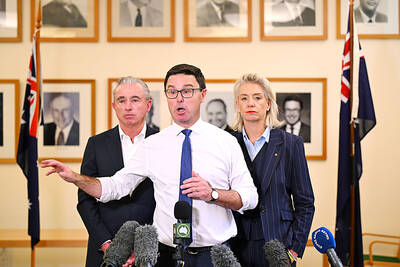
BACKLASH: The National Party quit its decades-long partnership with the Liberal Party after their election loss to center-left Labor, which won a historic third term Australia’s National Party has split from its conservative coalition partner of more than 60 years, the Liberal Party, citing policy differences over renewable energy and after a resounding loss at a national election this month. “Its time to have a break,” Nationals leader David Littleproud told reporters yesterday. The split shows the pressure on Australia’s conservative parties after Prime Minister Anthony Albanese’s center-left Labor party won a historic second term in the May 3 election, powered by a voter backlash against US President Donald Trump’s policies. Under the long-standing partnership in state and federal politics, the Liberal and National coalition had shared power

CONTROVERSY: During the performance of Israel’s entrant Yuval Raphael’s song ‘New Day Will Rise,’ loud whistles were heard and two people tried to get on stage Austria’s JJ yesterday won the Eurovision Song Contest, with his operatic song Wasted Love triumphing at the world’s biggest live music television event. After votes from national juries around Europe and viewers from across the continent and beyond, JJ gave Austria its first victory since bearded drag performer Conchita Wurst’s 2014 triumph. After the nail-biting drama as the votes were revealed running into yesterday morning, Austria finished with 436 points, ahead of Israel — whose participation drew protests — on 357 and Estonia on 356. “Thank you to you, Europe, for making my dreams come true,” 24-year-old countertenor JJ, whose

NO EXCUSES: Marcos said his administration was acting on voters’ demands, but an academic said the move was emotionally motivated after a poor midterm showing Philippine President Ferdinand Marcos Jr yesterday sought the resignation of all his Cabinet secretaries, in a move seen as an attempt to reset the political agenda and assert his authority over the second half of his single six-year term. The order came after the president’s allies failed to win a majority of Senate seats contested in the 12 polls on Monday last week, leaving Marcos facing a divided political and legislative landscape that could thwart his attempts to have an ally succeed him in 2028. “He’s talking to the people, trying to salvage whatever political capital he has left. I think it’s

A documentary whose main subject, 25-year-old photojournalist Fatima Hassouna, was killed in an Israeli airstrike in Gaza weeks before it premiered at Cannes stunned viewers into silence at the festival on Thursday. As the cinema lights came back on, filmmaker Sepideh Farsi held up an image of the young Palestinian woman killed with younger siblings on April 16, and encouraged the audience to stand up and clap to pay tribute. “To kill a child, to kill a photographer is unacceptable,” Farsi said. “There are still children to save. It must be done fast,” the exiled Iranian filmmaker added. With Israel


 RSS
RSS