


Four states in open revolt against an overhaul to the Constitution by Bolivian President Evo Morales and his pro-indigenous allies declared their intention to create independent regional governments.
A 130-member assembly in the eastern opposition stronghold of Santa Cruz on Thursday approved an "autonomy statute" under which the state would hold on to nearly two-thirds of the tax revenues it currently turns over to central authorities.
Among measures contemplated in the statute is a police force for Santa Cruz, a lowland state that is Bolivia's wealthiest. Local leaders say they'll seek a state referendum in coming months to approve it.
The other states which said they would approve regional charters by today were Beni, Pando and Tarija, which with Santa Cruz represent some 35 percent of Bolivia's more than 8.5 million people. They said their statutes would be similar to Santa Cruz's but did not immediately provide details.
Morales' government called on its supporters to turn out today en masse in Santa Cruz, the eponymous capital of the eastern state, to protest the autonomy move.
Pro-autonomy civic leaders plan to present the statute to the public also today in the city, where protesters have in recent weeks tried to take over national government tax offices.
A standoff between pro- and anti-Morales forces has become increasingly tense since a rump assembly of Morales allies approved in two votes a draft constitution that would establish a multiethnic state with self-governing regions for indigenous groups.
The charter, which Bolivia's voters must approve in referendums to be held sometime next year, would shift more power to central authorities at the expense of the country's nine states.
The most adversely affected would be Santa Cruz, its leaders say. The state is the most prosperous in South America's poorest country, with major agribusinesses including extensive soy farms.
Morales' core support comes from the poor, indigenous majority that lives primarily in arid Andean highlands.
The country's first indigenous president, Morales considered his December 2005 election victory a mandate to reverse what he considers centuries of discrimination by a European-descended elite.
Vice President Alvaro Garcia, addressing leaders of the revolting states on national television Thursday, called on the scores of opposition members engaged in hunger strikes to cease them. He said he feared "a catastrophic standoff" had been reached in a power struggle of unforeseeable consequences.
The Morales government sent 400 police reinforcements to Santa Cruz this week, but denied sending soldiers.
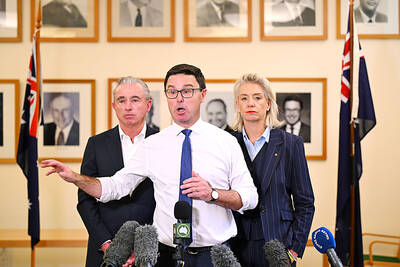
BACKLASH: The National Party quit its decades-long partnership with the Liberal Party after their election loss to center-left Labor, which won a historic third term Australia’s National Party has split from its conservative coalition partner of more than 60 years, the Liberal Party, citing policy differences over renewable energy and after a resounding loss at a national election this month. “Its time to have a break,” Nationals leader David Littleproud told reporters yesterday. The split shows the pressure on Australia’s conservative parties after Prime Minister Anthony Albanese’s center-left Labor party won a historic second term in the May 3 election, powered by a voter backlash against US President Donald Trump’s policies. Under the long-standing partnership in state and federal politics, the Liberal and National coalition had shared power

CONTROVERSY: During the performance of Israel’s entrant Yuval Raphael’s song ‘New Day Will Rise,’ loud whistles were heard and two people tried to get on stage Austria’s JJ yesterday won the Eurovision Song Contest, with his operatic song Wasted Love triumphing at the world’s biggest live music television event. After votes from national juries around Europe and viewers from across the continent and beyond, JJ gave Austria its first victory since bearded drag performer Conchita Wurst’s 2014 triumph. After the nail-biting drama as the votes were revealed running into yesterday morning, Austria finished with 436 points, ahead of Israel — whose participation drew protests — on 357 and Estonia on 356. “Thank you to you, Europe, for making my dreams come true,” 24-year-old countertenor JJ, whose
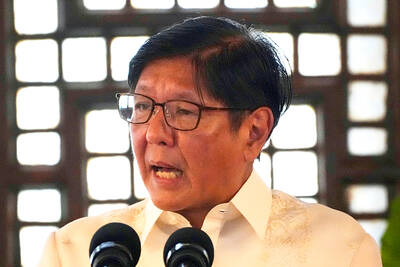
NO EXCUSES: Marcos said his administration was acting on voters’ demands, but an academic said the move was emotionally motivated after a poor midterm showing Philippine President Ferdinand Marcos Jr yesterday sought the resignation of all his Cabinet secretaries, in a move seen as an attempt to reset the political agenda and assert his authority over the second half of his single six-year term. The order came after the president’s allies failed to win a majority of Senate seats contested in the 12 polls on Monday last week, leaving Marcos facing a divided political and legislative landscape that could thwart his attempts to have an ally succeed him in 2028. “He’s talking to the people, trying to salvage whatever political capital he has left. I think it’s

A documentary whose main subject, 25-year-old photojournalist Fatima Hassouna, was killed in an Israeli airstrike in Gaza weeks before it premiered at Cannes stunned viewers into silence at the festival on Thursday. As the cinema lights came back on, filmmaker Sepideh Farsi held up an image of the young Palestinian woman killed with younger siblings on April 16, and encouraged the audience to stand up and clap to pay tribute. “To kill a child, to kill a photographer is unacceptable,” Farsi said. “There are still children to save. It must be done fast,” the exiled Iranian filmmaker added. With Israel


 RSS
RSS