


A radical Islamic group that was driven from power one year ago by a Western-supported offensive is making a significant comeback in Somalia and the government can do little to stop it, officials said, as violence took at least 17 more lives.
Sheik Qasim Ibrahim Nur, director of security at Somalia's National Security Ministry, said on Thursday that the government has no power to resist the Islamic group, which the US has accused of having ties to al-Qaeda.
Fighters linked to the group, the Council of Islamic Courts, have been waging an Iraq-style insurgency that has killed thousands of people this year, and the UN says the country is facing the biggest humanitarian crisis in Africa.
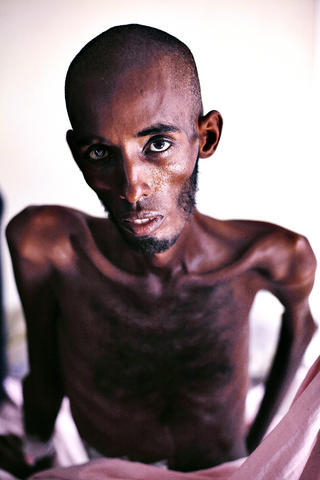
PHOTO: AFP
"About 80 percent of Somalia is not safe and is not under control of the government," Nur said. "Islamists are planning to launch a massive attack against the [government] and its allied troops."
He appealed for international support, saying Islamic fighters "are everywhere."
Government officials rarely acknowledge what many observers have concluded about their tenuous grip on power. But on Thursday, even presidential spokesman Hussein Mohamed Mohamud confirmed that Muslim fighters were regrouping. He added that they have "a lot of weapons and foreign fighters."
Earlier this month, US Secretary of State Condoleezza Rice urged more African nations to send peacekeepers to Somalia.
About 1,800 Ugandan peacekeepers are in Somalia, officially as the vanguard of a larger African Union peacekeeping force, though no other countries have sent reinforcements so far. Ethiopia, which with tacit US approval sent soldiers to Somalia last year to wipe out the Islamic militants, is not part of the peacekeeping force and is hoping to withdraw.
The US can do little by itself in Somalia. An intervention in the early 1990s left 18 US servicemen dead and the legacy of the battle, featured in the movie Black Hawk Down, still weighs heavily on both countries. But Western powers have long been concerned that the lawless country could become a breeding ground for terror.
Ted Dagne, an African specialist at the Congressional Research Service, the research arm of the US Congress, said the Islamic leadership was never truly gone, simply underground.
"The Somali and Ethiopian governments may have underestimated the level of organization and determination on the part of the Islamic courts," he said.
Dagne added that many people look back on the group's six months in power and conclude the country then "was relatively peaceful and gave hope to the people of Somalia that after over a decade of violence, they can live in peace."
Somali President Abdullahi Yusuf was in London, where he flew earlier in the week for what his aides described as a regular medical checkup. On Thursday, 73-year-old the president was said to be well, but uncertainty over his condition persists, adding to the tension in his homeland.
Officials from Ethiopia denied there is any Islamic resurgence.
"The facts on the ground tell you that they are in bad shape and having serious difficulties," said Bereket Simon, special adviser to Ethiopian Prime Minister Meles Zenawi.
Earlier on Thursday, mortars slammed into the biggest market in Mogadishu, killing at least 12 people and wounding more than 40, witnesses said. A separate gunbattle killed five people.
The death toll was expected to rise from the latest bloodshed, blamed on the vicious battles pitting insurgents against Somali troops and their Ethiopian allies.
"I saw so many dead people lying on the road, I couldn't even look at them, I was so scared for my life," Salah Garweyne, a Mogadishu resident, said.
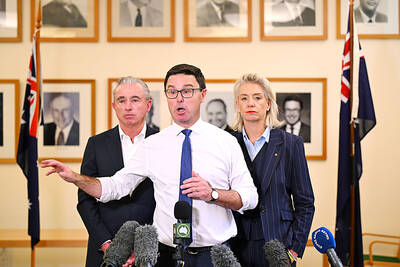
BACKLASH: The National Party quit its decades-long partnership with the Liberal Party after their election loss to center-left Labor, which won a historic third term Australia’s National Party has split from its conservative coalition partner of more than 60 years, the Liberal Party, citing policy differences over renewable energy and after a resounding loss at a national election this month. “Its time to have a break,” Nationals leader David Littleproud told reporters yesterday. The split shows the pressure on Australia’s conservative parties after Prime Minister Anthony Albanese’s center-left Labor party won a historic second term in the May 3 election, powered by a voter backlash against US President Donald Trump’s policies. Under the long-standing partnership in state and federal politics, the Liberal and National coalition had shared power

CONTROVERSY: During the performance of Israel’s entrant Yuval Raphael’s song ‘New Day Will Rise,’ loud whistles were heard and two people tried to get on stage Austria’s JJ yesterday won the Eurovision Song Contest, with his operatic song Wasted Love triumphing at the world’s biggest live music television event. After votes from national juries around Europe and viewers from across the continent and beyond, JJ gave Austria its first victory since bearded drag performer Conchita Wurst’s 2014 triumph. After the nail-biting drama as the votes were revealed running into yesterday morning, Austria finished with 436 points, ahead of Israel — whose participation drew protests — on 357 and Estonia on 356. “Thank you to you, Europe, for making my dreams come true,” 24-year-old countertenor JJ, whose

NO EXCUSES: Marcos said his administration was acting on voters’ demands, but an academic said the move was emotionally motivated after a poor midterm showing Philippine President Ferdinand Marcos Jr yesterday sought the resignation of all his Cabinet secretaries, in a move seen as an attempt to reset the political agenda and assert his authority over the second half of his single six-year term. The order came after the president’s allies failed to win a majority of Senate seats contested in the 12 polls on Monday last week, leaving Marcos facing a divided political and legislative landscape that could thwart his attempts to have an ally succeed him in 2028. “He’s talking to the people, trying to salvage whatever political capital he has left. I think it’s

A documentary whose main subject, 25-year-old photojournalist Fatima Hassouna, was killed in an Israeli airstrike in Gaza weeks before it premiered at Cannes stunned viewers into silence at the festival on Thursday. As the cinema lights came back on, filmmaker Sepideh Farsi held up an image of the young Palestinian woman killed with younger siblings on April 16, and encouraged the audience to stand up and clap to pay tribute. “To kill a child, to kill a photographer is unacceptable,” Farsi said. “There are still children to save. It must be done fast,” the exiled Iranian filmmaker added. With Israel


 RSS
RSS