


Israeli restrictions on movement in the West Bank and Gaza could neutralize increased aid to the Palestinians, aid groups warned, but the Palestinian prime minister said he failed to win a pledge from Israel to ease the measures.
Israeli roadblocks in the West Bank and a virtual quarantine of Gaza were on the table on Thursday when Palestinian Prime Minister Salam Fayyad met Israeli Defense Minister Ehud Barak.
Israel maintains dozens of checkpoints and roadblocks in the West Bank, saying they're needed to keep out Palestinian attackers, including suicide bombers. Already tight restrictions on Gaza were increased after the Islamic militant Hamas overran the territory in June.
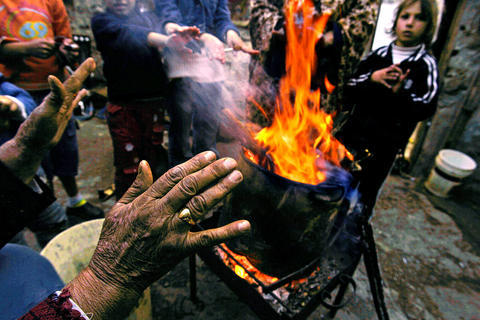
PHOTO: AP
Gaza was the focus of violence on Thursday when rocket fired by Gaza militants hit a house in the Israeli border town of Sderot and seriously injured an Israeli woman.
The incoming UN Middle East envoy, Robert Serry, denounced Thursday's rocket attack in unusually strong terms. "Let me be clear about this: We consider that to be terrorist acts," he said.
A few hours later, Israeli aircraft blew up a car in Gaza City, killing three militants, Palestinians said. The Israeli military said the target was a Palestinian cell that fired rockets at Israel earlier.
After their meeting, Fayyad was asked if Barak agreed to ease the travel restrictions. "It's a one-word answer -- no," Fayyad said.
`"Donors are being asked to fund the Palestinian Authority, whose funding needs are at least in part caused by these [Israeli] restrictions," he said. "Clearly, the tradeoff is there for everyone to see."
Next week in Paris, nations that have donated funds to the Palestinians in the past are set to meet. They will hear a request for US$5.6 billion in new aid.
But the World Bank warned that unless the Israeli restrictions are eased, additional aid may be a waste of money. Another international aid group, Oxfam, echoed that conclusion.
Even if the donors pay the full amount, the Palestinian economy would keep shrinking by about 2 percent a year as long as the Israeli restrictions remain in place, the World Bank wrote in a report on Thursday.
Oxfam said aid projects are stuck because Israel is not allowing raw materials into Gaza.
Israel supports the donors' efforts and has an interest in seeing the Palestinian economy recover, government spokesman Mark Regev said on Thursday. Regev said that if restrictions are eased too quickly, Palestinian militants trying to torpedo peace efforts could carry out more attacks. Talks on a final peace deal resumed on Wednesday.
In Geneva, the International Committee of the Red Cross (ICRC) said that the humanitarian situation in the Palestinian territories is worsening. Gaza's situation is particularly dire.
Referring to the donors' conference, the ICRC called for immediate political action to alleviate the suffering. The Red Cross rarely addresses conflict parties so openly, preferring instead to raise its concerns through less public channels.
"The measures imposed by Israel come at an enormous humanitarian cost, leaving the people living under occupation with just enough to survive, but not enough to live a normal and dignified life," said Beatrice Megevand Roggo, ICRC's head of operations for the Middle East.
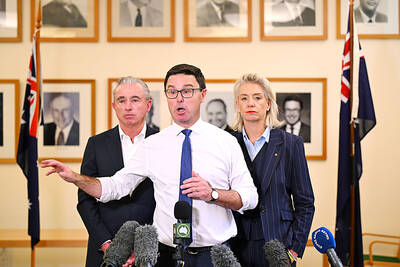
BACKLASH: The National Party quit its decades-long partnership with the Liberal Party after their election loss to center-left Labor, which won a historic third term Australia’s National Party has split from its conservative coalition partner of more than 60 years, the Liberal Party, citing policy differences over renewable energy and after a resounding loss at a national election this month. “Its time to have a break,” Nationals leader David Littleproud told reporters yesterday. The split shows the pressure on Australia’s conservative parties after Prime Minister Anthony Albanese’s center-left Labor party won a historic second term in the May 3 election, powered by a voter backlash against US President Donald Trump’s policies. Under the long-standing partnership in state and federal politics, the Liberal and National coalition had shared power

CONTROVERSY: During the performance of Israel’s entrant Yuval Raphael’s song ‘New Day Will Rise,’ loud whistles were heard and two people tried to get on stage Austria’s JJ yesterday won the Eurovision Song Contest, with his operatic song Wasted Love triumphing at the world’s biggest live music television event. After votes from national juries around Europe and viewers from across the continent and beyond, JJ gave Austria its first victory since bearded drag performer Conchita Wurst’s 2014 triumph. After the nail-biting drama as the votes were revealed running into yesterday morning, Austria finished with 436 points, ahead of Israel — whose participation drew protests — on 357 and Estonia on 356. “Thank you to you, Europe, for making my dreams come true,” 24-year-old countertenor JJ, whose

NO EXCUSES: Marcos said his administration was acting on voters’ demands, but an academic said the move was emotionally motivated after a poor midterm showing Philippine President Ferdinand Marcos Jr yesterday sought the resignation of all his Cabinet secretaries, in a move seen as an attempt to reset the political agenda and assert his authority over the second half of his single six-year term. The order came after the president’s allies failed to win a majority of Senate seats contested in the 12 polls on Monday last week, leaving Marcos facing a divided political and legislative landscape that could thwart his attempts to have an ally succeed him in 2028. “He’s talking to the people, trying to salvage whatever political capital he has left. I think it’s

A documentary whose main subject, 25-year-old photojournalist Fatima Hassouna, was killed in an Israeli airstrike in Gaza weeks before it premiered at Cannes stunned viewers into silence at the festival on Thursday. As the cinema lights came back on, filmmaker Sepideh Farsi held up an image of the young Palestinian woman killed with younger siblings on April 16, and encouraged the audience to stand up and clap to pay tribute. “To kill a child, to kill a photographer is unacceptable,” Farsi said. “There are still children to save. It must be done fast,” the exiled Iranian filmmaker added. With Israel


 RSS
RSS