


While the world holds its breath to know who will succeed Russian President Vladimir Putin, Russia's most famous astrologist says the answer is already in the planets.
Gazing into a laptop computer, rather than a crystal ball, Pavel Globa predicted that Putin would pick either First Deputy Prime Minister Dmitry Medvedev or Prime Minister Viktor Zubkov to replace him in an election on March 2.
Why? Because next year is the Year of the Rat in the Chinese zodiac, which historically favors uncharismatic figures like the gray Medvedev and even more gray Zubkov, Globa told journalists at a Moscow hotel.
"They don't stand out. No one really knows what they're saying, but they seem to be doing something. That's the rat," he says.
Putin's intentions remain one of politics' greatest enigmas. Most analysts think the former KGB officer will handpick a close ally to fill his Kremlin seat -- with Medvedev and Zubkov believed to be high among the secret candidates.
But few analysts would dare show the confidence of Globa, a small and dapper man of 54 whose often rambling predictions for next year held in thrall an entourage of half a dozen female acolytes, aides and astrologers.
Globa claims an 85 percent success rate, including predictions of the Soviet collapse, the Chernobyl nuclear disaster, and the Sept. 11, 2001, attacks.
The veiled magicians and mediums crowding Russia's tabloid newspaper classifieds aren't for him or his followers.
"Astrology is not about crystal balls and cards," sniffed Globa fan Tatyana Dadasheva. "Well, there is a branch of astrology that deals with palms ... In fact you can also read legs, birthmarks, anything. But we don't look in crystal balls."
Certainly Globa's special computer program, combining birth dates with terrestrial and celestial data into a zodiac circle crossed by intersecting lines, left no doubt.
"It's either Zubkov or Medvedev. The winner will be a puppet to our president who will step down but retain a huge role," he said.
The real uncertainty for Russia will follow, he warned, since the Year of the Rat always brings hope for change, followed by disillusion.
"1936 was the year of the rat and it seemed a quiet year. Hitler was still rising to power, Stalin hadn't launched into his excesses," said Globa, now living in Berlin.
"2008 will be the illusion of hope and change. We will put our hopes in the year [but] Russia needs to prepare for crisis in 2012," he said.
The good news, according to Globa, is that if Russia can hang on another few decades, a "future heaven" awaits.
Global warming means that currently chilly Russia will "enter a rather comfortable situation with a better climate, a population explosion, and a country where you can grow lemons, pineapples, champagne."
Predictions for Globa's future might not be so rosy, though.
He shot to popularity after the Soviet collapse of 1991 when people were desperate to know their fate and astrologers were free of stifling Soviet restrictions.
However, the pendulum has swung back and although Globa still has a five-minute slot early in the morning on the TNT cable channel in Russia, he's lived in Germany for the last nine years.
In Russia many people say "astrology is nonsense, charlatanism, or the devil's work," he says.
Alexander Sviyazh, a Moscow psychologist, said there are simply fewer takers for fortune-tellers in Putin's Russia.
"It was hugely in demand during the 1990s because everything was uncertain," he said.
Now "people are more materialistic. People who are not desperate ignore it. Only people with some extra money can afford to fantasize and get their horoscopes done, but for fun," he said.
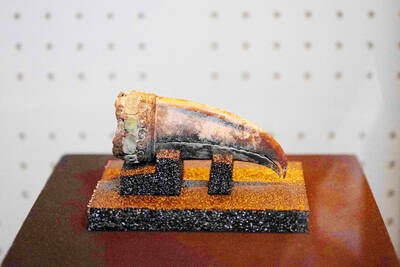
Archeologists in Peru on Thursday said they found the 5,000-year-old remains of a noblewoman at the sacred city of Caral, revealing the important role played by women in the oldest center of civilization in the Americas. “What has been discovered corresponds to a woman who apparently had elevated status, an elite woman,” archeologist David Palomino said. The mummy was found in Aspero, a sacred site within the city of Caral that was a garbage dump for more than 30 years until becoming an archeological site in the 1990s. Palomino said the carefully preserved remains, dating to 3,000BC, contained skin, part of the

TRUMP EFFECT: The win capped one of the most dramatic turnarounds in Canadian political history after the Conservatives had led the Liberals by more than 20 points Canadian Prime Minister Mark Carney yesterday pledged to win US President Donald Trump’s trade war after winning Canada’s election and leading his Liberal Party to another term in power. Following a campaign dominated by Trump’s tariffs and annexation threats, Carney promised to chart “a new path forward” in a world “fundamentally changed” by a US that is newly hostile to free trade. “We are over the shock of the American betrayal, but we should never forget the lessons,” said Carney, who led the central banks of Canada and the UK before entering politics earlier this year. “We will win this trade war and
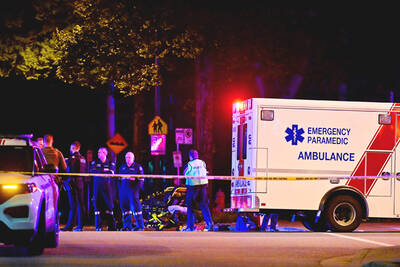
‘BODIES EVERYWHERE’: The incident occurred at a Filipino festival celebrating an anti-colonial leader, with the driver described as a ‘lone suspect’ known to police Canadian police arrested a man on Saturday after a car plowed into a street party in the western Canadian city of Vancouver, killing a number of people. Authorities said the incident happened shortly after 8pm in Vancouver’s Sunset on Fraser neighborhood as members of the Filipino community gathered to celebrate Lapu Lapu Day. The festival, which commemorates a Filipino anti-colonial leader from the 16th century, falls this year on the weekend before Canada’s election. A 30-year-old local man was arrested at the scene, Vancouver police wrote on X. The driver was a “lone suspect” known to police, a police spokesperson told journalists at the
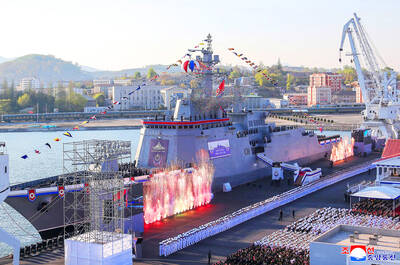
North Korean leader Kim Jong-un has unveiled a new naval destroyer, claiming it as a significant advancement toward his goal of expanding the operational range and preemptive strike capabilities of his nuclear-armed military, state media said yesterday. North Korea’s state-run Korean Central News Agency (KCNA) said Kim attended the launching ceremony for the 5,000-tonne warship on Friday at the western port of Nampo. Kim framed the arms buildup as a response to perceived threats from the US and its allies in Asia, who have been expanding joint military exercises amid rising tensions over the North’s nuclear program. He added that the acquisition


 RSS
RSS