


The US says it will not alter plans to build a missile defense system in Europe despite findings by US intelligence agencies that Iran does not have an active nuclear weapons program.
Since US officials have said the threat from Iran was the main reason for building the defense shield, however, the US may have a harder time persuading European allies that it still is necessary.
Already, a Czech official responsible for explaining the need for the missile defense system to the public in his country says his job has become more difficult after the US National Intelligence Estimate (NIE) on Iran was released on Monday. The report, reflecting analyses of all 16 US intelligence agencies, concluded that Iran suspended its attempt to build a nuclear weapon four years ago.
"Czech newspapers are full of headlines saying there is no longer a need for missile defense," said Tomas Klvana, the Czech government's coordinator for missile defense communication, who is in Washington for talks with administration officials and lawmakers. "It is hard for complex arguments to win against simple headlines."
Klvana says that the potential threat from ballistic missiles aimed at Europe remains whether Iran is pursuing nuclear weapons or not.
That view is shared by the Bush administration.
"The missile threat from Iran continues to progress and to cause us to be very concerned," said US Undersecretary of State John Rood, lead US negotiator on European missile defense issues. "Missile defense would be useful regardless of what kind of payload, whether that be conventional, chemical, biological or nuclear."
Rood said the US still hopes to build the system that would include radar installations in the Czech Republic and interceptors based in Poland and have it online by 2013.
The US has said that those sites were chosen to position the system to counter a threat from Iran, but Russia has objected strenuously to the plans, arguing that the system could undermine the deterrence of its nuclear arsenal. The disagreement has led to the worst friction in US-Russian relations since the Cold War.
On Tuesday, Rood reiterated the US position on the threat from Iran in talks with one of the most vocal critics of the US plans, Russian Army Chief of Staff General Yuri Baluyevsky. Baluyevsky is in Washington at the invitation of his US counterpart, the chairman of the Joint Chiefs of Staff, Admiral Mike Mullen.
Rood has pointed to Iran's announcement this month that it has manufactured new missiles with a range of 2,000km. That distance would put parts of southeastern Europe in targeting range. US officials have said they recently provided Russia with intelligence on the developments in Iran's missile program.
US Democratic Representative Ellen Tauscher, who a heads a congressional panel that has steered money bills for US missile defense programs, also says that the NIE will not affect funding considerations for the project.
"The NIE does not play into our consideration," she said. "Nothing has changed."
Tauscher successfully pushed to withhold financing for construction of the site in Poland in a bill passed last month that provided most of the money requested by the Bush administration for the overall program. She said she would consider seeking to restore it if the interceptor system were tested properly and if the administration won approval for the plans from the Polish and Czech governments.
That effort now seems more complicated by a perception in those countries that the administration has oversold the threat from Iran.
"The United States has been adamant in not tying missile defense plans in Europe to a threat from Russia," said Julianne Smith, director of the Center for Strategic and International Studies' Europe program. "If you knock down the threat from Iran, it complicates the communications strategy."
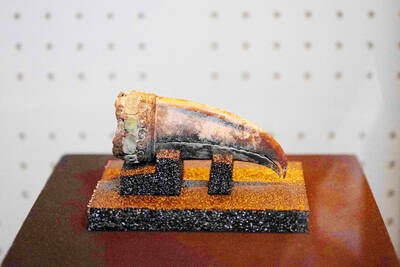
Archeologists in Peru on Thursday said they found the 5,000-year-old remains of a noblewoman at the sacred city of Caral, revealing the important role played by women in the oldest center of civilization in the Americas. “What has been discovered corresponds to a woman who apparently had elevated status, an elite woman,” archeologist David Palomino said. The mummy was found in Aspero, a sacred site within the city of Caral that was a garbage dump for more than 30 years until becoming an archeological site in the 1990s. Palomino said the carefully preserved remains, dating to 3,000BC, contained skin, part of the

TRUMP EFFECT: The win capped one of the most dramatic turnarounds in Canadian political history after the Conservatives had led the Liberals by more than 20 points Canadian Prime Minister Mark Carney yesterday pledged to win US President Donald Trump’s trade war after winning Canada’s election and leading his Liberal Party to another term in power. Following a campaign dominated by Trump’s tariffs and annexation threats, Carney promised to chart “a new path forward” in a world “fundamentally changed” by a US that is newly hostile to free trade. “We are over the shock of the American betrayal, but we should never forget the lessons,” said Carney, who led the central banks of Canada and the UK before entering politics earlier this year. “We will win this trade war and
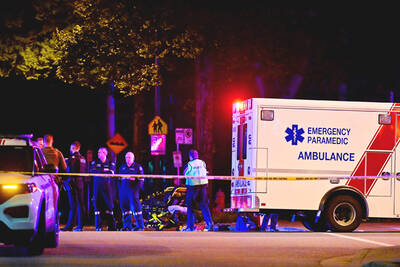
‘BODIES EVERYWHERE’: The incident occurred at a Filipino festival celebrating an anti-colonial leader, with the driver described as a ‘lone suspect’ known to police Canadian police arrested a man on Saturday after a car plowed into a street party in the western Canadian city of Vancouver, killing a number of people. Authorities said the incident happened shortly after 8pm in Vancouver’s Sunset on Fraser neighborhood as members of the Filipino community gathered to celebrate Lapu Lapu Day. The festival, which commemorates a Filipino anti-colonial leader from the 16th century, falls this year on the weekend before Canada’s election. A 30-year-old local man was arrested at the scene, Vancouver police wrote on X. The driver was a “lone suspect” known to police, a police spokesperson told journalists at the
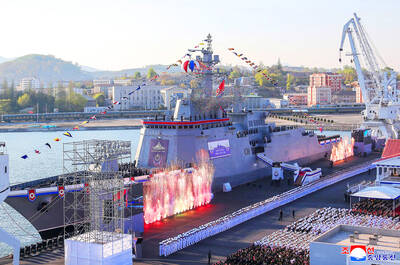
North Korean leader Kim Jong-un has unveiled a new naval destroyer, claiming it as a significant advancement toward his goal of expanding the operational range and preemptive strike capabilities of his nuclear-armed military, state media said yesterday. North Korea’s state-run Korean Central News Agency (KCNA) said Kim attended the launching ceremony for the 5,000-tonne warship on Friday at the western port of Nampo. Kim framed the arms buildup as a response to perceived threats from the US and its allies in Asia, who have been expanding joint military exercises amid rising tensions over the North’s nuclear program. He added that the acquisition


 RSS
RSS