


Church officials said Mexico City's world-renowned cathedral reopened yesterday, six days after more than 100 protesters barged into the cavernous building and interrupted Sunday Mass.
A new city plan to guarantee the cathedral's security persuaded church leaders to reopen the religious landmark, the Archdiocese of Mexico said in a statement.
"We trust that there won't be any more acts that put people at risk and desecrate the sacred grounds of the metropolitan cathedral," it said.
Protesters burst into the building on Nov. 18, angry that its bells seemed to toll longer than normal, drowning out a speech at a rally outside in favor of former leftist presidential candidate Andres Manuel Lopez Obrador.
Roman Catholic officials said the call to Mass was routine and not designed to interrupt the rally. Rivera closed the building to the public for "security" reasons, they said.
But the Latin American Episcopal Council questioned the closure, calling the Archdiocese's pretext for the shutdown "totally absurd."
In a letter released on Friday, the council called on Cardinal Norberto Rivera to reopen the cathedral so that "Mexico's faithful can use it."
Mexico City Mayor Marcelo Ebrard on Monday promised to assign a special police unit to the cathedral and install security cameras around and inside the building.
Ebrard had increased security at Rivera's request weeks ago, after several smaller political protests were held inside the cathedral building.
But Sunday's demonstrators blew past police officers, startling churchgoers and overturning pews as Lopez Obrador's rally continued outside on the country's largest square.
Lopez Obrador claims that Mexican President Felipe Calderon robbed him of last year's narrowly won presidential election and his backers are wary of the church's strong ties with Calderon's conservative National Action Party.
This week marked the first time the cathedral had been closed since 1926, when tensions over Mexico's harsh anti-clerical laws broke into armed conflict between the government and Catholic rebels in the bloody, three-year Cristero War.
All Mexican churches were closed during that conflict.

Crowds in Bangladesh are flocking to snap photographs with an unlikely social media star — an albino buffalo with flowing blond hair nicknamed “Donald Trump” that is due to be sacrificed within days. Owner Zia Uddin Mridha, 38, said his brother named the 700kg bull over its flowing helmet of hair resembling the signature look of the US president. “My younger brother picked this name because of the buffalo’s extraordinary hair,” he said at his farm in Narayanganj, just outside the capital, Dhaka. Mridha said that a constant stream of curious visitors — social media fans, onlookers and children — have come throughout
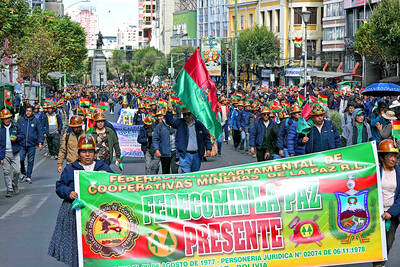
The Bolivian government on Friday struck a deal with protesting miners, but was still grappling with blockades and demonstrations by other workers across La Paz. Other groups are still blocking access roads into the city, which is also the seat of the government. Police on Thursday prevented the miners from entering the main square by using tear gas, while the demonstrators hurled stones and explosives with slingshots. Protests against the policies of Bolivian President Rodrigo Paz have convulsed the Andean nation since early this month, and roadblocks were choking routes into La Paz throughout Friday, the national road authority said. Miners demanded that Paz
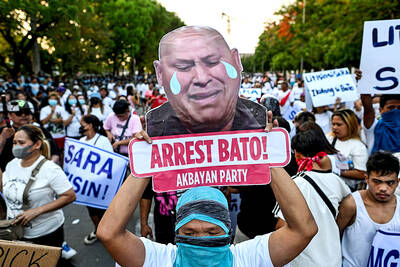
The Philippines said it has asked the country’s Supreme Court to allow it to arrest former Philippine president Rodrigo Duterte’s chief drug war enforcer to stand trial in an international tribunal. The International Criminal Court (ICC) last week unsealed an arrest warrant against Philippine Senator Ronald dela Rosa, accusing him along with Duterte and other “coperpetrators” of the “crime against humanity of murder.” Dela Rosa briefly sought refuge in the Philippine Senate last week while asking the Philippine Supreme Court to stop an ongoing attempt by government agents to arrest him. “By his own conduct, he has placed himself outside the protection of

The researchers in Ireland looked at their computer screen, marveling at a medieval book tracked down in a Roman library. They flipped through its digitized pages and found their sought-after treasure: the oldest surviving English poem. “We were extremely surprised. We were speechless. We couldn’t believe our eyes when we first saw that,” said Elisabetta Magnanti, a visiting research fellow at Trinity College Dublin’s school of English. The poem was also within the main body of Latin text, she said, calling it “extraordinary.” Composed in Old English by a Northumbrian agricultural worker in the 7th century, Caedmon’s Hymn appears within some copies of


 RSS
RSS