

Tough talk on Iran's nuclear program has raised the specter of a possible US attack, but tensions between the two diplomatic foes nevertheless appear to have eased on the issue of securing Iraq.
Iranian Foreign Minister Manouchehr Mottaki said on Tuesday that Iran had accepted an invitation by Washington for a fourth round of bilateral talks on curbing bloodshed in Iran's violence-wracked western neighbor.
"Iran has agreed with this request within the framework of its policy of helping the Iraqi people," Mottaki told reporters.
"The exact date of the fourth round of the talks will be announced in the near future" in Iraq, he said.
He said that Washington had requested the new talks through the Swiss embassy in Tehran, which looks after US interests in Iran in the absence of a US mission.
The US broke off diplomatic ties with Iran in the aftermath of the 1979 Islamic revolution.
US State Department spokesman Sean McCormack confirmed the talks were planned but did not specify a date.
"We have communicated to the Iranian Government that we are agreeable to that. We have not yet received back a reply," he told reporters on Tuesday.
"We are open to using this channel as a way of talking directly about important issues concerning security in Iraq. We don't yet have a date," he said.
A major source of diplomatic tension between Washington and Tehran is Iran's nuclear program. The US has stepped up sanctions on Tehran to punish it for what it believes is a drive to make nuclear arms.
Iran insists its uranium enrichment activities are aimed at generating power for civilian use.
US President George W. Bush last month raised the prospect of a "World War III" if Iran acquires the knowledge to build nuclear weapons.
Vice President Dick Cheney later warned of "serious consequences" if Iran continues to enrich uranium.
Such rhetoric is not expected to feature in the next Iraq talks, however.
The US has accused Iran of arming Shiite insurgents who have killed US troops in Iraq, but progress on this front has been reported in recent weeks.
US General James Simmons, a deputy corps commander in Iraq, said on Nov. 15 that Iran appeared to be holding to its pledge to stem the flow of arms into Iraq, contributing to a sharp fall in roadside bomb attacks there in recent months.
He said that there was no evidence that the flow of weapons across the border form Iran was continuing.
"We believe that this indicates the commitments Iran has made appear to be holding up," the general said.
In another possible sign of diplomatic detente over Iraq, nine Iranians held there on suspicion of aiding insurgents were freed by the US military this month, including two members of Iran's elite al-Quds force.
A senior Iraqi Shiite leader, Abdel Aziz al-Hakim, later said he had information from US officials that more Iranians would soon be released. Iran also opened two consulates in the main Iraqi Kurdish towns of Erbil and Sulaimaniyah.
In another significant diplomatic move, meanwhile, Washington shelved a controversial US$75 million funding package for Iranian political groups opposed to the regime in Tehran.
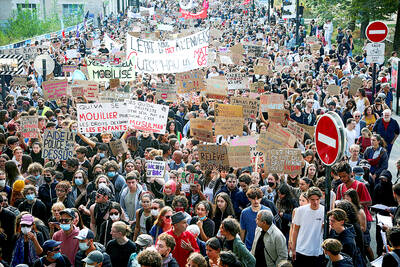
VIOLENT STANDOFFS: The government said 215 students have been injured since the start of the movement last month, including a teenager who lost a hand on Monday Thousands of demonstrators yesterday massed under heavy police surveillance in Paris and cities across France, as unions and teachers joined high-school students who for days have been demanding better conditions in protests punctuated by violent clashes. Students have blocked the entrances to hundreds of high schools for 15-to-17-year-olds since late last month, complaining of missing teachers, overloaded schedules, dilapidated classrooms and buildings that cannot cope with rising temperatures. In the Paris suburb of Creteil, where the protests started last month, students piled barriers outside the Saint-Exupery high school. “We are here to make our voice heard, all too often forgotten,” student Abderrahmane Abdelkader

As shark attack survivor Mel Ismail fought the predator that severed his leg, he noticed something odd. “I saw its eye ... a big black eye,” Ismail said. “But it was winking back at me — I was trying to get my fingers in its eye and just pushing its eye as I was being dragged.” When the shark swam off, he managed to struggle back to shore, the surfer and professional firefighter said in an Australian Broadcasting Corp interview broadcast on Thursday. He was surfing at Glenfield Beach near Geraldton on Australia’s west coast when he was attacked on Sept. 14. He
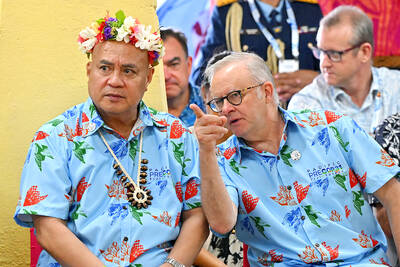
A Tuvalu government adviser yesterday said it felt like Australia had “taken over” the tiny country’s sovereignty during a visit by leaders to the Pacific island. The official — a senior government adviser who asked to remain anonymous because they were not authorized to speak to the media — said they were disappointed in Australia’s handling of the visit. The comments came during a visit by Australian Prime Minister Anthony Albanese and other leaders to Tuvalu, which has become a symbol of the existential threat posed by rising seas and is a key partner in Canberra’s Pacific strategy. “Just because we signed the

Halfway around the world from Russia, in a Caribbean tourism hot spot, men young and old are being lured by Moscow with tantalizing job offers, only to find themselves en route to the front lines in Ukraine. Moscow and Kyiv have recruited thousands of foreign nationals into their armies since Russia launched its invasion of Ukraine in 2022. Moscow is accused, in some cases, of using fake job ads to hoodwink men from deprived backgrounds in Africa, Asia and Latin America into traveling to Russia and then forcing them to fight on arrival. From countries such as India, Kenya, Equatorial Guinea, Colombia and


 RSS
RSS