

Just outside the gates of the vast Zasyadko mine, men accustomed to digging coal took up a grimmer job -- digging graves for colleagues killed in post-Soviet Ukraine's worst mining disaster.
A methane blast ripped through tunnels hundreds of meters below ground on Sunday, killing at least 90 people and rending hearts throughout the city at the center of Ukraine's vital but troubled coal industry.
Flags flew at half-staff nationwide on Tuesday. Hope of finding anyone still alive underground virtually vanished; 10 miners remain unaccounted for.
"Of course, this is a mournful day for all of us -- we are digging graves for our dead comrades," mine electrician Stanislav Omelyanenko said at a cemetery just outside the grounds of the mine.
At that cemetery and others, 17 of the victims were buried on Tuesday.
Zasyadko, one of Ukraine's biggest and best-known mines, has been the site of repeated accidents in the past decade. Ukraine's mines, regarded as among the world's most dangerous, are an important element of the country's economy.
The previous highest death toll in a Ukrainian mine was 81 killed in an explosion in the Luhansk region in 2000.
The bodies pulled from the area where the remaining miners were believed to have been trapped were burnt, indicating that others could not have survived, Mykhailo Volynets, the head of the Independent Trade Union of Miners, said on Monday.
"Unfortunately, there is no hope," Volynets said.
Tuesday was declared a day of mourning across the nation of 47 million. President Viktor Yushchenko, who visited Donetsk on Monday, ordered a government commission to investigate the accident and called for an overhaul of the coal mining sector.
More than three-quarters of Ukraine's roughly 200 coal mines are classified as dangerous because of high levels of methane, the concentration of which increases with depth. Mines must be ventilated to prevent explosions, but some rely on outdated ventilation equipment.
Deputy Prime Minister Andriy Klyuyev said that wasn't the case at Zasyadko.
"This is one of the most advanced mines, and it has the most modern methods of protection against methane," Klyuyev said. "Unfortunately, the deeper the mine, the more problems we encounter."
Experts say Ukraine's mines are dangerous largely because they are so deep, typically running more than 1,000m underground. Most European coal beds lie at a depth of 500m to 600m.
Volynets said that Ukrainian mines routinely neglect safety rules and workers are paid by the amount of coal they extract, not by the hour.

Japan has started its first nationwide survey of animal cafes amid concerns over animal welfare, hygiene and public health, a government official said, bringing greater scrutiny to the popular but lightly regulated sector. The desktop survey, which began this month, will examine the number of facilities, the types of animals they house and the conditions they are held in, and how visitors interact with the animals. Exotic animal cafes, where visitors can interact with species ranging from otters to owls and marmots, have become popular attractions for Japanese and foreign tourists. However, researchers say some facilities keep threatened species, raising
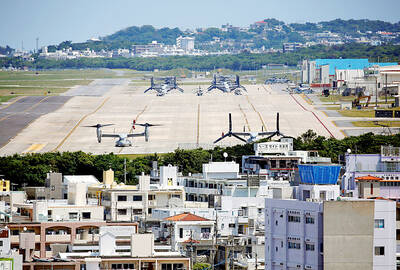
STRAIN ON TIES: The police arrested a 20-year-old man who matched the description of a suspect caught on CCTV leaving a hotel in Naha with the victim’s belongings A US Marine stationed on Japan’s southern island of Okinawa was arrested on suspicion of the murder of a Japanese woman, police said yesterday. The suspect “killed the 39-year-old woman at a hotel in Naha and stole her wallet on Saturday,” a local police spokesman said. US Ambassador George Glass posted on social media that he had spoken with Japan’s foreign ministry and Okinawa’s governor to offer “our sincere condolences and pledging full cooperation as the investigation continues.” Japanese Prime Minister Sanae Takaichi called the crime “exceptionally brutal and vicious” on X. The government has urged the US “to provide maximum cooperation

A US lawmaker has called on Starbucks to close its first stores in Xinjiang, China, calling it a “morally bankrupt decision” to do business in a region where Uighurs face repression. China denies widespread accusations about abuses of the Uighurs, a mainly Muslim people, saying its policies there were aimed at combating terrorism, separatism and religious extremism. Starbucks opened its first two stores this week in Xinjiang’s capital, Urumqi, including one at the city centre’s grand bazaar and a second at its international airport. John Moolenaar, chairman of the Select Committee on China of the House of Representatives, called on Starbucks to “immediately
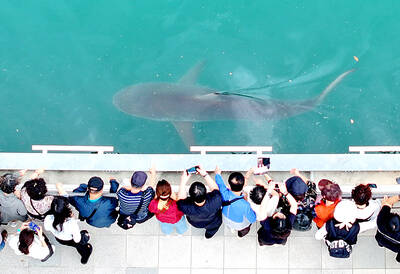
A shark stranded in a canal in the South Korean port of Busan has become the country’s latest wildlife sensation, with the city saying about 600,000 people have flocked to see it over the past two weeks. The 3.5m shark was first spotted in a narrow waterway in North Port on Sept. 18. As the days passed without the shark finding its way back to the ocean, authorities on Tuesday launched a rescue operation to guide it out, but the effort failed. The South Korean Coast Guard and other agencies deployed vessels to spray jets of water behind the shark


 RSS
RSS