

Iranian Kurds living in a sprawling refugee camp in Kurdish north Iraq dream of returning home, voicing hope the US will use its might to overthrow the Tehran regime and make that wish come true.
Close to 500 Iranian Kurds, including 150 children, are crammed in clay or breeze-block dwellings in the Zejnikan camp, 20km north of Arbil, in northern Iraq.
For most of the camp elders, home is an elusive dream they fled more than 25 years ago after many of them took up arms against Iran's Shiite clerical regime in a fight for autonomy.
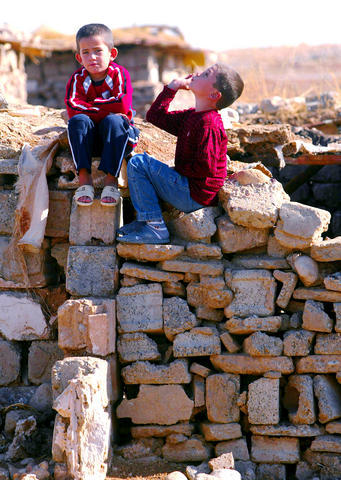
PHOTO: AFP
Amine Omar was 18 when she left her village. Now she is 36.
"We thought we would be gone for a year or two," she said sadly. "The Iranian soldiers were getting closer to the village. Our men were peshmerga [Kurdish fighters] and would have been killed."
During the first four years of their exile, home was a tent pitched in northern Iraq. Then they were moved to Zejnikan near the village of Baharka.
The Iranian Kurds were settled in a village that had been built by the ousted Iraqi regime of Saddam Hussein to house unruly Iraqi Kurds whose villages had been razed because they refused to bow to his rule.
NEW KEYS
Years later the regional Kurdish government has built 70 houses for the Iranian Kurds and the refugees are due to get the keys to their new homes within a month.
"We will be fine here but we want to go back home. I am hopeful. One day we will return," said Amine.
Mustafa Maanaf, a former peshmerga fighter, firmly believes that the US government holds his ticket home.
"We gave up the armed struggle so as not to embarrass our hosts, the Kurdish government in Iraq.
"The regime of the [Iranian] clerics will fall but this will only be possible through US military intervention like what happened here.
"It is our only hope," said the 40-year-old Maanaf who survives on a US$75 monthly handout from the Kurdistan Democratic Party of Iran and money he earns working as a mason.
Party representative Mohammed Saleh, who also heads the camp, agrees.
"We are awaiting a popular uprising in Iran backed by the Americans," said the 43-year-old, who dreams of taking his three children born in Iraq back home one day.But the dream is fading as the years go by.
FADED DREAM
Iranian Kurdish children born in Iraq know little to nothing of their ancestral homeland, with fewer having the chance to learn Farsi since they stopped teaching it at the camp school.
Young people are marrying into Kurdish Iraqi families and making roots in northern Iraq, others leave the camp to seek jobs in Arbil while the lucky ones have managed to emigrate to Australia, Sweden and the US.
According to the UN High Commissioner for Refugees, around 11,800 Iranian refugees, most of them Kurds, live in Iraq.
Faring Zrar, 12, is one of them and like his elders he dreams of Iran, which in his mind is closer to Eden.
"When I get older I will go back to Iran," he said. "It's not nice here. It is a desert. But Iran is like a paradise. Some cousins came and they told me: There are trees, rivers. It is beautiful in Iran and there everyone speaks English," he said.
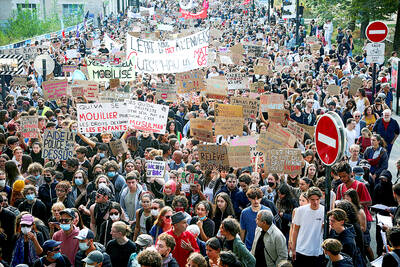
VIOLENT STANDOFFS: The government said 215 students have been injured since the start of the movement last month, including a teenager who lost a hand on Monday Thousands of demonstrators yesterday massed under heavy police surveillance in Paris and cities across France, as unions and teachers joined high-school students who for days have been demanding better conditions in protests punctuated by violent clashes. Students have blocked the entrances to hundreds of high schools for 15-to-17-year-olds since late last month, complaining of missing teachers, overloaded schedules, dilapidated classrooms and buildings that cannot cope with rising temperatures. In the Paris suburb of Creteil, where the protests started last month, students piled barriers outside the Saint-Exupery high school. “We are here to make our voice heard, all too often forgotten,” student Abderrahmane Abdelkader

As shark attack survivor Mel Ismail fought the predator that severed his leg, he noticed something odd. “I saw its eye ... a big black eye,” Ismail said. “But it was winking back at me — I was trying to get my fingers in its eye and just pushing its eye as I was being dragged.” When the shark swam off, he managed to struggle back to shore, the surfer and professional firefighter said in an Australian Broadcasting Corp interview broadcast on Thursday. He was surfing at Glenfield Beach near Geraldton on Australia’s west coast when he was attacked on Sept. 14. He

A Tuvalu government adviser yesterday said it felt like Australia had “taken over” the tiny country’s sovereignty during a visit by leaders to the Pacific island. The official — a senior government adviser who asked to remain anonymous because they were not authorized to speak to the media — said they were disappointed in Australia’s handling of the visit. The comments came during a visit by Australian Prime Minister Anthony Albanese and other leaders to Tuvalu, which has become a symbol of the existential threat posed by rising seas and is a key partner in Canberra’s Pacific strategy. “Just because we signed the

Halfway around the world from Russia, in a Caribbean tourism hot spot, men young and old are being lured by Moscow with tantalizing job offers, only to find themselves en route to the front lines in Ukraine. Moscow and Kyiv have recruited thousands of foreign nationals into their armies since Russia launched its invasion of Ukraine in 2022. Moscow is accused, in some cases, of using fake job ads to hoodwink men from deprived backgrounds in Africa, Asia and Latin America into traveling to Russia and then forcing them to fight on arrival. From countries such as India, Kenya, Equatorial Guinea, Colombia and


 RSS
RSS