

The most visited local "landmark" for many British adults is their nearby do-it-yourself (DIY) store, a survey published yesterday said, which suggests the UK is a nation of reluctant explorers, with little sense of adventure and a poor understanding of geography.
A third of those who took part in the survey thought Mount Everest is in Europe, while only half were aware that the Nile is the world's longest river. The research warns that most people are failing to make the most of their local area and have little knowledge of important geographical facts.
The survey was carried out to mark National Geographic's geography awareness week and also the so-called "GIS Day" yesterday, which aims to encourage young people to understand the extent to which geographic information -- and increasingly the opportunity to use technology such as digital mapping -- underpins our daily lives.
The UK was among more than 80 countries which will participate by holding workshops and school assemblies to mark GIS Day.
Asked how many countries there were in the world, only a third were correct in choosing 193. A third of people thought Mount Everest was either in the Alps or the UK and only half of respondents knew that the Nile was the world's longest river.
Asked which facility had been visited the most during the past month, the DIY superstore came top with 39 percent. The local museum was bottom with only 9 percent. Almost a third said they had never visited their local museum or church.
Respondents were also asked about what they remembered most about geography lessons at school from a list of eight topics. Maps came top with 24 percent, rocks/erosion and "don't know" were in joint second place with 16 percent and farming in last with 5 percent.
The findings follow a British Council survey carried out earlier this week, which showed that 11-to-16 year olds have the lowest international awareness among their age group in 10 nations.

Japan has started its first nationwide survey of animal cafes amid concerns over animal welfare, hygiene and public health, a government official said, bringing greater scrutiny to the popular but lightly regulated sector. The desktop survey, which began this month, will examine the number of facilities, the types of animals they house and the conditions they are held in, and how visitors interact with the animals. Exotic animal cafes, where visitors can interact with species ranging from otters to owls and marmots, have become popular attractions for Japanese and foreign tourists. However, researchers say some facilities keep threatened species, raising

STRAIN ON TIES: The police arrested a 20-year-old man who matched the description of a suspect caught on CCTV leaving a hotel in Naha with the victim’s belongings A US Marine stationed on Japan’s southern island of Okinawa was arrested on suspicion of the murder of a Japanese woman, police said yesterday. The suspect “killed the 39-year-old woman at a hotel in Naha and stole her wallet on Saturday,” a local police spokesman said. US Ambassador George Glass posted on social media that he had spoken with Japan’s foreign ministry and Okinawa’s governor to offer “our sincere condolences and pledging full cooperation as the investigation continues.” Japanese Prime Minister Sanae Takaichi called the crime “exceptionally brutal and vicious” on X. The government has urged the US “to provide maximum cooperation

A US lawmaker has called on Starbucks to close its first stores in Xinjiang, China, calling it a “morally bankrupt decision” to do business in a region where Uighurs face repression. China denies widespread accusations about abuses of the Uighurs, a mainly Muslim people, saying its policies there were aimed at combating terrorism, separatism and religious extremism. Starbucks opened its first two stores this week in Xinjiang’s capital, Urumqi, including one at the city centre’s grand bazaar and a second at its international airport. John Moolenaar, chairman of the Select Committee on China of the House of Representatives, called on Starbucks to “immediately
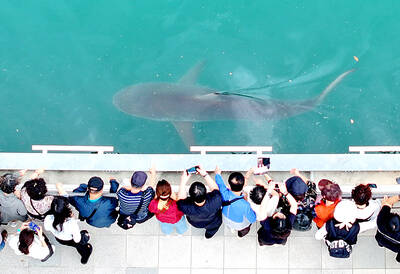
A shark stranded in a canal in the South Korean port of Busan has become the country’s latest wildlife sensation, with the city saying about 600,000 people have flocked to see it over the past two weeks. The 3.5m shark was first spotted in a narrow waterway in North Port on Sept. 18. As the days passed without the shark finding its way back to the ocean, authorities on Tuesday launched a rescue operation to guide it out, but the effort failed. The South Korean Coast Guard and other agencies deployed vessels to spray jets of water behind the shark


 RSS
RSS