


The space shuttle Discovery landed on Earth on Wednesday, successfully ending one of the trickiest and riskiest missions ever to the International Space Station (ISS).
Under clear blue skies, the shuttle, with its seven crew, landed on schedule at 1:01pm at the Kennedy Space Center in Florida after a mission lasting 15 days, two hours and 23 minutes.
"Congratulations on a tremendous mission and a great landing Pam," the controller based in Mission Control, Houston, said, talking to astronaut Pam Melroy, only the second woman to command a US shuttle.
During their mission, the five men and two women aboard Discovery had completed 238 orbits around the Earth and traveled some 10 million kilometers.
They spent a total of 11 days on the ISS on a complex mission to expand the space station, which is key to US dreams of launching manned missions to Mars.
During its descent back to Earth the shuttle crossed the US from the northwest down to the southeast in Florida, ahead of its landing on the Cape Canaveral runway on the Atlantic coast.
It was the first time the shuttle had crossed from west to east to land since the return of the shuttle Columbia, which blew up as it came back to Earth on Feb. 1, 2003.
All approaches back to the US since then have flown over the Gulf of Mexico.
The Discovery barreled back to Earth in some 62 minutes after leaving orbit, descending at speeds reaching some 9,000m per minute and pushing temperatures on its wings up to 1,500oC.
Launched on Oct. 23, the Discovery's main mission had been to deliver and install the Italian-built Harmony module, a 14.3 tonne piece of equipment that will connect US, European and Japanese science labs on the ISS.
They also began the difficult task of displacing a 16 tonnes truss which will eventually be installed on the station.
Their work paves the way for the European Columbus science lab to be installed in the next shuttle mission early next month, and the Japanese Kibo lab, due to be delivered next year.
The ISS, a US$100 billion project involving 16 countries, is considered crucial to US ambitions for a manned mission to Mars and is set to be complete within three years.
During the mission, the crew also had to undertake a risky, unplanned spacewalk to repair damage to two solar arrays caused when they were unfurled on wings far out from the station.
US astronaut Scott Parazynsky, a medical doctor by training, spent more than four hours on Saturday attached to the end of a robotic boom knitting together the damaged solar panels.
Braving possible electrocution, Parazynsky used makeshift wire "cufflinks" to fix the tears caused by a snagged wire.
Before heading back to Earth, the shuttle flew around the ISS so crew members could take images of the repaired solar antenna.

‘IN A DIFFERENT PLACE’: The envoy first visited Shanghai, where he attended a Chinese basketball playoff match, and is to meet top officials in Beijing tomorrow US Secretary of State Antony Blinken yesterday arrived in China on his second visit in a year as the US ramps up pressure on its rival over its support for Russia while also seeking to manage tensions with Beijing. The US diplomat tomorrow is to meet China’s top brass in Beijing, where he is also expected to plead for restraint as Taiwan inaugurates president-elect William Lai (賴清德), and to raise US concerns on Chinese trade practices. However, Blinken is also seeking to stabilize ties, with tensions between the world’s two largest economies easing since his previous visit in June last year. At the
Nearly half of China’s major cities are suffering “moderate to severe” levels of subsidence, putting millions of people at risk of flooding, especially as sea levels rise, according to a study of nationwide satellite data released yesterday. The authors of the paper, published by the journal Science, found that 45 percent of China’s urban land was sinking faster than 3mm per year, with 16 percent at more than 10mm per year, driven not only by declining water tables, but also the sheer weight of the built environment. With China’s urban population already in excess of 900 million people, “even a small portion

UNSETTLING IMAGES: The scene took place in front of TV crews covering the Trump trial, with a CNN anchor calling it an ‘emotional and unbelievably disturbing moment’ A man who doused himself in an accelerant and set himself on fire outside the courthouse where former US president Donald Trump is on trial has died, police said yesterday. The New York City Police Department (NYPD) said the man was declared dead by staff at an area hospital. The man was in Collect Pond Park at about 1:30pm on Friday when he took out pamphlets espousing conspiracy theories, tossed them around, then doused himself in an accelerant and set himself on fire, officials and witnesses said. A large number of police officers were nearby when it happened. Some officers and bystanders rushed
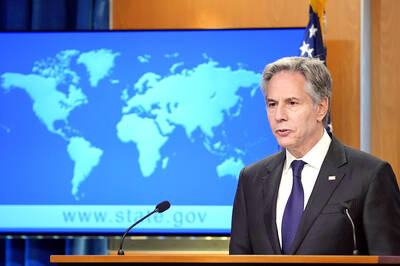
Beijing is continuing to commit genocide and crimes against humanity against Uyghurs and other Muslim minorities in its western Xinjiang province, U.S. Secretary of State Antony Blinken said in a report published on Monday, ahead of his planned visit to China this week. The State Department’s annual human rights report, which documents abuses recorded all over the world during the previous calendar year, repeated language from previous years on the treatment of Muslims in Xinjiang, but the publication raises the issue ahead of delicate talks, including on the war in Ukraine and global trade, between the top U.S. diplomat and Chinese


 RSS
RSS