


London's Metropolitan Police force was found guilty on Thursday of breaching health and safety laws in the fatal 2005 shooting of a Brazilian who officers mistook for a suicide bomber.
The ruling prompted calls for the resignation of police chief Ian Blair, Britain's most senior police officer, who insisted he would not quit, saying officers did their best in a "simply extraordinary situation."
Jean Charles de Menezes, 27, was shot seven times in the head at a London Underground train station on July 22, 2005, with the city still reeling from attacks on the public transport system that killed 52 people two weeks before.
His death came the day after another attempted attack was foiled and police believed de Menezes was Hussain Osman, one of the plotters in that case, who was jailed for life earlier this year.
Prosecutors had argued that de Menezes and members of the public were put at risk because he was allowed on two buses and an underground train while under police observation before being shot dead.
After a jury at London's Central Criminal Court returned its verdict, judge Richard Henriques fined the police force ?175,000 (US$364,000) and ordered it to pay costs of ?385,000.
The Brazilian foreign ministry praised the verdict, saying it had shown the police's "responsibility," and said it "opens the way for new initiatives in favor of the family of the innocent Brazilian citizen."
De Menezes's family, meanwhile, pledged to keep working for justice.
His cousin Alex Pereira said that a guilty verdict was "not enough."
"Those responsible for his death must be held accountable ... we won't stop the fight to obtain justice," he said, calling for a full investigation.
The court decision prompted calls from Britain's two main opposition parties for the police chief to step down in the wake of the affair, while British newspapers vociferously argued that he should offer his resignation.
"Would he show contrition, offer an apology perhaps for such an unmitigated catastrophe?" the Daily Mail wrote in its editorial. "Would he do the proper thing and resign? Not a chance. Until he goes, London's police force cannot hope to restore its good name."
Blair said he would not respond to the calls for his resignation, however, telling reporters outside court that he intended "to continue to lead the Met in its increasingly successful efforts to reduce crime and deter and disrupt terrorist activities."
The force had denied breaching health and safety laws during the month-long trial during which prosecutors alleged a series of "catastrophic" errors of judgment and 19 key failings on the day.
Blair said the force was "unlikely" to appeal against the verdict.
Deputy Assistant Commissioner Cressida Dick, who was in charge of the operation, told the court she had told officers to "stop" de Menezes, meaning challenge or detain, and did not instruct them to shoot him.
She was specifically cleared of wrongdoing by the jury.
The operations room at the time was noisy and chaotic, with officers struggling to hear radio transmissions from the scene, the prosecution said.
A spokesman for British Prime Minister Gordon Brown said he retained confidence in Blair, while Home Secretary Jacqui Smith said he and the force had "my full confidence and our thanks and support in the difficult job that they do."
The chairman of the Metropolitan Police Authority, which oversees the day-to-day running of the force and has the power to fire Blair, also expressed support, stressing the case was not brought against him personally.
This is not the first time Blair has been embroiled in a row over de Menezes's death -- he previously faced an investigation by the police watchdog amid claims he misled the public over the shooting.
A report in August, however, found no evidence to support the complaint.
Last year, British prosecutors ruled out bringing criminal charges against the armed officers who shot de Menezes, citing "insufficient evidence."

Kouri Richins, a Utah mother who published a children’s book about grief after the death of her husband is to serve a life sentence for his murder without the possibility of parole, a judge ruled on Wednesday. Richins was convicted in March of aggravated murder for lacing a cocktail given to her husband, Eric Richins, with five times the lethal dose of fentanyl at their home near Park City in 2022. A jury also found her guilty of four other felonies, including insurance fraud, forgery and attempted murder for trying to poison her husband weeks earlier on Feb. 14, 2022, with a

DELA ROSA CASE: The whereabouts of the senator, who is wanted by the ICC, was unclear, while President Marcos faces a political test over the senate situation Philippine authorities yesterday were seeking confirmation of reports that a top politician wanted by the International Criminal Court (ICC) had fled, a day after gunfire rang out at the Philippine Senate where he had taken refuge fearing his arrest. Senator Ronald “Bato” dela Rosa, the former national police chief and top enforcer of former Philippine president Rodrigo Duterte’s “war on drugs,” has been under Senate protection and is wanted for crimes against humanity, the same charges Duterte is accused of. “Several sources confirmed that the senator, Senator Bato, is no longer in the Senate premises, but we are still getting confirmation,” Presidential

HELP DENIED? The US Department of State said that the Cuban leadership refuses to allow the US to provide aid to Cubans, ‘who are in desperate need of assistance’ US Secretary of State Marco Rubio on Wednesday said that Cuba’s leadership must change, as Washington renewed an offer of US$100 million in aid if the communist nation agrees to cooperate. Cuba has been suffering severe economic tumult led by an energy shortage that plunged 65 percent of the country into darkness on Tuesday. Cuba’s leaders have blamed US sanctions, but Rubio, a Cuban American and critic of the government established by Fidel Castro, said the system was to blame, including corruption by the military. “It’s a broken, nonfunctional economy, and it’s impossible to change it. I wish it were different,” he told
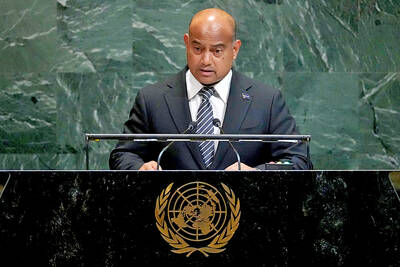
Nauru said it would hold a referendum to change its official name, described as a colonial relic from a time when “foreign tongues” mangled the native language. Nauru would change its name to Naoero to “more faithfully honor our nation’s heritage, our language and our identity,” Nauruan President David Adeang said in a statement on Tuesday. The Pacific island nation’s native language is Dorerin Naoero, which is spoken by the vast majority of its approximately 10,000 inhabitants. “Nauru emerged because Naoero could not be properly pronounced by foreign tongues, and was changed not by our choice, but for convenience,” the government said in


 RSS
RSS