


It had to be done quickly. Rogue Shiite militiamen were holding hostage a group of Sunni and Shiite tribal sheiks who had joined a revolt against al-Qaeda. For the Iraqi government and its US backers, the seven men represented a rare symbol of national unity.
A daring rescue operation secured their freedom.
A meeting on Tuesday between most of the former captives and military officials -- including the Iraqi commander of the rescue operation -- offered the first detailed picture of the tense and fast-moving events: the kidnapping, the slaying of one captive and the seven-hour rescue mission on Monday.
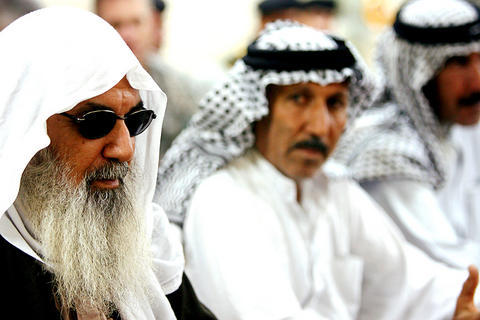
PHOTO: AP
The sheiks, recounting their 30-hour ordeal to a small group of reporters, said they were tortured and humiliated. At least three of the sheiks were visibly bruised. One man's left eye was red and swollen. The two others had bruises on their backs, arms and legs.
But they insisted that they emerged from captivity more determined than ever to continue their fight.
"We already forgot the pain and the wounds from our ordeal," said Haroon al-Mohammedawi, the bearded leader of the group from Khalis, a region in Diyala Province where the terror organization has a heavy presence.
"We pledge to you, the people and leadership of Iraq, that we will stay the course," he said.
militants
Al-Qaeda militants, the sheiks told Iraqi and US commanders, had prevented food rations from reaching them for a year, cut off power supply to their villages and ruined their orchards.
"Al-Qaeda has condemned us to death," said al-Mohammedawi, a Shiite. "But we have a strong uprising and we have volunteers from the age of 14 to 75."
The kidnapping came shortly after the sheiks attended a meeting on Sunday with government officials in Baghdad about battling al-Qaeda and fostering peace between Shiites and Sunnis.
They were traveling back to their homes in Diyala when the attackers intercepted their minibus in the capital's Shiite Shaab neighborhood. One of the seven sheiks resisted the kidnappers. He was shot and killed.
The swift action to rescue the sheiks, launched by about 200 Iraqi soldiers and backed by the US military, reflected the strategic importance of local reconciliation initiatives and the forging of alliances with Sunni tribes in areas where the terror network remains active.
Failure to free the hostages would have dealt a blow to efforts to rally the residents of Diyala, a mix of Shiites, Sunnis and Kurds, behind the US and Iraqi forces in the fight against al-Qaeda.
Lieutenant General Abboud Qanbar, the overall Iraqi commander of Baghdad, said the kidnappers belonged to "criminal gangs."
The US military, however, said the culprits were rogue members of the Shiite Mahdi Army militia led by anti-US cleric Muqtada al-Sadr, who in August ordered his fighters to lay down their arms for six months. The military has claimed that such splinter Shiite groups are doing everything possible to stop Iraqis from joining US forces -- even in the fight against the Sunni al-Qaeda in Iraq.
Major General Riyadh al-Qusaibi said he and his men had only "foggy" intelligence to work with when they set out to search for the sheiks.
They combed orchards and raided homes in a wide area before they finally located the house where the sheiks were held, he said.
"The area where the house was is not fit for rats to live in," al-Qusaibi said. "The kidnappers' response to our arrival was slow, and the gunfight lasted only minutes."
kidnappers
Four of the kidnappers were killed in the gunfight and six were detained, according to the Iraqi Defense Ministry. US military officials, however, said the number of suspected kidnappers detained was much larger.
Al-Qusaibi said several of his men were wounded, but none killed.
The US military has sought to play down the role it played in the rescue operation, touting the success as evidence of the growing capabilities of the Iraqi forces.
"The sheiks' rescue mission is one that required advanced coordination and execution that couldn't have been accomplished without significant coalition support just a few months ago," said Brigadier General John Campbell, who was involved in the rescue mission.

Kouri Richins, a Utah mother who published a children’s book about grief after the death of her husband is to serve a life sentence for his murder without the possibility of parole, a judge ruled on Wednesday. Richins was convicted in March of aggravated murder for lacing a cocktail given to her husband, Eric Richins, with five times the lethal dose of fentanyl at their home near Park City in 2022. A jury also found her guilty of four other felonies, including insurance fraud, forgery and attempted murder for trying to poison her husband weeks earlier on Feb. 14, 2022, with a

‘PERSONAL MISTAKES’: Eileen Wang has agreed to plead guilty to the felony, which comes with a maximum sentence of 10 years in federal prison A southern California mayor has agreed to plead guilty to acting as an illegal agent for the Chinese government and has resigned from her city position, officials said on Monday. Eileen Wang (王愛琳), mayor of Arcadia, was charged last month with one count of acting in the US as an illegal agent of a foreign government. She was accused of doing the bidding of Chinese officials, such as sharing articles favorable to Beijing, without prior notification to the US government as required by law. The 58-year-old was elected in November 2022 to a five-person city council, from which the mayor is selected

DELA ROSA CASE: The whereabouts of the senator, who is wanted by the ICC, was unclear, while President Marcos faces a political test over the senate situation Philippine authorities yesterday were seeking confirmation of reports that a top politician wanted by the International Criminal Court (ICC) had fled, a day after gunfire rang out at the Philippine Senate where he had taken refuge fearing his arrest. Senator Ronald “Bato” dela Rosa, the former national police chief and top enforcer of former Philippine president Rodrigo Duterte’s “war on drugs,” has been under Senate protection and is wanted for crimes against humanity, the same charges Duterte is accused of. “Several sources confirmed that the senator, Senator Bato, is no longer in the Senate premises, but we are still getting confirmation,” Presidential

HELP DENIED? The US Department of State said that the Cuban leadership refuses to allow the US to provide aid to Cubans, ‘who are in desperate need of assistance’ US Secretary of State Marco Rubio on Wednesday said that Cuba’s leadership must change, as Washington renewed an offer of US$100 million in aid if the communist nation agrees to cooperate. Cuba has been suffering severe economic tumult led by an energy shortage that plunged 65 percent of the country into darkness on Tuesday. Cuba’s leaders have blamed US sanctions, but Rubio, a Cuban American and critic of the government established by Fidel Castro, said the system was to blame, including corruption by the military. “It’s a broken, nonfunctional economy, and it’s impossible to change it. I wish it were different,” he told


 RSS
RSS