


US presidential contenders are offering markedly different ideas on how they would keep Iran from getting nuclear weapons, suddenly a central issue in the campaign for next year's election.
Republicans Rudy Giuliani, Fred Thompson and Mitt Romney have taken a hard line, speaking openly about a possible military strike against Iran, even as they say they support diplomatic measures to persuade Tehran to abandon its nuclear ambitions.
Democrats say they favor multinational diplomacy, combined with economic incentives as well as sanctions.
They have repeatedly criticized US President George W. Bush for refusing to negotiate with Iran, and say they would consider military action only after exhausting other options.
Among themselves, they have turned the question into a battle between front-runner Senator Hillary Rodham Clinton and her rivals over issues of foreign policy experience, judgment and leadership.
Rand Beers, who has worked as a national security adviser to both Republican and Democratic presidents, sees a subtext to the rhetoric.
"For Republicans, Iran represents a much more comfortable foreign policy subject to talk about than Iraq. It's a hard-nosed, hawkish credentialing and branding issue," Beers said. "On the Democratic side, there is far less saber rattling. They are trying to distinguish themselves from Bush and promote a dialogue and find common ground with Iran, which there may not be."
There is little doubt that relations between Iran and the US have reached a toxic and potentially dangerous level -- a situation the next president is likely to inherit.
Iran has refused to back down on its nuclear aspirations, saying it seeks electricity, not weapons.
According to the US government, Tehran also has sponsored terrorism throughout the Middle East and continues to support Shiite militias in Iraq that have been involved in attacking US soldiers.
The Bush administration last week slapped tough new sanctions on Iran, and the president recently warned that a nuclear Iran could lead to World War III.
That kind of rhetoric has been echoed and amplified in the Republican presidential contest.
Former New York mayor Giuliani, former Tennessee Senator Thompson and former Massachusetts governor Romney have spoken of a willingness to take pre-emptive military action against Iran if necessary.
Giuliani has been notably vocal, vowing to strike if Iran develops a weapon during his presidency. Romney last month proposed indicting Iranian President Mahmoud Ahmadinejad on a charge of inciting genocide.
John McCain, the Arizona senator, has been somewhat less bellicose. But he said that "there's only one thing worse than military action against Iran and that is a nuclear-armed Iran."
Clinton's vote for a Senate measure designating Iran's Revolutionary Guard a terrorist group has made her a target of stinging criticism from several rivals.
Fellow Senator Barack Obama of Illinois and former Senator John Edwards of North Carolina say Bush could interpret the measure as congressional approval for a military attack. Clinton has vigorously denied that would be the result and says she was voting for stepped-up diplomacy and economic sanctions.
For her part, Clinton contends that comments by Obama on personal diplomacy with countries like Iran are evidence that the Illinois senator is too inexperienced to lead in a dangerous world.
In a July debate, Obama was asked if he would be willing to meet, without precondition, the leaders of Iran and other unfriendly nations during the first year of his presidency.
"I would," he said.
Clinton said that showed Obama was "irresponsible" and "naive" on foreign policy matters. She has called for more direct diplomacy with Iran and countries such as North Korea, but has also said she would not commit to leader-to-leader meetings.
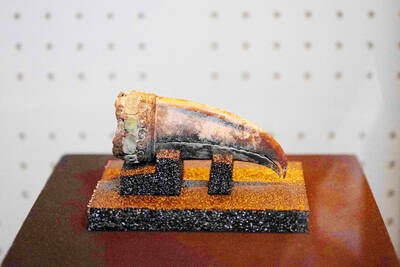
Archeologists in Peru on Thursday said they found the 5,000-year-old remains of a noblewoman at the sacred city of Caral, revealing the important role played by women in the oldest center of civilization in the Americas. “What has been discovered corresponds to a woman who apparently had elevated status, an elite woman,” archeologist David Palomino said. The mummy was found in Aspero, a sacred site within the city of Caral that was a garbage dump for more than 30 years until becoming an archeological site in the 1990s. Palomino said the carefully preserved remains, dating to 3,000BC, contained skin, part of the
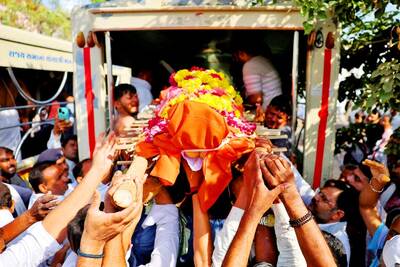
‘WATER WARFARE’: A Pakistani official called India’s suspension of a 65-year-old treaty on the sharing of waters from the Indus River ‘a cowardly, illegal move’ Pakistan yesterday canceled visas for Indian nationals, closed its airspace for all Indian-owned or operated airlines, and suspended all trade with India, including to and from any third country. The retaliatory measures follow India’s decision to suspend visas for Pakistani nationals in the aftermath of a deadly attack by shooters in Kashmir that killed 26 people, mostly tourists. The rare attack on civilians shocked and outraged India and prompted calls for action against their country’s archenemy, Pakistan. New Delhi did not publicly produce evidence connecting the attack to its neighbor, but said it had “cross-border” links to Pakistan. Pakistan denied any connection to

TRUMP EFFECT: The win capped one of the most dramatic turnarounds in Canadian political history after the Conservatives had led the Liberals by more than 20 points Canadian Prime Minister Mark Carney yesterday pledged to win US President Donald Trump’s trade war after winning Canada’s election and leading his Liberal Party to another term in power. Following a campaign dominated by Trump’s tariffs and annexation threats, Carney promised to chart “a new path forward” in a world “fundamentally changed” by a US that is newly hostile to free trade. “We are over the shock of the American betrayal, but we should never forget the lessons,” said Carney, who led the central banks of Canada and the UK before entering politics earlier this year. “We will win this trade war and

Armed with 4,000 eggs and a truckload of sugar and cream, French pastry chefs on Wednesday completed a 121.8m-long strawberry cake that they have claimed is the world’s longest ever made. Youssef El Gatou brought together 20 chefs to make the 1.2 tonne masterpiece that took a week to complete and was set out on tables in an ice rink in the Paris suburb town of Argenteuil for residents to inspect. The effort overtook a 100.48m-long strawberry cake made in the Italian town of San Mauro Torinese in 2019. El Gatou’s cake also used 350kg of strawberries, 150kg of sugar and 415kg of


 RSS
RSS