


When it comes to US presidential politics, the US news media love front-runners. But the media also seem to hate them, too.
Within the first five months of the presidential contest, the media effectively had reduced the field to five candidates, even though there were 17 mainstream Democrats and Republicans, a study of political coverage found.
But the tone of the coverage for the top two front-runners -- Democrat Senator Hillary Rodham Clinton and Republican Rudy Giuliani -- was hardly friendly.
Nearly four out of 10 stories were negative, more than three out of 10 were neutral and only three were positive.
hidebound
The study released by the Project for Excellence in Journalism and the Joan Shorenstein Center on the Press, Politics and Public Policy also portrays the political press as a hidebound institution that is out of touch with the desires of citizens.
It found that stories focused more on fundraising and polls than on where candidates stood on the issues, despite a public demand for more attention to the policies, views and records of the candidates.
The public's attention to campaign news is higher now than it was at similar points in the past two elections.
But according to the study, that interest is only shared by less than one in four people.
Of the five candidates -- Democrats Clinton and Senator Barack Obama and Republicans Giuliani, Mitt Romney and Senator John McCain -- received more than half the coverage.
Elizabeth Edwards, the cancer-stricken wife of Democrat John Edwards, received almost as much media attention as her husband.
According to the study, Democrats got more coverage -- and more positive ink and airtime -- than Republicans.
The study said that Obama enjoyed the friendliest coverage of the presidential field; McCain endured the most negative.
That was due in part to the media's focus on fundraising. Obama raised more than expected and McCain raised less.
The report is the most thorough analysis yet of media coverage of next year's US presidential campaign and offers both a sober evaluation as well as a dash of guidance on how to improve.
missing the point
But the report's authors are not necessarily optimistic. They note that a study of the presidential election in 2000 reached similar conclusions.
They argue that this election could represent a generational struggle in both of the parties, but say that early media coverage failed to capture that fundamental tension.
"If American politics is changing, the style and approach of the American press does not appear to be changing with it," the authors concluded.
Director of the Project for Excellence in Journalism Tom Rosenstiel said journalists face a conundrum: In a campaign that started as early as this one, why spend resources in a detailed analysis of candidates views and stances when the public is not that engaged?
Or is the public not engaged because the media is focusing on tactics and insider stories that don't affect readers, viewers and listeners?
The report analyzed 1,742 articles about the presidential contest that appeared from January through May in 48 news outlets including print, online, network TV, cable and radio news and talk shows.
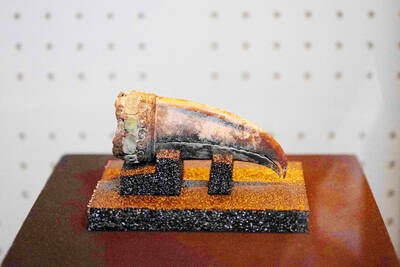
Archeologists in Peru on Thursday said they found the 5,000-year-old remains of a noblewoman at the sacred city of Caral, revealing the important role played by women in the oldest center of civilization in the Americas. “What has been discovered corresponds to a woman who apparently had elevated status, an elite woman,” archeologist David Palomino said. The mummy was found in Aspero, a sacred site within the city of Caral that was a garbage dump for more than 30 years until becoming an archeological site in the 1990s. Palomino said the carefully preserved remains, dating to 3,000BC, contained skin, part of the

TRUMP EFFECT: The win capped one of the most dramatic turnarounds in Canadian political history after the Conservatives had led the Liberals by more than 20 points Canadian Prime Minister Mark Carney yesterday pledged to win US President Donald Trump’s trade war after winning Canada’s election and leading his Liberal Party to another term in power. Following a campaign dominated by Trump’s tariffs and annexation threats, Carney promised to chart “a new path forward” in a world “fundamentally changed” by a US that is newly hostile to free trade. “We are over the shock of the American betrayal, but we should never forget the lessons,” said Carney, who led the central banks of Canada and the UK before entering politics earlier this year. “We will win this trade war and
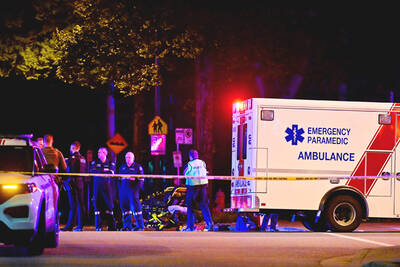
‘BODIES EVERYWHERE’: The incident occurred at a Filipino festival celebrating an anti-colonial leader, with the driver described as a ‘lone suspect’ known to police Canadian police arrested a man on Saturday after a car plowed into a street party in the western Canadian city of Vancouver, killing a number of people. Authorities said the incident happened shortly after 8pm in Vancouver’s Sunset on Fraser neighborhood as members of the Filipino community gathered to celebrate Lapu Lapu Day. The festival, which commemorates a Filipino anti-colonial leader from the 16th century, falls this year on the weekend before Canada’s election. A 30-year-old local man was arrested at the scene, Vancouver police wrote on X. The driver was a “lone suspect” known to police, a police spokesperson told journalists at the
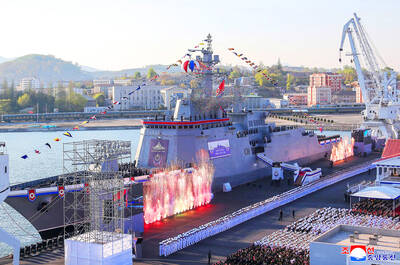
North Korean leader Kim Jong-un has unveiled a new naval destroyer, claiming it as a significant advancement toward his goal of expanding the operational range and preemptive strike capabilities of his nuclear-armed military, state media said yesterday. North Korea’s state-run Korean Central News Agency (KCNA) said Kim attended the launching ceremony for the 5,000-tonne warship on Friday at the western port of Nampo. Kim framed the arms buildup as a response to perceived threats from the US and its allies in Asia, who have been expanding joint military exercises amid rising tensions over the North’s nuclear program. He added that the acquisition


 RSS
RSS