

A suicide bomber on a bicycle killed 28 policemen at their base in the volatile Iraqi province of Diyala yesterday, police said, in one of the deadliest strikes on Iraq's security forces in months.
The bomber entered the base and attacked a group of policemen -- members of a rapid reaction force -- doing their morning exercises, said Major-General Ghanim al-Quraishi, police chief of Diyala province.
He said details of the bombing were confused because everyone at the scene had been killed or badly wounded.
The police base is in the city of Baqubah, the capital of Diyala province, where al-Qaeda and other Sunni Arab insurgent groups as well as Shiite Muslim militias operate.
At least 20 people were wounded in the attack, including a woman and a child, police said.
Mohammed al-Kirrawi, a doctor at the Baqubah general hospital, said most of the victims were struck by iron balls packed with the explosives to achieve maximum casualties.
He said the hospital lacked the necessary equipment to save many of the wounded.
"Among the wounded, there are seven in critical conditions and there is little hope that they will survive," he said.
car bomb
A car bomb in a residential area in the northern Iraqi town of Siniya also demolished two homes and killed seven people, police and health officials said. Eleven people were wounded, they said.
No group claimed immediate responsibility for the Baqubah bombing, but it bore the hallmarks of al-Qaeda, which has often used suicide bombers in attacks on Iraqi security forces to devastating effect.
Al-Qaeda has vowed to step up attacks on the security forces as well as Sunni Arab tribal leaders and Sunni insurgents who have allied themselves with US forces in Diyala province to try to root out the Sunni Islamist group.
US and Iraqi forces launched a major offensive against al-Qaeda in Diyala province in June, regaining control of Baqubah and forcing many of the group's fighters to flee elsewhere.
That led to the creation of "concerned citizens groups" modeled on the tribal police units first formed in western Anbar. Tribal chiefs in the area have joined forces with US troops in an attempt to drive al-Qaeda from the province.
Al-Qaeda, however, has proved resilient and US military commanders warn that it still retains the capability to launch devastating attacks.
kidnapping
On Sunday, 10 anti-al-Qaeda tribal sheiks -- seven Sunnis and three Shiites -- from Diyala were kidnapped in a Shiite district of Baghdad while driving back home after a meeting with the government in the capital.
Baqubah's police chief was among 26 people killed last month when a suicide bomber blew himself up in a mosque compound where local Shiite and Sunni Arab leaders were holding reconciliation talks.
The US military has poured 30,000 extra troops into Iraq as part of US President George W. Bush's new Iraq strategy to create a more stable security environment for the country's feuding leaders to reconcile their warring sects.
Tens of thousands of Iraqis have been killed in sectarian violence between majority Shiites and minority Sunni Arabs since February last year, when bombers blew up a revered Shiite shrine in the town of Samarra, north of Baghdad.
The second-ranking US general in Iraq, Lieutenant-General Raymond Odierno, said last week that violence had dropped to its lowest level since January last year.
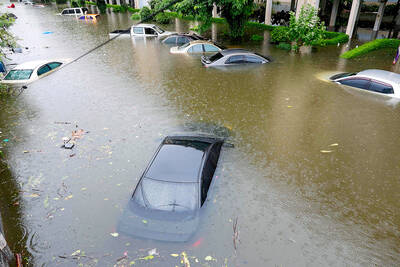
Several areas of Thailand’s capital city Bangkok were inundated by continuous rain from Thursday afternoon to yesterday morning that has disrupted traffic and forced some residents to evacuate. Major canals in Bangkok filled with accumulated rainfall exceeding 20cm, officials said yesterday. Floodwaters spread across the city, particularly in the central and eastern parts, blocking roads and stopping traffic. The Thai Meteorological Department warned that the heavy rain would continue in most parts of the country through today, citing a strong low-pressure system over the central region and strengthening southwest monsoon conditions. More than 84,000 people in 21 provinces nationwide were
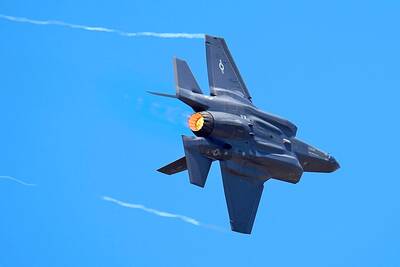
BAD TIMING: The disclosure of the incident, which is under investigation by at least two congressional committees, comes as Xi was to meet with Trump The Pentagon is investigating how parts of the US’ most advanced fighter jet ended up in Hong Kong, with a news outlet on Wednesday reporting that China has obtained the F-35 equipment. The F-35 Joint Program Office said in a statement that it and the US Department of Defense are aware of “a shipment issue” with F-35 components. “We are actively working with US authorities and industry partners to retrieve these components, investigate the incident and place safeguards to avoid a future occurrence,” the office said. UPS was shipping a cockpit canopy and weapons-bay door from an Australian military F-35 that was being

Yemen’s Saudi-led coalition early yesterday said it had intercepted two ballistic missiles and two drones launched by the Iran-backed Houthis toward the kingdom. The coalition said in posts on social media that the missiles were headed towards Khamis Mushait and the drones toward the capital, Riyadh, adding that it was monitoring the missile threat and drones launched at the kingdom, without providing further details. The Saudi Civil Defense had sent alerts overnight for Khamis Mushait and Abha, but not for Riyadh. The Houthis, who control the most populous parts of Yemen and much of the north, have been launching attacks

IN DEFENSE: Australia said it takes the protection of classified and export-controlled tech extremely seriously amid concerns over reverse engineering A US House of Representatives committee that oversees defense policy is investigating the diversion of potentially sensitive F-35 jet components this year from Australia to Hong Kong, a spokesperson said. “The committee is aware of this issue and we’ve received multiple briefings on it,” House Committee on Armed Services spokesperson Heather Vaughan said, adding that the group is “continuing to look into the incident and conduct oversight.” The Pentagon’s F-35 program office said in a statement that “we are aware of a shipment issue of unserviceable F-35 components and we are actively working with US authorities and industry partners to retrieve these


 RSS
RSS