


South Korea yesterday welcomed a media report that North Korea wants to learn from Vietnam about its economic reforms.
"It is encouraging if North Korea tries to learn from Vietnam's experiences," presidential spokesman Cheon Ho-seon said.
A Hong Kong-based weekly magazine reported on Sunday that the North's leader Kim Jong-Il intends to visit Vietnam to assess its Doi Moi economic reforms introduced in 1986.
Yazhou Zhoukan magazine said Kim made the remark while meeting Nong Duc Manh, secretary-general of Vietnam's Communist Party, in Pyongyang earlier this month.
It cited an interview with Foreign Minister Pham Gia Khiem who accompanied the secretary-general.
"Chairman Kim Jong-il highly evaluated the achievements Vietnam's Doi Moi has made in the past 20 years while meeting with Secretary-General Manh," Khiem was quoted as saying, adding that Kim accepted Manh's invitation visit to Hanoi.
The current trip to Hanoi by North Korean Prime Minister Kim Yong-il aims to prepare for the leader's visit, the magazine said.
Vietnam's reforms ushered in dramatic growth but left the authority of the communist party unchallenged.
Meanwhile, Seoul will need to spend about US$1 trillion or more to renovate North Korea's creaky infrastructure if the two were to reunite, a South Korean study said, adding that the cost will go up further over time.
But the South's economy can expect benefits through decreased military spending, selling to new markets in the North and tapping into its cheap land and labor, said the report from the National Assembly's Special Committee on Budget and Accounts.
The report said if the two Koreas reunified in 2015, it would cost the South US$858 billion over 10 years to absorb its destitute neighbor and raise its economy to half that of the South's.
If the two started in 2030, the cost would be US$1.32 trillion.
Many in South Korea are worried that unifying could wreck its economy -- the world's 13th largest. They also fear a flood of refugees coming over the border from the North -- whose economy is less than 3 percent the size of the South's.
North Korea infrastructure is a shambles with rail lines, roads and power grids built during Japan's 1910 to 1945 rule over the Korean Peninsula still in use.
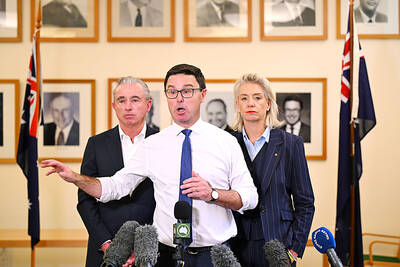
BACKLASH: The National Party quit its decades-long partnership with the Liberal Party after their election loss to center-left Labor, which won a historic third term Australia’s National Party has split from its conservative coalition partner of more than 60 years, the Liberal Party, citing policy differences over renewable energy and after a resounding loss at a national election this month. “Its time to have a break,” Nationals leader David Littleproud told reporters yesterday. The split shows the pressure on Australia’s conservative parties after Prime Minister Anthony Albanese’s center-left Labor party won a historic second term in the May 3 election, powered by a voter backlash against US President Donald Trump’s policies. Under the long-standing partnership in state and federal politics, the Liberal and National coalition had shared power
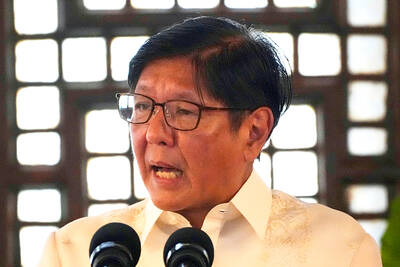
NO EXCUSES: Marcos said his administration was acting on voters’ demands, but an academic said the move was emotionally motivated after a poor midterm showing Philippine President Ferdinand Marcos Jr yesterday sought the resignation of all his Cabinet secretaries, in a move seen as an attempt to reset the political agenda and assert his authority over the second half of his single six-year term. The order came after the president’s allies failed to win a majority of Senate seats contested in the 12 polls on Monday last week, leaving Marcos facing a divided political and legislative landscape that could thwart his attempts to have an ally succeed him in 2028. “He’s talking to the people, trying to salvage whatever political capital he has left. I think it’s

CONTROVERSY: During the performance of Israel’s entrant Yuval Raphael’s song ‘New Day Will Rise,’ loud whistles were heard and two people tried to get on stage Austria’s JJ yesterday won the Eurovision Song Contest, with his operatic song Wasted Love triumphing at the world’s biggest live music television event. After votes from national juries around Europe and viewers from across the continent and beyond, JJ gave Austria its first victory since bearded drag performer Conchita Wurst’s 2014 triumph. After the nail-biting drama as the votes were revealed running into yesterday morning, Austria finished with 436 points, ahead of Israel — whose participation drew protests — on 357 and Estonia on 356. “Thank you to you, Europe, for making my dreams come true,” 24-year-old countertenor JJ, whose

A documentary whose main subject, 25-year-old photojournalist Fatima Hassouna, was killed in an Israeli airstrike in Gaza weeks before it premiered at Cannes stunned viewers into silence at the festival on Thursday. As the cinema lights came back on, filmmaker Sepideh Farsi held up an image of the young Palestinian woman killed with younger siblings on April 16, and encouraged the audience to stand up and clap to pay tribute. “To kill a child, to kill a photographer is unacceptable,” Farsi said. “There are still children to save. It must be done fast,” the exiled Iranian filmmaker added. With Israel


 RSS
RSS