


China has named Li Yuanchao (
The Organization Department is in charge of investigating candidates for appointments and promotions, giving it access to information on the careers of high-ranking officials and making it a nerve center for political jockeying.
The appointment gives Hu greater control over who gets what job in the party, something Hu will need to build support for his choice of potential successor when he begins stepping down from office five years from now.
Li took the position from He Guoqiang (
The head of the Organization Department before him, Vice President Zeng Qinghong (
Li, who has a doctorate in law and is seen as pro-business and experienced working with private enterprise, catapulted into the 25-member Politburo on Monday, following the close of the CCP's five-yearly Congress.
He began his political rise in the Shanghai branch of the Communist Youth League, an organization once headed by Hu and that is still seen as the president's power base.
Li moved on to the Youth League's secretariat in Beijing, where he worked briefly with Hu.
Hu emerged from the Congress in stronger shape than before, but not without having made compromises on some appointments.
Those included the elevation to the party's all-powerful nine-member Politburo Standing Committee of two men considered close to Zeng, who stepped down from the committee, but is expected to continue to influence Chinese politics through his allies there.
Another league veteran and Hu loyalist, Li Keqiang (李克強), was promoted all the way to the Politburo Standing Committee although not placed in a ranking that marks him as the clear heir apparent.
Meanwhile, former Democratic Party chairman Martin Lee (
Lee has received a barrage of criticism from pro-Beijing politicians over an article he wrote in the Wall Street Journal last Thursday entitled "China's Olympics Opportunity."
In the piece, Lee called on US President George W. Bush to: "Use the next 10 months to press for a significant improvement of basic human rights in my country, including press, assembly and religious freedoms.
"How does it profit our nation if it wins gold medals but suffers from the continued absence of democracy, human rights and the rule of law?" the article said.
Pro-Beijing politicians seized on the comments, saying Lee was inviting foreign interference in China's internal affairs.
But Lee said he was merely echoing calls by Beijing officials for human rights improvements from the Games.
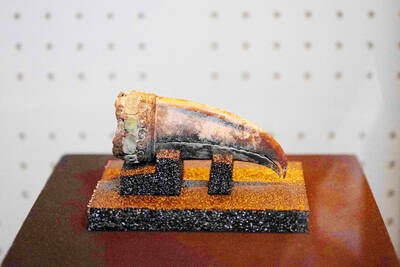
Archeologists in Peru on Thursday said they found the 5,000-year-old remains of a noblewoman at the sacred city of Caral, revealing the important role played by women in the oldest center of civilization in the Americas. “What has been discovered corresponds to a woman who apparently had elevated status, an elite woman,” archeologist David Palomino said. The mummy was found in Aspero, a sacred site within the city of Caral that was a garbage dump for more than 30 years until becoming an archeological site in the 1990s. Palomino said the carefully preserved remains, dating to 3,000BC, contained skin, part of the

‘WATER WARFARE’: A Pakistani official called India’s suspension of a 65-year-old treaty on the sharing of waters from the Indus River ‘a cowardly, illegal move’ Pakistan yesterday canceled visas for Indian nationals, closed its airspace for all Indian-owned or operated airlines, and suspended all trade with India, including to and from any third country. The retaliatory measures follow India’s decision to suspend visas for Pakistani nationals in the aftermath of a deadly attack by shooters in Kashmir that killed 26 people, mostly tourists. The rare attack on civilians shocked and outraged India and prompted calls for action against their country’s archenemy, Pakistan. New Delhi did not publicly produce evidence connecting the attack to its neighbor, but said it had “cross-border” links to Pakistan. Pakistan denied any connection to

TRUMP EFFECT: The win capped one of the most dramatic turnarounds in Canadian political history after the Conservatives had led the Liberals by more than 20 points Canadian Prime Minister Mark Carney yesterday pledged to win US President Donald Trump’s trade war after winning Canada’s election and leading his Liberal Party to another term in power. Following a campaign dominated by Trump’s tariffs and annexation threats, Carney promised to chart “a new path forward” in a world “fundamentally changed” by a US that is newly hostile to free trade. “We are over the shock of the American betrayal, but we should never forget the lessons,” said Carney, who led the central banks of Canada and the UK before entering politics earlier this year. “We will win this trade war and
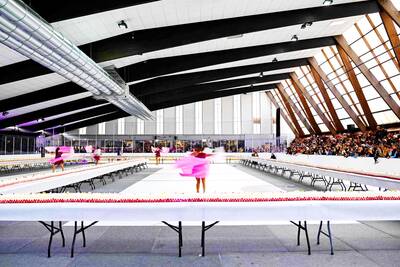
Armed with 4,000 eggs and a truckload of sugar and cream, French pastry chefs on Wednesday completed a 121.8m-long strawberry cake that they have claimed is the world’s longest ever made. Youssef El Gatou brought together 20 chefs to make the 1.2 tonne masterpiece that took a week to complete and was set out on tables in an ice rink in the Paris suburb town of Argenteuil for residents to inspect. The effort overtook a 100.48m-long strawberry cake made in the Italian town of San Mauro Torinese in 2019. El Gatou’s cake also used 350kg of strawberries, 150kg of sugar and 415kg of


 RSS
RSS