

AP, CARACAS
Thousands of university students scuffled with police and government supporters during a protest demanding that civil liberties be respected under constitutional reforms being drafted by allies of President Hugo Chavez.
Police tossed tear gas canisters into the crowd of opposition students on Tuesday after clashes broke out with a smaller group of pro-Chavez demonstrators near the National Assembly. Journalists estimated the crowd at approximately 20,000 protesters, but pro-Chavez lawmakers said there were fewer.
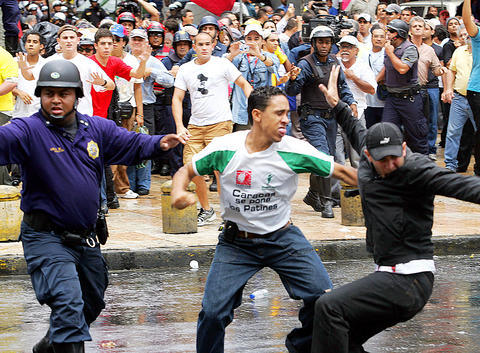
PHOTO: AFP
There were no reports of arrests or serious injuries, though student leader Stalin Gonzalez said at least five demonstrators suffered minor injuries during the bottle and rock-throwing melee.
The students said they fear civil liberties would be severely weakened under the constitutional changes under consideration. Critics are particularly concerned by an amendment that would allow authorities to detain citizens without charges during a state of emergency.
The National Assembly, dominated by Chavez supporters, is poised to approve 67 constitutional amendments in the coming days that would give the government control over the Central Bank, create new types of cooperative property and extend presidential terms from six to seven years while allowing Chavez to run again in 2012.
To take effect, the reforms must be approved by voters in a Dec. 2 referendum.
Protesters complained that the police blocked their march before it reached the National Assembly while authorities frequently allow Chavez backers to stage street demonstrations without restrictions.
"It's clear proof of political discrimination," Gonzalez said.
National Guard troops later escorted a group of students into the National Assembly, where they presented lawmakers with a document outlining their concerns.
Pro-Chavez lawmaker Calixto Ortega told state television the concerns raised by students would be taken into consideration before final approval of the reforms.
"Nobody is being excluded," he said.
Speaking on behalf of groups from mostly private universities after the march, student leader Yon Goicochea told a news conference more protests would be staged next week and warned authorities not to impede the demonstrations.
"We have rights that cannot be negotiated," he said.
Public ombudsman German Mundarain -- a close ally of Chavez -- urged lawmakers on Monday to reconsider an amendment that would let the government waive some civil liberties during a state of emergency.
Roman Catholic leaders have argued that the proposed changes would violate fundamental rights.
Chavez, who was re-elected last year on promises of radical revolutionary change, says the reforms are fully democratic and necessary to accelerate Venezuela's transition to socialism.
"They say the reform is morally unacceptable. They are the ones who are morally unacceptable," Chavez said on Sunday, referring to Catholic leaders who have criticized him.
Meanwhile, in an unusual form of protest, Venezuelan media reported that headless effigies with messages reading "Reform, No!" and "Freedom" appeared hanging from street lamps on avenues in Caracas and the eastern city of Ciudad Guayana.

CRACKED SCREEN: The problem is an embarrassing setback for Apple, which spent more than a decade developing the device and touted its durability The iPhone Duo, one of Apple’s biggest new products in years, is drawing a growing number of complaints from customers who say the foldable display cracked after just hours or days of use. In these cases, customers reported hearing a crunching sound when unfolding the phone, followed by a large crack forming along the center crease. Some users also experienced a white patch or other display malfunction on the right side of the screen. Reports of the problem first surfaced on Reddit and other social media platforms. Bloomberg News has since independently verified the issue with more than half a
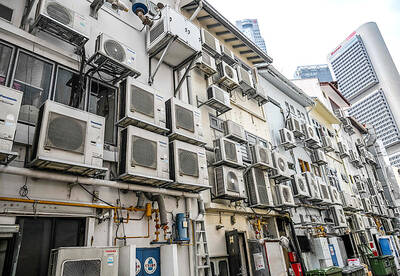
Long dubbed an “air-conditioned nation,” Singapore is experimenting with cooling alternatives from chilled beams to “passive displacement” to curb its thirst for energy-guzzling air-conditioning. The city-state has the highest per-capita air-conditioner ownership rate in Southeast Asia, with about 99 percent of private residences equipped with cooling units. Singapore’s local building sector accounts for one-fifth of its emissions, while cooling itself accounts for 40 to 60 percent of a building’s energy consumption, according to studies. A stroll down Orchard Road highlights that dependence. Shoppers are greeted by blasts of cool air that waft into the street as doors swing open — a major draw
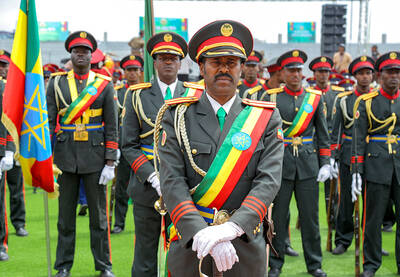
Ethiopian online influencers are pushing for their government to invade neighboring Eritrea and seize access to the sea, following its success against rebel and Eritrean forces in the past few weeks. The Ethiopian army has advanced right up to the border after repelling an offensive by rebels in the northern Tigray State who were supported by Eritrean troops. Ethiopian Prime Minister Abiy Ahmed has repeatedly said that securing a base on the Red Sea is a vital national objective for Ethiopia, which lost its coastline when Eritrea gained independence in 1993. Some online influencers say that the opportunity to invade has arrived. “The time
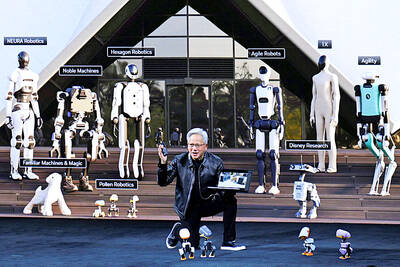
Beijing yesterday dismissed as “groundless speculation” a report that said Nvidia CEO Jensen Huang (黃仁勳) was the target of a Chinese spy plot. The article by the New York Times, published on Thursday, said that US intelligence officials concluded that a Chinese executive linked to a Singapore-based data center company had been funneling information to Beijing. “The report in question is based on groundless speculation and is nothing more than an attempt to smear China,” Chinese Ministry of Foreign Affairs spokesman Guo Jiakun (郭嘉昆) told a regular briefing. China is in a race for tech dominance with the US, which restricts the export


 RSS