


South Korea's spy agency said yesterday that then-president Park Chung-hee had approved the infamous 1973 kidnapping in Tokyo of dissident Kim Dae-jung, who later ruled the country and won the Nobel Peace Prize.
The National Intelligence Service (NIS) also said a 1987 mid-air airplane explosion was committed by North Korean agents.
The NIS was announcing the result of a three-year investigation into two of the most notorious incidents in South Korea's turbulent history. The probe was ordered by South Korean President Roh Moo-hyun and carried out by a civilian-led "truth committee."
Two years after narrowly losing a 1971 presidential election to authoritarian leader Park Chung-hee, Kim was abducted by South Korean agents in a Tokyo hotel and whisked to a waiting boat where, according to most versions of the story, agents planned to kill him and dump the body.
"This committee confirms that its precursor, the Korea Central Intelligence Agency (KCIA), undertook a kidnapping in Japan, and expresses deep regret over this," the National Intelligence Service report said.
Kim was blindfolded and taken to the port city of Osaka where a group of agents put him on a boat and tied him down to a cross-shaped wooden board while debating ways to sink it.
"There is physical evidence to support the possibility that, up to a certain point, the plan had been pursued as an assassination," the NIS report said.
The US Central Intelligence Agency and Japanese officials learned of the plot and the US sent what is believed to have been an aircraft to find the boat and buzz the kidnappers, intelligence officials and Kim himself have said.
With the kidnappers caught in the act, Kim's life was spared. He was later taken to South Korea and placed under house arrest.
It has long been a mystery who was behind the abduction, with fingers of blame pointed at either Lee Hu-rak, Korean CIA head at the time, or President Park himself.
"Alongside the possibility that ex-President Park might have ordered it in person, he must have given at least a tacit approval," the NIS said in a six-volume, 3,300-page report into these and other historical incidents.
The report marked Seoul's first official admission that a state agency was to blame for the kidnapping. South Korean ambassador Yu Myung-hwan visited the Japanese foreign ministry yesterday to explain the findings to Senior Vice Foreign Minister Hitoshi Kimura.
The report said President Park began trying to curb Kim after the opposition leader very nearly defeated him in a 1971 presidential election.
"As Kim Dae-jung's political standing rose dramatically in the aftermath of the presidential poll, Park started considering Kim as the most serious obstacle to his plan to extend his presidency," the report said.
It cited testimony by former lawmaker Choi Young-keun, who quoted then South Korean CIA head Lee as saying in early 1980: "I had no choice but follow the order from President Park."
The South Korean CIA head also told his deputy, who objected to the kidnapping order: "Hey, do you think I like to do this myself?"
The truth committee called on the government to "make an official apology to Kim Dae-jung for threatening his life and breaching his human rights."
A spokesman for Kim, now 81, said Park had given the order to murder the dissident and expressed regret that the NIS probe did not pin the blame more firmly on the ex-president.
Park in 1972 changed the constitution to perpetuate his rule. He was assassinated in 1979.
Regarding the bombing of a Korean Airlines plane over the Andaman Sea off Burma in 1987, which killed all 115 aboard, the NIS confirmed the plane was blown up by a time-bomb planted by North Korean agents.
Two North Korean agents were captured afterwards in Bahrain but the man committed suicide while his female companion was taken to Seoul.
She later made a chilling confession that they blew up the plane on orders from Pyongyang to try to scare away foreigners from the 1988 Seoul summer Olympics.
The NIS said its immediate predecessor, the National Security Planning Agency, had given rise to unwarranted conspiracy theories by conducting an over-hasty investigation and relying only on the testimony of the arrested agent, Kim Hyun-hee.
The agent was jailed but later pardoned and now lives in South Korea.
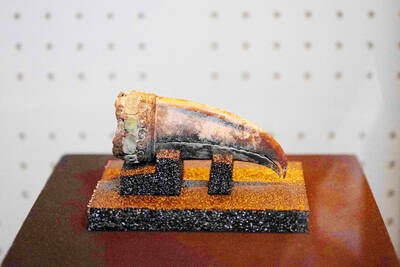
Archeologists in Peru on Thursday said they found the 5,000-year-old remains of a noblewoman at the sacred city of Caral, revealing the important role played by women in the oldest center of civilization in the Americas. “What has been discovered corresponds to a woman who apparently had elevated status, an elite woman,” archeologist David Palomino said. The mummy was found in Aspero, a sacred site within the city of Caral that was a garbage dump for more than 30 years until becoming an archeological site in the 1990s. Palomino said the carefully preserved remains, dating to 3,000BC, contained skin, part of the
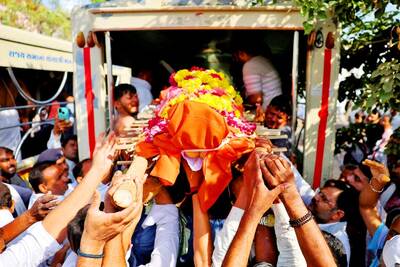
‘WATER WARFARE’: A Pakistani official called India’s suspension of a 65-year-old treaty on the sharing of waters from the Indus River ‘a cowardly, illegal move’ Pakistan yesterday canceled visas for Indian nationals, closed its airspace for all Indian-owned or operated airlines, and suspended all trade with India, including to and from any third country. The retaliatory measures follow India’s decision to suspend visas for Pakistani nationals in the aftermath of a deadly attack by shooters in Kashmir that killed 26 people, mostly tourists. The rare attack on civilians shocked and outraged India and prompted calls for action against their country’s archenemy, Pakistan. New Delhi did not publicly produce evidence connecting the attack to its neighbor, but said it had “cross-border” links to Pakistan. Pakistan denied any connection to

TRUMP EFFECT: The win capped one of the most dramatic turnarounds in Canadian political history after the Conservatives had led the Liberals by more than 20 points Canadian Prime Minister Mark Carney yesterday pledged to win US President Donald Trump’s trade war after winning Canada’s election and leading his Liberal Party to another term in power. Following a campaign dominated by Trump’s tariffs and annexation threats, Carney promised to chart “a new path forward” in a world “fundamentally changed” by a US that is newly hostile to free trade. “We are over the shock of the American betrayal, but we should never forget the lessons,” said Carney, who led the central banks of Canada and the UK before entering politics earlier this year. “We will win this trade war and
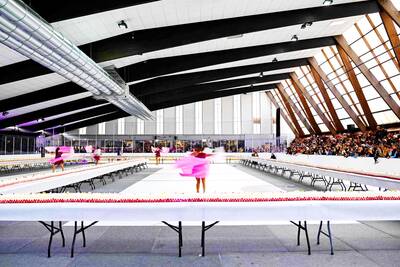
Armed with 4,000 eggs and a truckload of sugar and cream, French pastry chefs on Wednesday completed a 121.8m-long strawberry cake that they have claimed is the world’s longest ever made. Youssef El Gatou brought together 20 chefs to make the 1.2 tonne masterpiece that took a week to complete and was set out on tables in an ice rink in the Paris suburb town of Argenteuil for residents to inspect. The effort overtook a 100.48m-long strawberry cake made in the Italian town of San Mauro Torinese in 2019. El Gatou’s cake also used 350kg of strawberries, 150kg of sugar and 415kg of


 RSS
RSS