


The administration of US President George W. Bush has no closer friend in South America than President Alvaro Uribe, an Oxford-educated lawyer raised in the privileged world of cattle estates and elite schools.
Venezuelan President Hugo Chavez was born into poverty and rose through the ranks of the army before emerging as the chief scourge of US policy in the region.
Such ideological opposites might be expected to focus on historical rivalries between their countries, which were at the edge of war as recently as the late 1980s. Instead, they are rapidly moving to strike energy deals, resolve a boundary dispute and increase trade, with Colombia's exports to Venezuela climbing to a record US$4 billion this year.
"This is the most favorable moment for relations between the two countries since they separated in 1830," said Socorro Ramirez, a political scientist at the National University here and a specialist on Venezuela, referring to the origins of Colombia and Venezuela as one nation after their independence from Spain.
Obstacles to warmer ties persist, with senior officials often exchanging barbs. Their border remains a haven for guerrillas, drug trafficking and other intrigue; two Colombian intelligence agents were recently killed on the Venezuelan side in an unsolved incident.
But Uribe has surprised Colombia's conservative establishment by embracing projects that have lifted Chavez's profile across the region. He welcomed Chavez's offer to help broker the release of dozens of captives held by Colombia's largest rebel group, including three US military contractors captured in 2003.
At a summit meeting near Venezuela's border on Oct. 12 to inaugurate a pipeline taking Colombian natural gas to its neighbor, Uribe also offered to join the Bank of the South, a regional development bank championed by Venezuela as an alternative to the World Bank.
US concerns over drug trafficking and energy security are in play in this new stage of Andean diplomacy. The US remains the main consumer for both Colombian cocaine and Venezuelan oil, but Washington's low prestige in the Andes has left Uribe, with little choice but to strengthen bonds with Chavez.
Uribe is still subject to taunts from Chavez, who practices a confrontational style ingrained in Venezuela's political system, as when he urged the Colombian leader this month to lend a guerrilla leader a plane to travel to Caracas for talks. The suggestion was met here with bland declarations of respect for Venezuela as a "brother country."
"What exists in Venezuela, as well as Colombia, is political leadership that reflects the popular will and we respect that," Colombian foreign minister Fernando Araujo said.
On Thursday, Araujo's office disavowed comments in Washington by Defense Minister Juan Manuel Santos, who said he had little faith in Chavez's efforts to mediate with the Revolutionary Armed Forces of Colombia (FARC).
Efforts here to engage Chavez stand in sharp contrast with those of the Bush administration, which has clashed with Venezuela over issues like Chavez's growing arms purchases from Russia.
"Uribe surely has no illusions about Chavez's regional ambitions, but he wisely keeps any provocative rhetoric in check," said Michael Shifter, vice president for policy at the Inter-American Dialogue, a policy group in Washington focusing on Latin America. "Washington might draw some lessons from Uribe's ability to deal with Chavez."
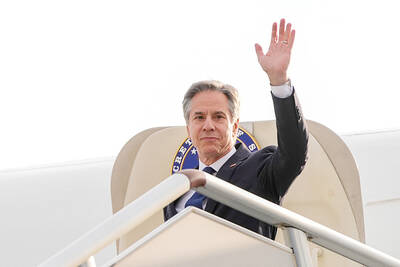
‘IN A DIFFERENT PLACE’: The envoy first visited Shanghai, where he attended a Chinese basketball playoff match, and is to meet top officials in Beijing tomorrow US Secretary of State Antony Blinken yesterday arrived in China on his second visit in a year as the US ramps up pressure on its rival over its support for Russia while also seeking to manage tensions with Beijing. The US diplomat tomorrow is to meet China’s top brass in Beijing, where he is also expected to plead for restraint as Taiwan inaugurates president-elect William Lai (賴清德), and to raise US concerns on Chinese trade practices. However, Blinken is also seeking to stabilize ties, with tensions between the world’s two largest economies easing since his previous visit in June last year. At the
Nearly half of China’s major cities are suffering “moderate to severe” levels of subsidence, putting millions of people at risk of flooding, especially as sea levels rise, according to a study of nationwide satellite data released yesterday. The authors of the paper, published by the journal Science, found that 45 percent of China’s urban land was sinking faster than 3mm per year, with 16 percent at more than 10mm per year, driven not only by declining water tables, but also the sheer weight of the built environment. With China’s urban population already in excess of 900 million people, “even a small portion

UNSETTLING IMAGES: The scene took place in front of TV crews covering the Trump trial, with a CNN anchor calling it an ‘emotional and unbelievably disturbing moment’ A man who doused himself in an accelerant and set himself on fire outside the courthouse where former US president Donald Trump is on trial has died, police said yesterday. The New York City Police Department (NYPD) said the man was declared dead by staff at an area hospital. The man was in Collect Pond Park at about 1:30pm on Friday when he took out pamphlets espousing conspiracy theories, tossed them around, then doused himself in an accelerant and set himself on fire, officials and witnesses said. A large number of police officers were nearby when it happened. Some officers and bystanders rushed
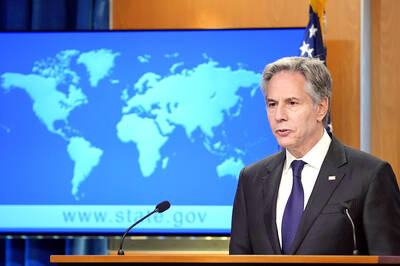
Beijing is continuing to commit genocide and crimes against humanity against Uyghurs and other Muslim minorities in its western Xinjiang province, U.S. Secretary of State Antony Blinken said in a report published on Monday, ahead of his planned visit to China this week. The State Department’s annual human rights report, which documents abuses recorded all over the world during the previous calendar year, repeated language from previous years on the treatment of Muslims in Xinjiang, but the publication raises the issue ahead of delicate talks, including on the war in Ukraine and global trade, between the top U.S. diplomat and Chinese


 RSS
RSS