


EU leaders broke more than two years of political deadlock early yesterday by approving a new treaty of reforms filling the void left by the bloc's aborted constitution.
The EU's Portuguese presidency said the agreement closed the chapter on a crisis that has gripped the EU since French and Dutch voters rejected the proposed constitution in mid-2005.
"With this accord Europe has emerged from its institutional crisis," Portuguese Prime Minister Jose Socrates told journalists shortly after the deal was clinched at a Lisbon summit.
Socrates said that leaders would formally sign what will become the treaty of Lisbon in the Portuguese capital on Dec. 13.
The treaty aims to give the first serious update to the EU's decision-making architecture since 10 mostly former communist countries joined in May 2004 followed by Bulgaria and Romania in January this year.
"In this case we're really talking about a historic agreement and it really gives the EU a capacity to act in the 21st century," European Commission chief Jose Manuel Barroso said.
EU leaders sealed the deal after overcoming Polish and Italian gripes about the treaty in last-minute wrangling on the sidelines of the two-day summit which opened on Thursday.
Poland had threatened to veto the deal if the treaty does not give authority to the so-called "Ioannina" mechanism, named after the Greek city where it was agreed upon, which allows a minority of nations to temporarily block EU decisions.
But after tough bargaining, Polish President Lech Kaczynski said that "Poland got everything it wanted. I'm very happy this business is behind us."
Italian Prime Minister Romano Prodi obtained an extra seat in the European Parliament in a compromise easing Italian concerns that the country would emerge with fewer lawmakers under the new treaty than EU heavyweights France and Britain.
The compromise leaves Italy on a par with Britain and with one seat fewer than France.
Britain also had many reservations about the treaty, but obtained "red line" opt-outs in key areas at the last EU summit in June.
"The UK's red lines are secured," said British Prime Minister Gordon Brown, attending his first summit since succeeding Tony Blair, "the British national interest has been protected."
The Polish and Italian leaders were only satisfied after French President Nicolas Sarkozy and veteran EU summiteer, Luxembourg Prime Minister Jean-Claude Juncker, held lengthy tete-a-tetes with them.
Treaty talks aside, the summit was abuzz with the announcement in Paris that Sarkozy and his wife Cecilia had divorced.
Meanwhile, at least 150,000 people demonstrated near the summit venue calling for leaders to give a bigger place to social issues in the EU.
After signing the treaty in December, member states will have one year to ratify it so that it can come into effect, as planned, on January 1, 2009.
EU leaders deem the reform treaty essential because the bloc's rules have not had a serious update since 10 mostly former communist countries joined in May 2004, followed by Bulgaria and Romania in January this year.
Like the constitution, the treaty includes plans for a European foreign policy supremo and a more permanent president to replace the current cumbersome and expensive rotating six-month presidency system.
It also streamlines decision-making by cutting down the number of EU decisions which would require unanimous support from member states.
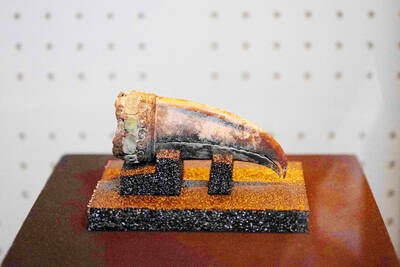
Archeologists in Peru on Thursday said they found the 5,000-year-old remains of a noblewoman at the sacred city of Caral, revealing the important role played by women in the oldest center of civilization in the Americas. “What has been discovered corresponds to a woman who apparently had elevated status, an elite woman,” archeologist David Palomino said. The mummy was found in Aspero, a sacred site within the city of Caral that was a garbage dump for more than 30 years until becoming an archeological site in the 1990s. Palomino said the carefully preserved remains, dating to 3,000BC, contained skin, part of the
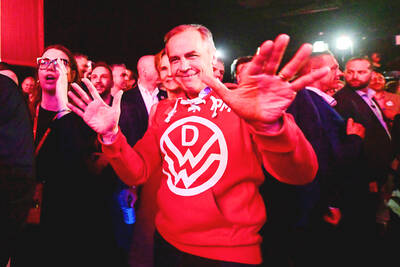
TRUMP EFFECT: The win capped one of the most dramatic turnarounds in Canadian political history after the Conservatives had led the Liberals by more than 20 points Canadian Prime Minister Mark Carney yesterday pledged to win US President Donald Trump’s trade war after winning Canada’s election and leading his Liberal Party to another term in power. Following a campaign dominated by Trump’s tariffs and annexation threats, Carney promised to chart “a new path forward” in a world “fundamentally changed” by a US that is newly hostile to free trade. “We are over the shock of the American betrayal, but we should never forget the lessons,” said Carney, who led the central banks of Canada and the UK before entering politics earlier this year. “We will win this trade war and
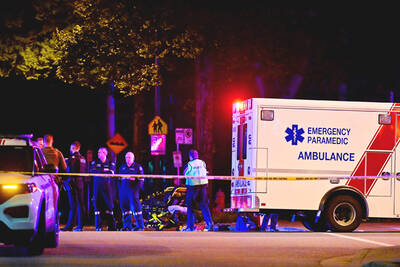
‘BODIES EVERYWHERE’: The incident occurred at a Filipino festival celebrating an anti-colonial leader, with the driver described as a ‘lone suspect’ known to police Canadian police arrested a man on Saturday after a car plowed into a street party in the western Canadian city of Vancouver, killing a number of people. Authorities said the incident happened shortly after 8pm in Vancouver’s Sunset on Fraser neighborhood as members of the Filipino community gathered to celebrate Lapu Lapu Day. The festival, which commemorates a Filipino anti-colonial leader from the 16th century, falls this year on the weekend before Canada’s election. A 30-year-old local man was arrested at the scene, Vancouver police wrote on X. The driver was a “lone suspect” known to police, a police spokesperson told journalists at the
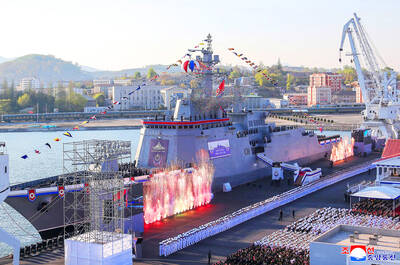
North Korean leader Kim Jong-un has unveiled a new naval destroyer, claiming it as a significant advancement toward his goal of expanding the operational range and preemptive strike capabilities of his nuclear-armed military, state media said yesterday. North Korea’s state-run Korean Central News Agency (KCNA) said Kim attended the launching ceremony for the 5,000-tonne warship on Friday at the western port of Nampo. Kim framed the arms buildup as a response to perceived threats from the US and its allies in Asia, who have been expanding joint military exercises amid rising tensions over the North’s nuclear program. He added that the acquisition


 RSS
RSS