


It is one of the most notorious cases in British legal history, the story of an apparently mild-mannered doctor who poisoned and dismembered his showgirl wife, then fled across the Atlantic with his young lover -- only to be caught after a sharp-eyed captain recognized him from the newspapers.
Hawley Crippen was hanged in 1910, after a jury at the Old Bailey central criminal court in London took just 27 minutes to find him guilty of murdering his wife, Cora, who had vanished earlier that year.
Nearly a century later, research appears to show that the evidence which sent Crippen to the gallows was mistaken: the human remains discovered under his London house could not be those of Cora.
Working from a sample kept at the museum of the Royal London Hospital Archives, a forensic science team from the US compared mitochondrial DNA from the remains presented at the trial with samples taken from Cora Crippen's surviving relatives.
The results were conclusive, said David Foran, the head of the forensic science program at Michigan State University.
"That body cannot be Cora Crippen, we're certain of that," he said.
Police found the mutilated remains with no head and no bones. Newspapers at the time described Crippen as "one of the most dangerous and remarkable men who have lived this century."
But according to John Trestrail, the toxicologist who led the new research, poisoners rarely inflict external damage on their victims.
"It is so unusual that a poisoner would dismember the victim, because a poisoner attempts to get away with murder without leaving any trace. In my database of 1,100 poisoning cases, this is the only one which involves dismemberment," said Trestrail, who heads the regional poison center in Grand Rapids, Michigan.
The discrepancy prompted him to re-examine the evidence in the Crippen case. Working with a genealogist, Beth Wills, he set about finding Mrs Crippen's surviving family. After seven years, the team tracked down three distant relatives in California and Puerto Rico.
The challenge then was to find viable DNA from samples presented at the trial. At the archives of the Royal London Hospital, in Whitechapel, researchers found the microscope slide which helped hang Crippen. In court, a pathologist, Bernard Spilsbury, identified it as an abdominal scar consistent with Cora's medical history.
Mitochondrial DNA is passed down in the egg from mother to daughter and remains relatively unchanged through generations, but the DNA in the sample was different from the known relatives of Mrs Crippen.
"We took a lot of precautions when doing this testing," Foran said. "We just didn't stop. We went back and started from scratch and tested it again."
The evidence offers no suggestion of who may have been buried in the coal cellar at 39 Hilldrop Crescent, Holloway, in north London.
But, according to Trestrail, Crippen is innocent of the crime for which he was hanged.
"Two weeks before he was hanged he wrote `I am innocent and some day evidence will be found to prove it.' When I read that the hairs stood up on my arms. I think he was right."
The team concede that they may never discover what happened to Mrs Crippen, but several intriguing clues emerged during the research.
Cora sang on the British stage under the name of Belle Elmore. Ten years after the trial, a singer with a similar name was registered as living with Cora's sister in New York.
Records show that the same woman entered the US through Ellis Island from Bermuda in 1910 -- shortly after Mrs Crippen disappeared.
"Are Belle Rose and Cora Crippen one and the same?" asked Trestrail. "We can't prove any of that -- that is another investigation."
Trestrail believes that Crippen should be given a posthumous pardon.
On Tuesday, J. Patrick Crippen, his closest living relative, said: "Those of us in the family who have ever taken the time to explore the circumstances surrounding the trial, conviction and hanging of Dr Crippen have never been convinced that this was the finest example of English justice."
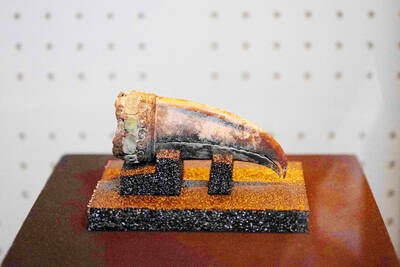
Archeologists in Peru on Thursday said they found the 5,000-year-old remains of a noblewoman at the sacred city of Caral, revealing the important role played by women in the oldest center of civilization in the Americas. “What has been discovered corresponds to a woman who apparently had elevated status, an elite woman,” archeologist David Palomino said. The mummy was found in Aspero, a sacred site within the city of Caral that was a garbage dump for more than 30 years until becoming an archeological site in the 1990s. Palomino said the carefully preserved remains, dating to 3,000BC, contained skin, part of the
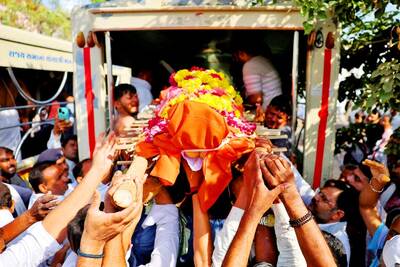
‘WATER WARFARE’: A Pakistani official called India’s suspension of a 65-year-old treaty on the sharing of waters from the Indus River ‘a cowardly, illegal move’ Pakistan yesterday canceled visas for Indian nationals, closed its airspace for all Indian-owned or operated airlines, and suspended all trade with India, including to and from any third country. The retaliatory measures follow India’s decision to suspend visas for Pakistani nationals in the aftermath of a deadly attack by shooters in Kashmir that killed 26 people, mostly tourists. The rare attack on civilians shocked and outraged India and prompted calls for action against their country’s archenemy, Pakistan. New Delhi did not publicly produce evidence connecting the attack to its neighbor, but said it had “cross-border” links to Pakistan. Pakistan denied any connection to

TRUMP EFFECT: The win capped one of the most dramatic turnarounds in Canadian political history after the Conservatives had led the Liberals by more than 20 points Canadian Prime Minister Mark Carney yesterday pledged to win US President Donald Trump’s trade war after winning Canada’s election and leading his Liberal Party to another term in power. Following a campaign dominated by Trump’s tariffs and annexation threats, Carney promised to chart “a new path forward” in a world “fundamentally changed” by a US that is newly hostile to free trade. “We are over the shock of the American betrayal, but we should never forget the lessons,” said Carney, who led the central banks of Canada and the UK before entering politics earlier this year. “We will win this trade war and

Armed with 4,000 eggs and a truckload of sugar and cream, French pastry chefs on Wednesday completed a 121.8m-long strawberry cake that they have claimed is the world’s longest ever made. Youssef El Gatou brought together 20 chefs to make the 1.2 tonne masterpiece that took a week to complete and was set out on tables in an ice rink in the Paris suburb town of Argenteuil for residents to inspect. The effort overtook a 100.48m-long strawberry cake made in the Italian town of San Mauro Torinese in 2019. El Gatou’s cake also used 350kg of strawberries, 150kg of sugar and 415kg of


 RSS
RSS