


French commuters struggled to work yesterday as public transport workers put President Nicolas Sarkozy's reform plans to the test with a 24 hour strike in defense of historic pensions privileges.
Nationwide rail traffic was at a near standstill with just 46 TGV high-speed trains running out of the normal 700, and the platforms of main line stations were almost empty of passengers.
In Paris, where metro and bus networks laid on a skeleton service, motorists hoping to beat the traffic with a pre-dawn drive to work quickly found themselves bumper-to-bumper with others of the same mind.
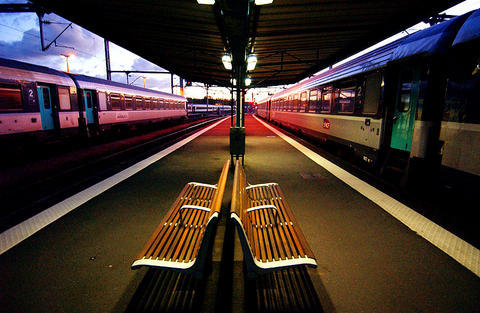
PHOTO: AFP
The capital's new Velib self-service bicycle scheme was a hugely popular commuting option, and competition was fierce for any bicycles left at the service stations dotted around the city.
For thousands of others, the best option was to don some comfortable shoes and simply walk to the office.
The main Gare du Nord train station -- the largest in Europe in terms of passenger traffic -- was largely deserted, apart from four trains from the Eurostar service to London, which suffered a number of cancellations.
Rail links into the capital from its two airports were also down, causing some passengers to spend Wednesday night camped out in terminals so as to be sure of getting their morning flights.
Travellers had been urged to postpone their journeys and many commuters made arrangements to take the day off or work from home.
The strike, which kicked off Wednesday evening, came as France prepared to host Saturday's final of the rugby World Cup, with tens of thousands of British and South African fans expected in the capital.
Street demonstrations were planned in some 60 towns and cities, as trade unions try to force Sarkozy to drop plans to reform France's so-called "special" pension systems enjoyed by 1.6 million rail, energy and other workers.
Invoking social equity, the president has begun moves to lengthen contribution periods for these workers from 37.5 years to 40, closer in line with other public and private sector employees. Currently some railway staff can retire on a full pension at the age of 50.
The protest movement is seen as the first major challenge to the head of state, who has promised a root-and-branch overhaul of the country's economy and society.
The last time a government tried to change the "special" pensions regimes was in 1995, when then prime minister Alain Juppe was forced into a humiliating climbdown by three weeks of strikes and street protests.
But Sarkozy's government insists that conditions have moved on in the last 12 years and that most French people now accept the reform.
"There are some reforms that everyone knows should have been implemented but which never have been. Well, we are going to go ahead and do it, calmly but firmly," Sarkozy said on Tuesday.
Asked whether yesterday's protests could herald another mass movement like that of 1995, Prime Minister Francois Fillon quoted the Greek philosopher Heraclitus: "No man ever steps in the same river twice."
But Bernard Thibault of the General Labour Confederation (CGT) said more strikes would take place unless the government amends its proposals.
"Thee workers are fed up with being constantly portrayed as privileged or in some way guilty on the issue of pensions," he said.

‘IN A DIFFERENT PLACE’: The envoy first visited Shanghai, where he attended a Chinese basketball playoff match, and is to meet top officials in Beijing tomorrow US Secretary of State Antony Blinken yesterday arrived in China on his second visit in a year as the US ramps up pressure on its rival over its support for Russia while also seeking to manage tensions with Beijing. The US diplomat tomorrow is to meet China’s top brass in Beijing, where he is also expected to plead for restraint as Taiwan inaugurates president-elect William Lai (賴清德), and to raise US concerns on Chinese trade practices. However, Blinken is also seeking to stabilize ties, with tensions between the world’s two largest economies easing since his previous visit in June last year. At the
Nearly half of China’s major cities are suffering “moderate to severe” levels of subsidence, putting millions of people at risk of flooding, especially as sea levels rise, according to a study of nationwide satellite data released yesterday. The authors of the paper, published by the journal Science, found that 45 percent of China’s urban land was sinking faster than 3mm per year, with 16 percent at more than 10mm per year, driven not only by declining water tables, but also the sheer weight of the built environment. With China’s urban population already in excess of 900 million people, “even a small portion

UNSETTLING IMAGES: The scene took place in front of TV crews covering the Trump trial, with a CNN anchor calling it an ‘emotional and unbelievably disturbing moment’ A man who doused himself in an accelerant and set himself on fire outside the courthouse where former US president Donald Trump is on trial has died, police said yesterday. The New York City Police Department (NYPD) said the man was declared dead by staff at an area hospital. The man was in Collect Pond Park at about 1:30pm on Friday when he took out pamphlets espousing conspiracy theories, tossed them around, then doused himself in an accelerant and set himself on fire, officials and witnesses said. A large number of police officers were nearby when it happened. Some officers and bystanders rushed

Beijing is continuing to commit genocide and crimes against humanity against Uyghurs and other Muslim minorities in its western Xinjiang province, U.S. Secretary of State Antony Blinken said in a report published on Monday, ahead of his planned visit to China this week. The State Department’s annual human rights report, which documents abuses recorded all over the world during the previous calendar year, repeated language from previous years on the treatment of Muslims in Xinjiang, but the publication raises the issue ahead of delicate talks, including on the war in Ukraine and global trade, between the top U.S. diplomat and Chinese


 RSS
RSS