


The son and heir apparent of Iraq's top Shiite politician has come out strongly in favor of autonomy for Iraq's religiously and ethnically divided regions, a potentially explosive issue on Iraq's already highly polarized political landscape.
Ammar al-Hakim, who is being groomed to take over the Supreme Islamic Iraqi Council, the country's largest Shiite party, has been a firm supporter of federalism from the outset.
But his unusually strident language on Saturday appeared to signal growing impatience with Iraqi Prime Minister Nouri al-Maliki's inaction on key issues and his failure to bring fractured groups together.
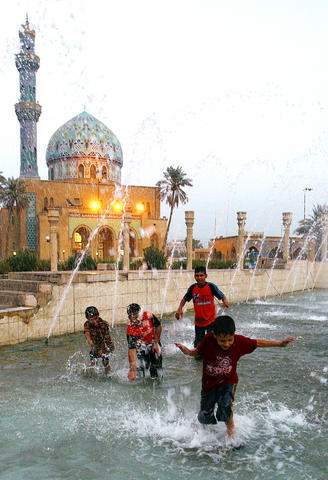
PHOTO: AP
Addressing hundreds of supporters at the party's Baghdad headquarters, al-Hakim called on Iraqis to press ahead with the creation of self-rule regions, but cautioned that the country's unity must be safeguarded.
"Federalism is one way to accomplish this goal," he said.
He said Baghdad's monopoly of power over decision-making and national wealth had turned the central government into a "tyrannical and dominating" body.
"I call on the sons of our nation to create their [self-rule] regions," al-Hakim said.
The idea of breaking up Iraq into self-rule entities has gained traction in Washington after two US senators, Joseph Biden and Sam Brownback, proposed giving more control to ethnically and religiously divided regions.
A nonbinding resolution to that effect won Senate approval last month, but Republicans supported it only after the measure was amended to make clear that US President George W. Bush should press for a new federalized system only if the Iraqis wanted it.
Al-Maliki and other Iraqi politicians denounced the decision as an infringement on Iraq's sovereignty. But Iraqi President Jalal Talabani, a Kurd and firm proponent of federalism, praised the resolution, saying it cemented Iraq's unity and opposed its breakup.
Al-Hakim is the son of Abdul-Aziz al-Hakim, the Supreme Council leader who was diagnosed with cancer in May and has been receiving chemotherapy treatment in Iran.
The younger al-Hakim delivered the remarks in a sermon commemorating the start of the Muslim Id al-Fitr feast that marks the end of Ramadan. His father, the organization's patriarch, greeted well-wishers at the ceremony but did not address the crowd.
The Supreme Council has been a staunch backer of federalism and wants the country's mainly Shiite and oil-rich south become a self-rule region similar to that established 16 years ago by minority Kurds in northern Iraq.
The Iraqi Constitution, adopted two years ago, provides for a federal system. A year ago, parliament pushed through a law allowing the formation of federal regions but not for 18 months.
Regardless, federal regions cannot be formed before nationwide elections are first held for local councils. Those councils will decide on seeking union with other provinces to form a federal region. No date has been set for the vote because parliament has yet to pass legislation on the organization of local elections.
The law is one of several Washington has been pressing al-Maliki's government to push through parliament to enhance reconciliation.
Others would ensure equitable distribution of oil wealth and reinstatement of former Iraqi president Saddam Hussein loyalists in government jobs.
Al-Maliki has failed to achieve progress on the wanted legislation despite a major eight-month-old security drive in Baghdad and surrounding regions launched in part to give him the room he needs to make political compromises.
The joint US-Iraqi operation has reduced the level of violence but failed to stem it altogether. On Saturday, a spokesman said Iraqi forces clashed with suspected al-Qaeda-linked insurgents during a four-day operation in a Sunni enclave in central Baghdad.
Iraqi military spokesman Brigadier General Qassim al-Moussawi said 48 gunmen were killed in the fighting, in which Iraqi army soldiers were supported by local Sunni tribesmen and other civilians who have turned against al-Qaeda in the volatile Fadhil neighborhood.
Saturday, however, saw Iraq's civilian death toll fall to its lowest level in recent memory, with only four people killed or found dead nationwide, reports said.

SPEAKING OUT: After Siranudh Scott’s allegations surfaced, celebrities and public figures took to social media to share their own experiences of sexual misconduct and abuse A high-profile alleged sexual abuse case within a wealthy Thai beer brewing family has prompted a wave of painful accounts from survivors of unconnected abuse in the conservative nation. Siranudh Scott, a member of the billionaire Thai family that founded the ubiquitous Singha beer brand, posted an emotional video this month accusing his elder brother Sunit of repeatedly abusing him when he was a teenager. Sunit, who is in his 30s, later denied the allegations in a video posted online, but Singha parent Boonrawd dismissed him from his executive role with the company on Tuesday last week. “I felt I needed to speak
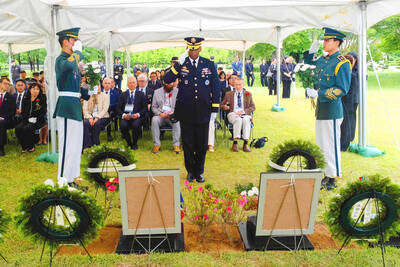
‘CROSSING THE LINE’: China’s embassy in Seoul criticized US Forces Korea Commander General Xavier Brunson, asking if his ‘hostile’ remarks were authorized by Washington South Korea and the US are in talks over recent public remarks by the commander of US Forces Korea, Seoul’s presidential office said yesterday, after the comments drew sharp criticism from China. In a recent podcast interview, US Forces Korea Commander General Xavier Brunson described South Korea as “the dagger in the heart of Asia” from China’s east coast, prompting the Chinese embassy in Seoul to say that he had “truly crossed the line.” The interview came amid growing speculation that Washington might seek to expand the role of US Forces Korea in countering the growing regional influence of China, a key
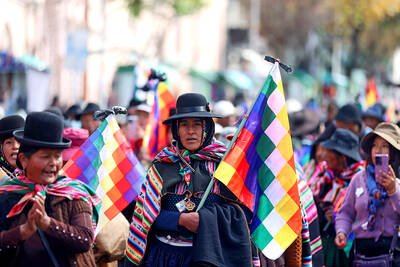
SEEKING ORDER: Rodrigo Paz said that ‘anyone who wants to destroy the nation will have to deal with this president and the full force of the constitution’ Bolivian President Rodrigo Paz on Wednesday said that the nation was at a “breaking point” after nearly a month of protests that have caused shortages of food, fuel and medicine. Paz, who took office six months ago amid the worst economic crisis there in four decades, is battling a groundswell of fury over his policies. The political capital, La Paz, has been besieged by low-income workers and members of the indigenous majority calling for his resignation. “The country needs order and is reaching breaking point,” the 58-year-old said at a public event in La Paz, renewing his appeal for dialogue. On Tuesday, the Bolivian

Forecasters in Europe yesterday warned of exceptional heat as record temperatures driven by a “heat dome” push temperatures well above seasonal norms across the continent. The surge follows a record-breaking Monday, with France logging its hottest day in the month of May on record, its weather agency said, and the UK also posting unprecedented highs. A so-called “heat dome” of warm air from northern Africa trapped under a high-pressure system over western Europe is behind the high temperatures not usually seen until high summer. Restrictions on outdoor work were imposed in parts of Italy, beaches in southwest France filled earlier than usual and


 RSS
RSS