


More than half a million women still die every year in pregnancy or after childbirth in spite of two decades of efforts to bring down the toll, reports revealed yesterday.
Little has changed, particularly in much of the developing world. Women die of avoidable complications such as high blood pressure or hemorrhage in childbirth -- and often the baby dies too or does not survive the next few years without a mother. Tens of thousands die painfully in backstreet abortions in countries where contraception is not readily available and abortion is heavily restricted or banned.
Papers prepared for a major conference in London next week and published in the medical journal the Lancet today reveal the scale of the failure. New figures show it is highly unlikely that the Millennium Development Goal 5 -- to slash death rates by 75 percent from their 1990 level by 2015 -- will be achieved.
In 1990 it was estimated that 576,300 women died in pregnancy, labor or after giving birth. The latest calculations, from the Harvard Center for Population and Development Studies in Cambridge, Massachusetts, show that 15 years later, in 2005, some 535,900 died. The maternal mortality ratio dropped from 425 in 100,000 to 402 in 100,000.
But that, says Ken Hill, lead author of the paper, is a best estimate. Because of the lack of data from some of the countries with the worst death tolls, calculations have to be based on better performing countries that do collect figures.
That makes it look as though there has been a drop of 2.5 percent in the mortality rate a year but it could be as low as 0.4 percent.
Abortion rates have dropped, mostly because of a rise in contraceptive use in eastern Europe.
Globally numbers came down from 46 million in 1995 to about 42 million in 2003. But the picture in Africa and parts of Asia remains dire and experts say the administration of George W. Bush has worsened the problem through its pro-abstinence policies there.
"There couldn't be a better set of findings to show the failure of the Bush administration policy -- the emphasis on abstinence and monogamy, the obsession with abortion, the defunding of good family planning organizations because they talk about abortion," said Sharon Camp, president and CEO of the Guttmacher Institute, which carried out the abortion study with the WHO.
"You'd think people who want to reduce abortion would stand up for family planning services, but as soon as you scratch the surface they have a much broader agenda. They are basically opposed to sex outside marriage," she said.
In Uganda, which she calls "the Bush administration showcase for monogamy in relation to HIV," the abortion rate is 54 for every 1,000 women aged 15 to 44, whereas in the US it is 21 for every 1,000.


When a hiker fell from a 55m waterfall in wild New Zealand bush, rescuers were forced to evacuate the badly hurt woman without her dog, which could not be found. After strangers raised thousands of dollars for a search, border collie Molly was flown to safety by a helicopter pilot who was determined to reunite the pet and the owner. A week earlier, an emergency rescue helicopter found the woman with bruises and lacerations after a fall at a rocky spot at the waterfall on the South Island’s West Coast. She was airlifted on March 24, but they were forced to

HIGH HOPES: The power source is expected to have a future, as it is not dependent on the weather or light, and could be useful for places with large desalination facilities A Japanese water plant is harnessing the natural process of osmosis to generate renewable energy that could one day become a common power source. The possibility of generating power from osmosis — when water molecules pass from a less salty solution to a more salty one — has long been known. However, actually generating energy from that has proved more complicated, in part due the difficulty of designing the membrane through which the molecules pass. Engineers in Fukuoka, Japan, and their private partners think they might have cracked it, and have opened what is only the world’s second osmotic power plant. It generates
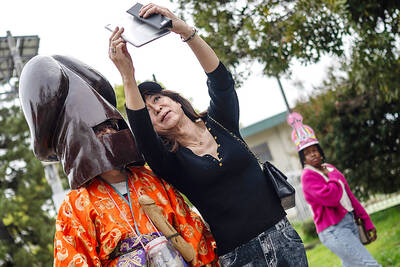
Showcasing phallus-shaped portable shrines and pink penis candies, Japan’s annual fertility festival yesterday teemed with tourists, couples and families elated by its open display of sex. The spring Kanamara Matsuri near Tokyo features colorfully dressed worshipers carrying a trio of giant phallic-shaped objects as they parade through the street with glee. The festival, as legend has it, honors a local blacksmith in the Edo Period (1603-1868) who forged an iron dildo to break the teeth of a sharp-toothed demon inhabiting a woman’s vagina that had been castrating young men on their wedding nights. A 1m black steel phallus sits in the courtyard of

Hundreds of Filipinos and tourists flocked to a sun-bleached field north of Manila yesterday, on Good Friday, to witness one of the country’s most blood-soaked displays of religious fervor, undeterred by rising fuel prices. Scores of bare-chested flagellants with covered faces walked barefoot through the dusty streets of Pampanga Province’s San Fernando as they flogged their backs with bamboo whips in the scorching heat. Agence France-Presse (AFP) journalists said they saw devotees deliberately puncturing their skin with glass shards attached to a small wooden paddle to ensure their bleeding during the ritual, a way to atone for sins and seek miracles from


 RSS
RSS