


At first, Liu Xiaoyuan (劉曉原) just fumed when his online journal postings disappeared with no explanation. Then he decided to do something few, if any, of China's censored bloggers had tried. He sued his service provider.
"Each time I would see one of my entries blocked, I'd feel so furious and indignant," said Liu, a 43-year-old Beijing lawyer. "It was just so disrespectful."
Liu's frustration is hardly unique. For China's 162 million Web users, surfing the Internet can be like running an obstacle course with blocked Web sites, partial search results and posts disappearing at every turn.
Blog entries like Liu's, which mused on sensitive topics such as the death penalty, corruption and legal reform, are often automatically rejected if they trigger a keyword filter. Sometimes, they're deleted by human censors employed by Internet companies.
In the lead-up to the sensitive Communist Party Congress, which convenes on Monday to approve top leaders who will serve under President Hu Jintao (
"What you see now is unprecedented," said Xiao Qiang (蕭強), director of the China Internet Project at the University of California, Berkeley. "They are forcing most of the interactive sites to simply close down and have unplugged Internet data centers. These are things they haven't done before."
Thousands of sites suddenly went offline in August and last month when Internet data centers, which host Web servers, were shut down. In three cities, some services were temporarily cut off, while some interactive Web sites remain unplugged -- until after the congress.
It is not uncommon for authorities to crack down on public opinion before party congresses, which are held every five years.
In an increasingly wired China, political rumors and speculation that used to end up in Hong Kong's more liberal media are now often found circulating first in Chinese cyberspace.
The government has built a patchwork system of controls that include software to root out offensive keywords and block blacklisted Web sites. Government censors, known as Net nannies, surf the Web looking for pornography, subversive political content or other illegal material. Major Internet portals like Sohu.com and Sina employ their own censors to make sure nothing runs afoul of government restrictions.
In a report this week, Reporters Without Borders said China's Internet censorship system "is unparalleled anywhere in the world and is an insult to the spirit of online freedom."
Commercial sites that don't comply with censorship orders are criticized, fined, forced to fire the employee responsible for the error or closed down, the Paris-based group said. A point system is also used to keep track of compliance, with sites that rack up a certain number of demerits at risk of losing their business licenses, it said.
To underscore its determination, the government also imprisons people who mail, post online or access politically sensitive content within China. Reporters Without Borders says 50 Chinese "cyber dissidents" are currently in prison.
All the controls reinforce a climate of fear and obedience that keep most Internet users in line, experts said.
But if self-censorship fails, "Sohu will protect you from yourself," said Rebecca MacKinnon, a new media expert at Hong Kong University.
Liu has tried to sue Sohu for breach of contract for blocking nine of his blog entries.
Liu insists the postings conformed with Sohu's user guidelines as well as Chinese law. He said that identical material posted to his Sina blog was not blocked. He is not asking for compensation, only to have his entries restored.
A Beijing district court dis-missed his suit in August, saying that it did not meet unspecified criteria. His appeal is pending.

Crowds in Bangladesh are flocking to snap photographs with an unlikely social media star — an albino buffalo with flowing blond hair nicknamed “Donald Trump” that is due to be sacrificed within days. Owner Zia Uddin Mridha, 38, said his brother named the 700kg bull over its flowing helmet of hair resembling the signature look of the US president. “My younger brother picked this name because of the buffalo’s extraordinary hair,” he said at his farm in Narayanganj, just outside the capital, Dhaka. Mridha said that a constant stream of curious visitors — social media fans, onlookers and children — have come throughout

The Bolivian government on Friday struck a deal with protesting miners, but was still grappling with blockades and demonstrations by other workers across La Paz. Other groups are still blocking access roads into the city, which is also the seat of the government. Police on Thursday prevented the miners from entering the main square by using tear gas, while the demonstrators hurled stones and explosives with slingshots. Protests against the policies of Bolivian President Rodrigo Paz have convulsed the Andean nation since early this month, and roadblocks were choking routes into La Paz throughout Friday, the national road authority said. Miners demanded that Paz
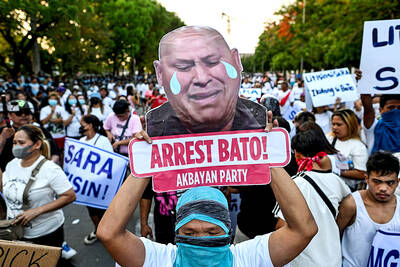
The Philippines said it has asked the country’s Supreme Court to allow it to arrest former Philippine president Rodrigo Duterte’s chief drug war enforcer to stand trial in an international tribunal. The International Criminal Court (ICC) last week unsealed an arrest warrant against Philippine Senator Ronald dela Rosa, accusing him along with Duterte and other “coperpetrators” of the “crime against humanity of murder.” Dela Rosa briefly sought refuge in the Philippine Senate last week while asking the Philippine Supreme Court to stop an ongoing attempt by government agents to arrest him. “By his own conduct, he has placed himself outside the protection of

The researchers in Ireland looked at their computer screen, marveling at a medieval book tracked down in a Roman library. They flipped through its digitized pages and found their sought-after treasure: the oldest surviving English poem. “We were extremely surprised. We were speechless. We couldn’t believe our eyes when we first saw that,” said Elisabetta Magnanti, a visiting research fellow at Trinity College Dublin’s school of English. The poem was also within the main body of Latin text, she said, calling it “extraordinary.” Composed in Old English by a Northumbrian agricultural worker in the 7th century, Caedmon’s Hymn appears within some copies of


 RSS
RSS