


In the land of Ernesto "Che" Guevara's last stand, Bolivians are preparing to commemorate the 40th anniversary of the revolutionary's death with a mixture of honor and hatred.
For many here, the Argentine-born doctor-turned-guerrilla leader who was executed at age 39 remains an iconic hero, a socialist ideologue who was snatched from life too soon and is even revered as a saint by some.
But for others in the country where Che was killed four decades ago, particularly the soldiers involved in Che's capture, the occasion arouses feelings of bitterness and anger.
"We feel sick about this grand show that goes on every year on the anniversary of his death," said Gary Prado, 68, the commander of the elite army rangers unit that captured Che on Oct. 8, 1967.
"The homage that [Bolivian] President Evo Morales pays him is an offense to the country's dignity," he said.
"Rather than honor a man who came to invade the country, we should honor the armed forces, the soldiers who defended the country," Prado said.
Che led a small clutch of rebels in Bolivia for 11 months. His fighters took control of a remote swath of jungle with the aim of training a larger rebel army. Though they survived clashes, hunger and illness, they also encountered an unexpected lack of cooperation from local dissidents.
"He came here for our own good but the Bolivians betrayed him," said tailor Jose Mujica, 84, recalling how locals were harassed and threatened by soldiers who warned of consequences if they did not cooperate in the hunt for the rebel chief.
At the time, authorities even restricted the sale of cortisone in pharmacies because they had heard Guevara was suffering from worsening asthma and would probably need the medication as treatment.
The Bolivian army and two Cuban-American CIA agents captured Guevara in the village of La Higuera. He was taken to an abandoned school and the following afternoon, on Oct. 9, he was summarily executed by Bolivian Sergeant Mario Teran.
Susana Ocinaga, the nurse who washed the blood and mud from Guevara's corpse at the hospital morgue, said his "wide-open eyes" have left an indelible imprint on her memory.
"I felt like he was watching me, that he was going to speak to me," she recalled.
Now a 74-year-old grandmother, Ocinaga said that Guevara is "forever linked to Bolivia by his blood," even though his remains, recovered in 1997, have been shipped to Cuba, where he played a key role in that country's revolution of the 1950s.
In La Higuera, where the cult of Che lives on today with effigies and slogans adorning many buildings and household walls, 63-year-old farmer Manuel Cortez recalled his "penetrating gaze" which sometimes made the locals "afraid."
"But in fact he was fighting for the poor people. I will never forget the commander," he said.
A nighttime march with the lighting of a tribute flame is planned in La Higuera yesterday.
In neighboring Vallegrande, where his remains were found, a political-themed ceremony is set for today.
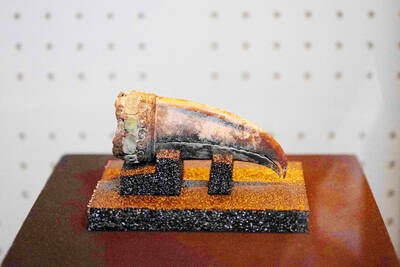
Archeologists in Peru on Thursday said they found the 5,000-year-old remains of a noblewoman at the sacred city of Caral, revealing the important role played by women in the oldest center of civilization in the Americas. “What has been discovered corresponds to a woman who apparently had elevated status, an elite woman,” archeologist David Palomino said. The mummy was found in Aspero, a sacred site within the city of Caral that was a garbage dump for more than 30 years until becoming an archeological site in the 1990s. Palomino said the carefully preserved remains, dating to 3,000BC, contained skin, part of the
‘WATER WARFARE’: A Pakistani official called India’s suspension of a 65-year-old treaty on the sharing of waters from the Indus River ‘a cowardly, illegal move’ Pakistan yesterday canceled visas for Indian nationals, closed its airspace for all Indian-owned or operated airlines, and suspended all trade with India, including to and from any third country. The retaliatory measures follow India’s decision to suspend visas for Pakistani nationals in the aftermath of a deadly attack by shooters in Kashmir that killed 26 people, mostly tourists. The rare attack on civilians shocked and outraged India and prompted calls for action against their country’s archenemy, Pakistan. New Delhi did not publicly produce evidence connecting the attack to its neighbor, but said it had “cross-border” links to Pakistan. Pakistan denied any connection to

TRUMP EFFECT: The win capped one of the most dramatic turnarounds in Canadian political history after the Conservatives had led the Liberals by more than 20 points Canadian Prime Minister Mark Carney yesterday pledged to win US President Donald Trump’s trade war after winning Canada’s election and leading his Liberal Party to another term in power. Following a campaign dominated by Trump’s tariffs and annexation threats, Carney promised to chart “a new path forward” in a world “fundamentally changed” by a US that is newly hostile to free trade. “We are over the shock of the American betrayal, but we should never forget the lessons,” said Carney, who led the central banks of Canada and the UK before entering politics earlier this year. “We will win this trade war and

Armed with 4,000 eggs and a truckload of sugar and cream, French pastry chefs on Wednesday completed a 121.8m-long strawberry cake that they have claimed is the world’s longest ever made. Youssef El Gatou brought together 20 chefs to make the 1.2 tonne masterpiece that took a week to complete and was set out on tables in an ice rink in the Paris suburb town of Argenteuil for residents to inspect. The effort overtook a 100.48m-long strawberry cake made in the Italian town of San Mauro Torinese in 2019. El Gatou’s cake also used 350kg of strawberries, 150kg of sugar and 415kg of


 RSS
RSS